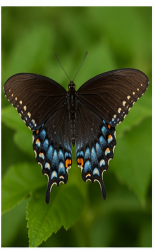
Pipevine Swallowtails (Battus philenor) are among North America’s most recognizable butterflies, admired for their shimmering blue hindwings, elegant tail-like wing extensions, and graceful flight. They are important native pollinators that inhabit woodlands, gardens, meadows, and river corridors wherever pipevine plants grow. Their caterpillars feed exclusively on pipevines (Aristolochia spp.), from which they obtain toxic compounds that make both the larvae and adult butterflies distasteful to predators.
Unlike many insects featured on Pestipedia, the Pipevine Swallowtail is considered a beneficial species. It contributes to pollination, supports native biodiversity, and serves as an important model in studies of butterfly mimicry and chemical defense.
Taxonomy and Classification
The Pipevine Swallowtail belongs to the family Papilionidae, commonly known as swallowtail butterflies. Members of this family are recognized by the distinctive tails extending from their hindwings and their large, colorful appearance.
- Order: Lepidoptera
- Family: Papilionidae
- Genus: Battus
- Species: Battus philenor
This butterfly is one of the best-known toxic swallowtails in North America and serves as the model species for several other butterflies that mimic its appearance for protection.
Physical Description
Pipevine Swallowtails are medium to large butterflies with striking coloration that changes depending on the angle of the light.
- Wingspan: Approximately 70–100 mm.
- Forewings: Velvety black to dark charcoal.
- Hindwings: Iridescent blue or blue-green in males, with females often displaying brighter metallic blue coloration.
- Tail Extensions: Long, slender tails on the hindwings characteristic of swallowtails.
- Underside: Dark with rows of bright orange spots bordered by iridescent blue.
- Caterpillars: Dark reddish-purple or black with fleshy orange tubercles covering the body.
The bright colors serve as warning signals to predators that the butterfly contains defensive toxins.
Distribution and Habitat
Pipevine Swallowtails occur throughout much of the eastern, central, and southern United States, extending into parts of the Southwest, Mexico, and Central America.
Preferred habitats include:
- Woodland edges
- River corridors
- Gardens with native flowering plants
- Meadows
- Open forests
- Areas containing pipevine host plants
Their distribution closely follows the availability of native pipevine species used by the caterpillars.
Behavior and Life Cycle
Pipevine Swallowtails undergo complete metamorphosis with four life stages: egg, larva, pupa, and adult.
Females lay clusters of reddish-orange eggs on pipevine leaves and stems. After hatching, caterpillars feed exclusively on pipevine foliage, absorbing toxic aristolochic acids from the plant.
As they grow, the caterpillars become increasingly toxic to predators. Mature larvae pupate in suspended chrysalises attached to stems or nearby vegetation. Adults emerge several weeks later during warm weather.
Depending on climate, the species may produce two or more generations each year.
Ecological Importance
Pipevine Swallowtails play several important ecological roles.
- Pollination: Adults visit numerous flowering plants while feeding on nectar.
- Protective Mimicry: Their toxic coloration is copied by other butterflies, including the Spicebush Swallowtail and female Black Swallowtail in some regions.
- Biodiversity: They contribute to healthy native ecosystems and support complex food webs.
- Indicator Species: Healthy populations often indicate thriving native plant communities.
The butterfly’s remarkable chemical defenses make it one of the most extensively studied swallowtail species.
Management and Conservation
Because Pipevine Swallowtails are beneficial pollinators, pest control is unnecessary. Conservation efforts focus on preserving host plants and nectar sources.
- Plant Native Pipevines: Growing native Aristolochia species supports caterpillar development.
- Provide Nectar Plants: Lantana, phlox, verbena, ironweed, milkweed, and other flowering plants provide food for adults.
- Reduce Pesticide Use: Avoid broad-spectrum insecticides that harm butterflies and other pollinators.
- Preserve Habitat: Maintain woodland edges and native vegetation where butterflies can breed.
- Create Pollinator Gardens: Diverse native plantings encourage healthy butterfly populations.
Research and Scientific Importance
Pipevine Swallowtails are widely studied for their chemical defenses, mimicry, migration, and evolutionary ecology. Scientists continue investigating how predators learn to avoid toxic butterflies and how unrelated butterfly species evolve similar warning coloration. Their relationship with pipevine plants also provides valuable insight into insect-plant coevolution.
Conclusion
The Pipevine Swallowtail is one of North America’s most spectacular native butterflies. Its brilliant coloration, fascinating chemical defenses, and valuable role as a pollinator make it an important member of natural ecosystems. Protecting native pipevine plants and reducing pesticide use help ensure that future generations continue to enjoy this remarkable butterfly.