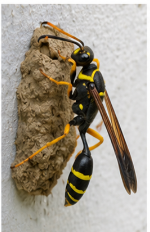
Pipe Organ Mud Daubers (Trypoxylon politum) are solitary hunting wasps best known for constructing long, narrow mud nests that resemble the pipes of a church organ. Unlike social wasps such as yellowjackets or paper wasps, Pipe Organ Mud Daubers live alone and do not defend colonies. They are considered highly beneficial insects because they hunt spiders, helping naturally reduce spider populations around homes, barns, gardens, and forests. Although their mud nests may be considered unsightly when attached to buildings, these wasps are non-aggressive and rarely sting unless directly handled.
Pipe Organ Mud Daubers are common throughout much of eastern North America and are an important component of natural pest control programs due to their role as specialized spider predators.
Taxonomy and Classification
Pipe Organ Mud Daubers belong to the family Crabronidae, a diverse group of solitary hunting wasps. Unlike social wasps that live in large colonies, each female independently builds her own nest, captures prey, and raises her offspring.
- Order: Hymenoptera
- Family: Crabronidae
- Genus: Trypoxylon
- Species: Trypoxylon politum
This species is one of several mud-dauber wasps found in North America but is easily recognized by its distinctive pipe-like mud nests.
Physical Description
Pipe Organ Mud Daubers are slender wasps with graceful bodies adapted for hunting spiders.
- Length: Approximately 20–28 mm.
- Color: Glossy black body with pale white or ivory markings on the legs and abdomen.
- Body Shape: Extremely narrow waist connecting the thorax and abdomen.
- Wings: Clear to smoky with a slight bluish sheen.
- Nest: Long cylindrical mud tubes constructed side by side, giving the appearance of miniature organ pipes.
Females are slightly larger than males and perform all nest construction and hunting activities.
Distribution and Habitat
Pipe Organ Mud Daubers are widespread throughout eastern North America and occur anywhere suitable nesting sites and spider populations are available.
Common habitats include:
- Woodlands
- Gardens
- Barns and sheds
- Bridges and culverts
- Porches and garages
- Building overhangs and eaves
They prefer sheltered locations protected from rain where mud nests remain intact throughout larval development.
Behavior and Life Cycle
Pipe Organ Mud Daubers are solitary insects that spend much of their lives constructing nests and hunting spiders.
The female gathers moist mud and forms long tubular cells attached vertically to walls, rocks, or other solid surfaces. After completing a chamber, she captures numerous spiders, paralyzing them with her sting before placing them inside the tube as food for her developing larva.
Once sufficient prey has been collected, she deposits a single egg and seals the chamber with more mud before beginning construction of the next tube.
After hatching, the larva feeds on the immobilized spiders, pupates inside the sealed chamber, and later emerges as an adult by chewing through the hardened mud.
Ecological Importance
Pipe Organ Mud Daubers provide valuable ecological services by naturally suppressing spider populations.
- Spider Control: Each female captures dozens of spiders during nest construction.
- Pollination: Adults occasionally visit flowers for nectar.
- Biodiversity: They contribute to healthy predator-prey relationships in gardens and forests.
- Non-aggressive Behavior: Unlike social wasps, they rarely sting people and do not defend nests aggressively.
Their presence is generally considered beneficial around homes and landscapes.
Management and Prevention
Because Pipe Organ Mud Daubers are beneficial insects, management is usually only necessary when nests are built in undesirable locations.
- Remove Old Nests: Scrape away abandoned mud tubes after adults have emerged.
- Seal Sheltered Surfaces: Limit suitable nesting areas by repairing cracks and gaps around buildings.
- Reduce Mud Sources: Limiting constantly wet soil near structures may discourage nest construction.
- Avoid Broad-spectrum Insecticides: These chemicals kill beneficial predators and are rarely necessary for solitary wasps.
- Relocate When Possible: If nests are not causing problems, leaving them undisturbed benefits local ecosystems.
Conservation and Research
Scientists study Pipe Organ Mud Daubers because of their remarkable nesting behavior, prey selection, and role in biological pest control. Their carefully constructed mud nests provide valuable insight into insect architecture, while their specialized hunting strategies demonstrate the complexity of solitary wasp behavior. Conserving these beneficial predators helps maintain healthy ecosystems and reduces reliance on chemical pest control.
Conclusion
Pipe Organ Mud Daubers are fascinating solitary wasps that pose little threat to humans while providing valuable natural control of spider populations. Their unique mud nests, specialized hunting techniques, and peaceful behavior make them one of North America’s most interesting beneficial insects. In most situations, these wasps should be appreciated and preserved rather than eliminated.