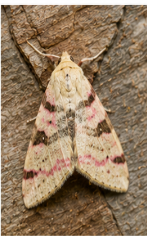
Pink-striped Oakworm Moths (Anisota virginiensis) are large, native silk moths whose caterpillars are well known for feeding on oak trees throughout eastern North America. The larvae, commonly called pink-striped oakworms, occasionally appear in large numbers and can temporarily defoliate individual oak trees. Although heavy outbreaks may alarm homeowners, healthy, established oaks usually recover by producing a second flush of leaves. The adult moths are short-lived, do not feed, and serve as an important food source for birds, bats, and other wildlife.
Pink-striped Oakworm Moths are an important part of forest ecosystems and are only considered occasional nuisance pests when caterpillar populations become unusually high.
Taxonomy and Classification
Pink-striped Oakworm Moths belong to the family Saturniidae, commonly known as giant silk moths. Members of this family are recognized for their relatively large size, stout bodies, and impressive caterpillars.
- Order: Lepidoptera
- Family: Saturniidae
- Genus: Anisota
- Species: Anisota virginiensis
The species is closely related to other oakworm moths that specialize in feeding on oak foliage throughout North America.
Physical Description
Adult Pink-striped Oakworm Moths are medium to large moths with warm orange and brown coloration that provides effective camouflage among dead leaves and tree bark.
- Wingspan: Approximately 45–60 mm.
- Color: Orange-brown to cinnamon-colored wings with subtle darker markings.
- Body: Thick and hairy, typical of giant silk moths.
- Antennae: Males possess broader, feathery antennae used to detect female pheromones.
- Larvae: Dark caterpillars with distinctive pink or salmon-colored stripes running along the body and short black spines.
The colorful caterpillars are much more noticeable than the relatively plain adult moths.
Distribution and Habitat
Pink-striped Oakworm Moths occur throughout much of eastern North America wherever oak trees are abundant.
Typical habitats include:
- Oak forests
- Mixed hardwood woodlands
- Urban parks
- Residential neighborhoods with mature oak trees
- Forest edges
- Suburban landscapes
The species is most common in areas dominated by red, black, pin, and other native oak species.
Behavior and Life Cycle
Pink-striped Oakworm Moths complete one generation each year across most of their range.
Adult females deposit clusters of eggs on oak leaves during summer. After hatching, young caterpillars feed together before gradually dispersing as they grow larger.
The caterpillars pass through several molts while consuming large quantities of foliage. Mature larvae eventually descend from the tree and burrow into the soil, where they pupate and overwinter. Adults emerge the following summer to mate and begin the next generation.
Adult moths are nocturnal, are commonly attracted to outdoor lights, and generally survive only a few days because they do not feed.
Damage and Pest Status
The caterpillar stage is responsible for all plant damage.
- Leaf Feeding: Caterpillars consume oak leaves, sometimes stripping branches almost completely.
- Temporary Defoliation: Heavy outbreaks can make trees appear nearly leafless by late summer.
- Landscape Nuisance: Large numbers of wandering mature caterpillars may accumulate on sidewalks, driveways, and patios before pupation.
- Tree Health: Healthy mature oaks usually recover without permanent injury, although repeated severe defoliation over multiple years can weaken stressed trees.
Most infestations are localized and naturally decline within one or two seasons.
Management and Prevention
Integrated Pest Management (IPM) is recommended when populations become unusually high.
- Monitoring: Inspect oak trees during midsummer for clusters of feeding caterpillars.
- Hand Removal: Small infestations can often be removed manually from ornamental trees.
- Encourage Natural Enemies: Birds, predatory insects, spiders, and parasitic wasps help suppress caterpillar populations.
- Biological Controls: Young larvae may be managed with Bacillus thuringiensis (Bt) when necessary.
- Maintain Healthy Trees: Proper watering and mulching help oaks recover quickly following temporary defoliation.
- Avoid Unnecessary Spraying: Because outbreaks are usually short-lived, insecticide applications are seldom required on healthy mature trees.
Conservation and Research
Pink-striped Oakworm Moths are important members of forest ecosystems. Their caterpillars provide food for numerous birds, mammals, reptiles, and beneficial insects, while the adults contribute to overall biodiversity. Forest entomologists continue studying the environmental factors that trigger periodic outbreaks and the natural predators that regulate populations.
Conclusion
Although Pink-striped Oakworm caterpillars occasionally defoliate oak trees, the species is generally a natural component of healthy hardwood forests. Most infestations resolve naturally with little lasting impact, making conservation of beneficial predators and careful monitoring the preferred management strategy.