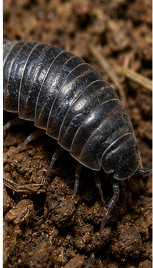
Pillbugs (Armadillidium vulgare), commonly called Roly-Polies, are small terrestrial crustaceans best known for their ability to roll into a tight ball when disturbed. Despite their insect-like appearance and their frequent inclusion in pest control discussions, Pillbugs are not insects. They are isopods and are more closely related to crabs, shrimp, and lobsters than to ants, beetles, or cockroaches.
Pillbugs are primarily beneficial decomposers. They feed on dead leaves, decaying wood, fungi, and other decomposing organic material, helping return nutrients to the soil. Their activity contributes to nutrient cycling and the breakdown of plant debris in gardens, forests, compost piles, and other moist environments.
The primary conflict with Pillbugs is usually nuisance activity rather than serious damage. Large numbers may wander into basements, garages, crawl spaces, and ground-level rooms when outdoor conditions become too wet, too dry, or otherwise unfavorable. In gardens, unusually high populations may occasionally feed on tender seedlings, strawberries, melons, potatoes, and other soft plant material close to the soil surface.
Taxonomy and Classification
Pillbugs belong to the subphylum Crustacea and the order Isopoda. They are among the most successful crustaceans to have adapted to life on land, although they remain highly dependent on moisture.
- Phylum: Arthropoda
- Subphylum: Crustacea
- Class: Malacostraca
- Order: Isopoda
- Family: Armadillidiidae
- Genus: Armadillidium
- Species: Armadillidium vulgare
- Common Names: Pillbug, Roly-Poly, Doodle Bug
Pillbugs are closely related to Sowbugs, another common group of terrestrial isopods. The easiest way to distinguish them is by their defensive behavior. Pillbugs can roll into a nearly complete sphere, while Sowbugs have flatter bodies and cannot completely enclose themselves in a ball.
Physical Description
Adult Pillbugs are oval, convex, and heavily segmented. Most measure approximately 1/4 to 1/2 inch long. Their armored appearance is created by overlapping plates that protect the upper surface of the body.
- Length: Approximately 1/4 to 1/2 inch
- Color: Slate gray, dark gray, brown, or nearly black
- Body Shape: Oval and strongly convex
- Body Covering: Hard, segmented protective plates
- Legs: Seven pairs
- Antennae: Two visible antennae
- Key Identification Feature: Ability to roll into a tight ball
Their seven pairs of walking legs are an important reminder that Pillbugs are not insects. Adult insects have only three pairs of legs. Pillbugs also lack wings and cannot fly.
The overlapping body segments allow the animal to bend inward when threatened. This defensive behavior is called conglobation. When completely rolled up, the Pillbug’s vulnerable legs and underside are protected inside a hard outer sphere.
Pillbugs vs. Sowbugs
Pillbugs and Sowbugs are frequently confused because both live in damp environments and feed primarily on decomposing organic matter. However, several differences can help separate them.
| Feature | Pillbugs | Sowbugs |
|---|---|---|
| Body Shape | Rounded and strongly convex | Flatter and more elongated |
| Defensive Behavior | Roll into a tight ball | Cannot completely roll into a ball |
| Rear Appendages | Usually not prominently visible | Often have visible tail-like projections |
| Habitat | Dark, moist areas | Dark, moist areas |
| Primary Diet | Decaying organic matter | Decaying organic matter |
Distribution and Habitat
Pillbugs are widely distributed and are found in many parts of the world. Human commerce and the movement of soil, plants, agricultural materials, and landscaping products have helped spread several species beyond their original ranges.
Because Pillbugs lose moisture easily, they are restricted to environments with relatively high humidity. During the day, they usually remain hidden beneath objects that protect them from sunlight and drying conditions.
Common habitats include:
- Under logs and fallen branches
- Beneath rocks and stones
- Under flowerpots
- Inside compost piles
- Within heavy leaf litter
- Under landscape timbers
- Beneath bricks and paving stones
- In thick mulch
- Under decaying boards
- Around damp foundations
Indoors, Pillbugs may be found in damp basements, crawl spaces, garages, laundry areas, and other ground-level locations. Indoor activity usually indicates excessive moisture or a large outdoor population close to the foundation.
Respiration and Dependence on Moisture
Pillbugs retain important features of their aquatic ancestry. They breathe through specialized structures associated with the underside of the body and require humid conditions to function properly. This dependence on moisture explains why Pillbugs are rarely successful as permanent indoor pests.
A Pillbug that wanders into a dry room will usually die from dehydration unless it finds a damp hiding place. Unlike cockroaches, ants, or pantry pests, Pillbugs do not normally reproduce throughout dry indoor living spaces.
Life Cycle and Reproduction
Pillbugs have an unusual reproductive system compared with insects. After mating, the female carries developing eggs in a specialized fluid-filled pouch on the underside of her body called a marsupium.
The young hatch inside this protective pouch and remain there during their earliest development. When they emerge, they resemble tiny pale versions of adults. They gradually darken and increase in size through a series of molts.
Young Pillbugs undergo simple development rather than the egg, larva, pupa, and adult metamorphosis seen in insects such as beetles and moths. As they grow, they shed their outer covering in an unusual two-part molting process. The rear half of the body may molt before the front half.
Depending on environmental conditions, Pillbugs may live for several years. Their populations are usually greatest in areas with abundant moisture, shelter, and decaying organic matter.
Behavior and Diet
Pillbugs are primarily nocturnal. During daylight hours, they hide in cool, dark, moist locations. At night, they emerge to feed and move across the soil surface.
Their normal diet includes:
- Dead leaves
- Decaying plant material
- Rotting wood
- Fungi
- Algae
- Compost materials
- Other soft decomposing organic matter
By breaking larger pieces of plant material into smaller fragments, Pillbugs increase the surface area available to fungi, bacteria, and other decomposers. This helps accelerate the return of nutrients to the soil.
Garden Damage and Pest Status
Pillbugs are usually beneficial and should not automatically be treated as pests. Problems generally occur only when populations become unusually high or when tender living plant material is readily available.
Potential damage may include:
- Seedling Damage: Feeding on tender stems or young leaves close to the soil.
- Fruit Damage: Gouging strawberries, melons, or other ripe fruit touching damp ground.
- Root Vegetable Damage: Feeding on potatoes or other damaged tubers near the soil surface.
- Greenhouse Damage: Feeding on tender plants where moisture and shelter are abundant.
- Indoor Nuisance: Large numbers wandering into basements, garages, or ground-level rooms.
It is important to confirm that Pillbugs are actually causing the damage. They are frequently found feeding on fruit or vegetables that were already damaged by slugs, insects, disease, cracking, or contact with wet soil. Their presence does not always mean they caused the original injury.
Why Pillbugs Enter Homes
Pillbugs usually enter buildings accidentally. Heavy rain may flood their outdoor hiding places, while drought may force them to search for moisture. Large outdoor populations can also result in frequent accidental entry through gaps near ground level.
Common entry points include:
- Foundation cracks
- Gaps beneath exterior doors
- Basement windows
- Garage door edges
- Utility penetrations
- Crawl space vents
- Cracks around patios and slabs
Finding a few Pillbugs indoors is not usually evidence of an infestation inside the building. Persistent numbers, however, may indicate excessive moisture or favorable habitat immediately outside the structure.
Management and Prevention
Pillbug management should focus on moisture reduction, habitat modification, and exclusion. Chemical treatment is rarely necessary for occasional indoor activity.
| Management Strategy | Description | Purpose |
|---|---|---|
| Moisture Reduction | Improve drainage and repair leaks. | Makes the environment less suitable for Pillbugs. |
| Harborage Removal | Remove boards, bricks, debris, and unnecessary ground cover. | Reduces protected hiding places. |
| Mulch Management | Avoid excessively deep or constantly wet mulch. | Reduces moisture and shelter near plants and foundations. |
| Exclusion | Seal cracks and install effective door sweeps. | Prevents accidental indoor entry. |
| Physical Protection | Protect vulnerable seedlings and keep fruit off damp soil. | Reduces occasional feeding damage. |
Moisture Reduction
Reducing excessive moisture is the most important step in Pillbug control. Check gutters, downspouts, irrigation systems, outdoor faucets, and drainage patterns around the property.
- Direct downspouts away from foundations.
- Repair leaking outdoor faucets.
- Avoid excessive irrigation.
- Improve drainage in persistently wet garden beds.
- Ventilate damp crawl spaces where appropriate.
- Correct plumbing leaks in basements and utility areas.
Harborage Removal
Objects resting directly on moist soil create ideal hiding places. Removing unnecessary shelter near foundations and vulnerable garden plants can significantly reduce local populations.
- Move firewood away from the building.
- Remove old boards and construction debris.
- Store bricks and landscape materials off the ground.
- Thin excessively deep mulch.
- Remove heavy accumulations of wet leaves.
- Keep the immediate foundation perimeter relatively dry and clear.
Protecting Garden Plants
If Pillbugs are confirmed to be damaging seedlings or fruit, physical and cultural controls should be tried before pesticides. Raise strawberries and melons away from wet soil, reduce excessive moisture, and remove decaying plant debris close to vulnerable crops.
Young seedlings may be protected temporarily with collars or other barriers. Monitoring at night can help confirm whether Pillbugs are actually responsible for the damage.
Ecological Importance
Pillbugs provide important ecological benefits. Their feeding helps break down dead vegetation and return nutrients to the soil. They also contribute to soil processes and provide food for spiders, beetles, birds, amphibians, reptiles, and other predators.
Researchers have also studied Pillbugs for their ability to accumulate certain metals from their environment. This characteristic has led to interest in their potential use as indicators of soil contamination and environmental quality.
Conservation and Research
Pillbugs are generally viewed as beneficial or neutral members of soil ecosystems. Research focuses on their adaptations to terrestrial life, water conservation, respiration, reproductive biology, decomposition activity, and response to soil contaminants.
Their unusual biology makes them valuable subjects for studying the transition of crustaceans from aquatic to terrestrial environments. Their dependence on moisture, specialized respiratory structures, protective rolling behavior, and marsupium-based reproduction demonstrate how successfully these animals have adapted to life on land.
Conclusion
Pillbugs, or Roly-Polies, are small terrestrial crustaceans that play an important role in breaking down decaying organic matter. Their ability to roll into a tight ball is an effective defense against predators and moisture loss, while their dependence on humid environments explains why they are commonly found beneath logs, stones, flowerpots, mulch, and other damp objects. Although very large populations may occasionally damage seedlings or ripe fruit near the soil, most Pillbugs are beneficial decomposers rather than serious pests. Indoor activity is usually temporary and can be managed by reducing moisture, removing outdoor hiding places, and sealing ground-level entry points. In most gardens and natural areas, Pillbugs should be tolerated as valuable participants in decomposition and nutrient cycling.