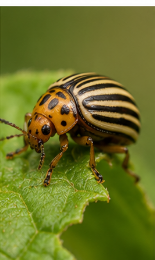
Potato Beetles (Leptinotarsa decemlineata), more commonly known as Colorado Potato Beetles, are among the most destructive insect pests of potatoes and other plants in the nightshade family. Both adults and larvae feed aggressively on foliage and can completely strip plants of their leaves when populations are high.
Although potatoes are their most important agricultural host, Colorado Potato Beetles also attack tomatoes, eggplants, peppers, and wild nightshades. Their ability to reproduce rapidly, survive cold winters, and develop resistance to insecticides has made them one of the most difficult crop pests to control.
Overview
The Colorado Potato Beetle is a highly recognizable leaf beetle known for the ten black stripes running along its yellow or orange wing covers. The species name decemlineata refers to these ten lines. Adults and larvae consume leaves, stems, and tender growing points, often beginning near the upper portions of the plant.
Heavy feeding can leave only the main stems and larger leaf veins behind. This type of damage is called defoliation. Potato plants can tolerate limited leaf loss early in the season, but severe defoliation during flowering and tuber development can dramatically reduce the size, number, and quality of harvested potatoes.
Colorado Potato Beetles are especially challenging because local populations may become resistant to insecticides that previously provided effective control. Repeated use of the same active ingredient or chemical class can select for resistant beetles, sometimes within only a few seasons.
Taxonomy and Classification
Potato Beetles belong to the order Coleoptera, which includes all beetles, and the family Chrysomelidae, commonly known as the leaf beetles. Members of this family are primarily plant feeders, and many are important agricultural or garden pests.
- Order: Coleoptera
- Family: Chrysomelidae
- Genus: Leptinotarsa
- Species: Leptinotarsa decemlineata
- Common Names: Colorado Potato Beetle and Potato Beetle
Colorado Potato Beetles undergo complete metamorphosis, developing through the egg, larval, pupal, and adult stages. Depending on climate and location, the beetles may complete one to three generations in a single growing season.
The species is believed to have originated in parts of the southwestern United States and Mexico, where it fed on native nightshade plants. After cultivated potatoes became widely available, the beetle adapted to the crop and expanded rapidly into major potato-growing regions.
Identification
Adult Colorado Potato Beetles are oval, rounded, and approximately 3/8 inch long. Their bold markings make them easier to recognize than many other leaf beetles.
- Adult Appearance: Adults have yellow, cream, or orange wing covers marked with ten distinct black stripes, five on each side.
- Pronotum: The area behind the head is yellow-orange with irregular black spots.
- Larvae: Larvae are soft-bodied, hump-backed, and reddish-orange, with a dark head and two rows of black spots along each side.
- Eggs: Eggs are yellow to bright orange and are deposited upright in clusters on the undersides of leaves.
- Pupae: Pupae are orange or yellowish and develop underground in small earthen cells.
The larvae may resemble large, swollen lady beetle larvae, but they have a smoother, more rounded body and are usually reddish with clearly visible black spots. The youngest larvae are small and dark, becoming larger and more orange as they mature.
Distribution and Habitat
Colorado Potato Beetles are widely distributed throughout much of North America and have also become established in many parts of Europe and Asia. They occur wherever potatoes and other suitable nightshade crops are grown.
The beetles are closely associated with plants in the family Solanaceae. Important cultivated hosts include potatoes, tomatoes, eggplants, peppers, and certain tobacco plants. Wild hosts include horsenettle, buffalo bur, black nightshade, and related weeds.
Adults overwinter in the soil, commonly along field edges, hedgerows, drainage areas, gardens, or locations where potatoes were grown during the previous season. They may burrow several inches underground to escape freezing temperatures.
Life Cycle
Adult beetles emerge from the soil in spring as temperatures warm and host plants begin growing. They walk or fly to nearby potato fields, gardens, or volunteer nightshade plants. After feeding for a short period, adults mate and females begin laying eggs.
A female may lay several hundred eggs during her lifetime. Eggs are usually deposited in clusters of approximately 20 to 60 on the undersides of leaves. The eggs hatch within several days, depending on temperature.
The larvae immediately begin feeding on foliage. They pass through four growth stages, called instars. The fourth and final larval stage consumes the greatest amount of plant material and is often responsible for much of the visible defoliation.
When fully grown, the larvae drop to the ground and burrow into the soil. They form small chambers and pupate. New adults emerge after approximately one to two weeks and may begin another generation if enough of the growing season remains.
Late-season adults eventually enter the soil and remain dormant through winter. Their ability to overwinter successfully contributes to recurring infestations in gardens and agricultural areas.
Behavior and Feeding
Colorado Potato Beetles are active during warm weather and usually feed openly on the leaves of host plants. Adults frequently begin at the edges or upper surfaces of leaves, while newly hatched larvae often feed together near the egg mass.
As larvae grow, they spread throughout the plant and consume increasing amounts of foliage. Both adults and larvae may feed on terminal shoots, flowers, and tender stems when leaf tissue becomes scarce.
Overwintered adults may walk significant distances while searching for suitable plants, although crop rotation is still effective when new potato fields are separated from previous plantings. Once adults establish themselves in a field, females can quickly produce dense clusters of larvae.
Damage and Problems
Colorado Potato Beetle damage is usually easy to recognize. Feeding begins as irregular holes along leaf edges or between veins. As populations increase, entire leaves may be consumed.
Defoliation
Both adults and larvae chew potato foliage. Heavy infestations can skeletonize plants, leaving only thick stems and major veins. Defoliated plants have less leaf area available for photosynthesis and cannot produce or enlarge tubers effectively.
Yield Loss
Potato plants are most vulnerable during flowering and tuber bulking. Severe leaf loss during these stages can substantially reduce the number and size of potatoes. Repeated defoliation may also weaken plants and delay maturity.
Damage to Other Crops
Tomatoes and eggplants can also be damaged. Young transplants may be completely stripped, while larger plants may suffer reduced flowering, poor fruit development, or slowed growth.
Insecticide Resistance
One of the most serious problems associated with Colorado Potato Beetles is their ability to develop insecticide resistance. Populations have developed resistance to numerous chemical classes after repeated exposure.
Resistance occurs when naturally tolerant beetles survive treatment and reproduce. Over time, the resistant traits become more common. Applying higher rates or repeating ineffective treatments usually increases selection pressure and may worsen the problem.
Monitoring
Regular monitoring should begin soon after potato plants emerge. Early detection allows growers and gardeners to manage adults, egg masses, and young larvae before severe damage occurs.
- Inspect plant tops and leaf undersides for adult beetles.
- Look for clusters of yellow-orange eggs.
- Check young leaves for small reddish larvae.
- Estimate the percentage of foliage lost to feeding.
- Continue monitoring after treatment to determine whether control was successful.
Young larvae are generally easier to control than mature larvae or adults. Monitoring should therefore occur at least weekly during periods of active beetle development.
Management and Control
Effective control requires an integrated pest management approach. Depending entirely on insecticides is unlikely to provide sustainable control because resistance can develop rapidly.
Crop Rotation
Crop rotation is one of the most valuable management practices. Potatoes and other nightshade crops should not be planted in the same location year after year. Rotating to corn, grains, legumes, hay, or other non-host crops forces emerging adults to search for food elsewhere.
For commercial fields, greater separation between last season’s potato crop and the new planting generally provides better protection. Small garden plots should also rotate potatoes to different beds whenever space allows.
Hand Removal
In home gardens, adults and larvae can be picked from plants and dropped into soapy water. Egg masses can be crushed or removed along with the affected leaf section. Frequent removal can prevent populations from becoming established.
Row Covers
Lightweight row covers can protect young plants before beetles arrive. Covers must be sealed at the edges and should only be used where potatoes or other nightshade crops were not grown recently, since overwintering adults may already be present beneath the cover.
Trenches and Barriers
Plastic-lined trenches may intercept adults walking from overwintering sites into new fields. Beetles fall into the trench and have difficulty climbing the smooth surface. This method is most effective where field layout and beetle movement patterns are predictable.
Biological Control
Natural enemies include predatory stink bugs, lady beetles, ground beetles, spiders, parasitic flies, and certain fungal pathogens. These organisms may reduce eggs and young larvae but do not always prevent damaging outbreaks on their own.
Products containing Bacillus thuringiensis var. tenebrionis, often abbreviated as Btt, may be effective against young Colorado Potato Beetle larvae. This biological insecticide must be consumed and is generally less effective once larvae become large.
Chemical Control
Insecticides may be needed when populations exceed treatment thresholds. Products should be applied while larvae are young and actively feeding. Rotate among insecticides with different modes of action rather than repeatedly using the same active ingredient.
Applications should follow the pesticide label, including rates, timing, pre-harvest intervals, and pollinator precautions. If a correctly applied treatment fails, resistance may be present, and repeating the same product is unlikely to improve control.
Prevention
Remove volunteer potato plants and wild nightshades that may support beetles between crop cycles. Destroy crop residue after harvest, rotate planting areas, inspect transplants, and monitor emerging plants early in spring.
Gardeners should avoid leaving unharvested potatoes in the ground because volunteer plants may appear the following season and provide an early food source. Maintaining healthy plants through proper irrigation and nutrition also helps them tolerate limited feeding.
Conservation and Research
The Colorado Potato Beetle is widely studied as a model for insecticide resistance and insect adaptation. Research focuses on improved biological controls, resistant potato varieties, RNA-based technologies, sterile insect methods, fungal pathogens, and more precise monitoring systems.
Scientists also study how the beetle detoxifies plant chemicals and pesticides. Understanding these mechanisms may help researchers develop new control methods that remain effective while reducing harm to beneficial insects and the environment.
Conclusion
Potato Beetles (Leptinotarsa decemlineata) are highly destructive leaf-feeding pests of potatoes, tomatoes, eggplants, and other nightshade plants. Adults and larvae can rapidly defoliate crops, particularly during critical stages of tuber and fruit development.
The beetle’s rapid reproduction and exceptional ability to develop insecticide resistance make long-term management difficult. Crop rotation, early monitoring, egg and larval removal, biological controls, barriers, and responsible insecticide rotation provide the most effective approach. Early action is essential because young larvae are easier to control before they cause widespread defoliation.