Overview
Engraver Beetles are bark beetles belonging primarily to the genus Ips and are among the most destructive pests of conifer forests worldwide. These insects are named for the intricate gallery patterns they carve beneath tree bark, creating “engraved” tunnel systems that disrupt the tree’s vascular tissues.
Engraver beetles primarily attack pine, spruce, fir, and other coniferous trees. They are especially attracted to trees weakened by drought, storm damage, wildfire injury, overcrowding, or disease. However, during major outbreaks, they can also overwhelm healthy trees through mass attacks coordinated by chemical pheromones.
These beetles are considered major forest health pests because their tunneling destroys the cambium and phloem layers beneath the bark, preventing the movement of water and nutrients throughout the tree. Infested trees often die rapidly, leading to extensive ecological and economic losses.
Quick Facts
- Common Name: Engraver Beetles
- Scientific Group: Ips species
- Order: Coleoptera
- Family: Curculionidae
- Subfamily: Scolytinae
- Main Hosts: Pines, spruce, and other conifers
- Primary Damage: Bark tunneling and girdling
- Threat Level: Severe forest pest
Taxonomy and Classification
Engraver beetles belong to the bark beetle group within the weevil family. They are closely related to other bark beetles and ambrosia beetles.
- Kingdom: Animalia
- Phylum: Arthropoda
- Class: Insecta
- Order: Coleoptera
- Family: Curculionidae
- Subfamily: Scolytinae
- Genus: Ips
They undergo complete metamorphosis with egg, larval, pupal, and adult stages developing beneath the bark of host trees.
Identification
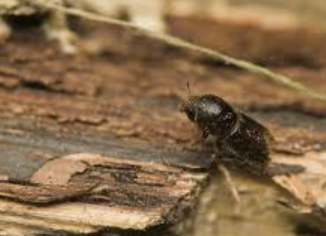
Adult engraver beetles are very small, cylindrical insects usually measuring between 1/8 and 3/8 inch long.
Adult Characteristics
- Reddish-brown to black coloration
- Cylindrical body shape
- Hard wing covers
- Concave rear end called the declivity
- Spines lining the rear edge
The scooped-out rear section lined with spines is one of the most important identifying features of Ips beetles.
Larvae
Larvae are cream-colored, legless grubs that feed beneath the bark. They tunnel through the phloem tissue while developing.
Gallery Systems
The galleries produced beneath the bark form complex branching patterns that resemble engravings. These patterns are often species-specific and help identify the attacking beetle.
Habitat and Distribution
Engraver beetles occur throughout conifer forests across North America, Europe, and Asia. They are common in forests, logging areas, ornamental landscapes, and plantations.
Preferred habitats include:
- Pine forests
- Spruce stands
- Burned forests
- Drought-stressed woodlands
- Recently logged areas
- Storm-damaged forests
Freshly cut wood, slash piles, and weakened trees provide ideal breeding material.
Life Cycle
Engraver beetles can produce several overlapping generations each year, especially in warm climates.
Initial Attack
The male beetle usually begins the infestation by boring through the bark into the cambium layer.
Pheromone Release
Once inside the tree, the male releases aggregation pheromones that attract additional beetles to the host.
Gallery Construction
Females create parent galleries radiating outward from the central chamber. Eggs are deposited along these tunnels.
Larval Development
Larvae hatch and feed outward from the parent galleries, creating perpendicular tunnels as they consume the phloem.
Adult Emergence
New adults emerge through small exit holes and disperse to locate new host trees.
Damage and Impact
Engraver beetles kill trees by disrupting the tissues responsible for transporting nutrients and water.
Girdling
The combined parent and larval galleries effectively girdle the tree, stopping nutrient flow through the phloem.
Needle Fading
Infested trees often develop:
- Yellow needles
- Red-brown foliage
- Crown thinning
- Branch dieback
- Rapid tree death
Pitch Tubes
Trees may produce small pitch tubes where beetles entered the bark. These consist of resin mixed with boring dust.
Blue-Stain Fungi
Engraver beetles frequently introduce blue-stain fungi into the wood. These fungi accelerate tree decline and stain the wood, reducing its commercial value.
Signs of Infestation
- Small holes in bark
- Fine reddish-brown frass
- Pitch tubes on trunk
- Yellowing or browning needles
- Peeling bark
- Distinctive galleries beneath bark
- Rapid crown discoloration
Behavior and Ecology
Engraver beetles are highly responsive to environmental stress and tree chemistry. Drought, overcrowding, fire injury, and storm damage all increase susceptibility to attack.
They communicate using pheromones that coordinate mass attacks capable of overwhelming tree defenses.
Healthy conifers can often defend themselves by producing resin that pushes beetles out. However, stressed trees lose this defensive capability.
Economic Importance
Engraver beetles are among the most economically important forest pests in the world.
Outbreaks can result in:
- Timber losses
- Increased wildfire risk
- Reduced property values
- Forest ecosystem disruption
- Loss of wildlife habitat
- Expensive tree removal costs
Prevention and Control
Management focuses heavily on sanitation and maintaining healthy forests.
Forest Sanitation
- Remove infested trees quickly
- Dispose of infested bark properly
- Chip or burn slash material
- Avoid leaving fresh pine debris on-site
Tree Health Management
Healthy trees are more resistant to attack.
- Provide supplemental watering during drought
- Prevent root damage
- Reduce overcrowding
- Avoid unnecessary injuries
Preventive Treatments
High-value ornamental trees may be protected with preventive bark sprays before beetle flight periods.
Pheromone Monitoring
Pheromone traps are commonly used to monitor beetle activity and population trends.
Interesting Facts
- Engraver beetles get their name from the gallery patterns beneath bark.
- The male initiates the attack in many species.
- Some species can produce multiple generations annually.
- Mass attacks are coordinated using chemical pheromones.
- Blue-stain fungi help weaken host trees.
- Outbreaks are often associated with drought conditions.
Conservation and Research
Although engraver beetles are destructive during outbreaks, they also serve natural ecological roles by helping decompose weakened and dying trees.
Current research focuses on:
- Pheromone communication
- Climate-related outbreak patterns
- Forest thinning strategies
- Biological control agents
- Tree resistance mechanisms
- Beetle-fungus interactions
Understanding the relationship between drought stress, forest density, and beetle population growth remains a major focus of forest health research. :contentReference[oaicite:0]{index=0}