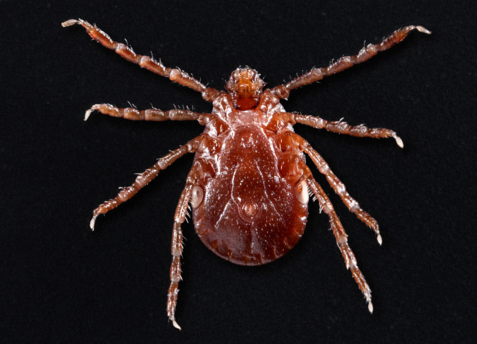
The Asian longhorned tick (Haemaphysalis longicornis) is an invasive, blood-feeding tick that poses a significant threat to livestock, pets, wildlife, and potentially human health. Unlike many familiar North American ticks, females in established U.S. populations can reproduce without mating. This ability allows a single tick to begin a new population and can produce extremely heavy infestations in favorable habitats.
The species was first reported outside a U.S. port-of-entry inspection site in New Jersey in 2017, although examinations of archived specimens indicate that it had been present for several years before its discovery. It has since become established across parts of the eastern United States. Thousands of ticks may occur in vegetation or on a heavily infested animal, sometimes causing severe blood loss.
Taxonomy and Classification
- Scientific name: Haemaphysalis longicornis
- Common names: Asian longhorned tick, longhorned tick, bush tick, cattle tick, and scrub tick
- Class: Arachnida
- Order: Ixodida
- Family: Ixodidae
- Genus: Haemaphysalis
Asian longhorned ticks are hard ticks in the family Ixodidae. Like other arachnids, adult ticks have eight legs rather than the six legs found on insects. The larvae temporarily have only six legs before developing into eight-legged nymphs.
Identification
Unfed Asian longhorned ticks are small and generally light reddish-tan to dark reddish-brown. They lack the bold white markings seen on female lone star ticks and the ornate patterns found on some dog ticks. An unfed adult female is only a few millimeters long, while larvae and nymphs may be approximately the size of a sesame seed or smaller. After taking a blood meal, a female expands considerably and may become gray-green with yellowish markings and approximately the size of a pea.
Male Asian longhorned ticks are rare in U.S. populations. Unfortunately, the species can be extremely difficult to distinguish from native Haemaphysalis ticks without magnification and specialist knowledge. Color, size, or a photograph alone may not provide a reliable identification. A suspected specimen should be sealed in a secure container or zip-top bag and submitted to a veterinarian, Cooperative Extension office, state agriculture department, or public health authority.
Distribution and Habitat
The Asian longhorned tick is native to parts of eastern Asia, including China, Japan, Korea, and the Russian Far East. It has also spread to Australia, New Zealand, and several Pacific islands. In the United States, established populations are concentrated in the eastern half of the country.
As of April 12, 2024, the Centers for Disease Control and Prevention listed detections in Arkansas, Connecticut, Delaware, Georgia, Illinois, Indiana, Kentucky, Maryland, Massachusetts, Missouri, New Jersey, New York, North Carolina, Ohio, Pennsylvania, Rhode Island, South Carolina, Tennessee, Virginia, and West Virginia. Distribution continues to be monitored, and individual ticks or populations may be discovered beyond previously documented locations.
These ticks occupy pastures, wooded edges, brushy areas, tall grass, and shaded sites used by animal hosts. They have been collected from cattle, sheep, goats, horses, dogs, cats, deer, elk, wildlife, and people. Large numbers can gather on vegetation while waiting for a passing host.
Life Cycle and Behavior
The Asian longhorned tick passes through egg, larval, nymphal, and adult stages. It follows a three-host life cycle. A larva feeds on one animal, drops into the environment, and molts into a nymph. The nymph finds another host, feeds, drops off, and molts into an adult. An adult female feeds on a third host before leaving it to deposit eggs in a protected location.
Most U.S. populations reproduce through parthenogenesis, meaning a female can produce viable eggs without mating. Her offspring are essentially genetic copies. This reproductive strategy helps explain why isolated introductions can develop into dense local populations.
Ticks do not fly or jump. They climb grasses and other vegetation and wait with their front legs extended, a behavior called questing. When an animal brushes against the vegetation, the tick transfers to the host and searches for a feeding location. Activity varies with local weather, but the USDA reports that Asian longhorned ticks are generally active from March through November.
Livestock Damage and Disease Concerns
Asian longhorned ticks are especially concerning to livestock producers because hundreds or thousands may feed on a single animal. Heavy infestations can cause irritation, stress, reduced weight gain, lower milk production, anemia, weakness, and potentially death from blood loss. Young, sick, or otherwise vulnerable animals may be affected most severely.
The tick can transmit Theileria orientalis Ikeda, a parasite that infects cattle and damages red blood cells. Affected cattle may develop anemia, fever, weakness, labored breathing, reduced production, pregnancy loss, or death. Producers who notice pale gums, unusual weakness, declining production, or heavy tick burdens should contact a veterinarian promptly rather than attempting to diagnose the disease themselves.
Risks to People and Pets
Asian longhorned ticks can attach to people, although the CDC reports that they appear less attracted to humans than blacklegged ticks, lone star ticks, and American dog ticks. In other parts of the world, the species transmits pathogens capable of causing serious human and animal diseases.
Its public-health role in the United States remains under investigation. Current USDA information indicates that it is not a competent vector of the bacteria responsible for Lyme disease or human granulocytic anaplasmosis. Laboratory research has shown that it can transmit the bacterium responsible for Rocky Mountain spotted fever, but that bacterium has not been found in wild U.S. Asian longhorned ticks. Finding pathogen DNA in a tick also does not, by itself, prove that the species can efficiently transmit the pathogen to people.
Any tick bite should still be taken seriously. A person who develops fever, rash, headache, unusual fatigue, or other concerning symptoms after a bite should contact a healthcare professional and explain when and where the exposure occurred.
Prevention and Control
Protecting People
- Use an EPA-registered tick repellent according to its label.
- Wear long pants, long sleeves, socks, and closed shoes in tick habitat.
- Treat clothing and outdoor gear with an appropriately labeled permethrin product, or purchase pretreated clothing.
- Avoid brushing against tall grass, weeds, and dense vegetation where practical.
- Check the body, clothing, children, pets, and equipment after outdoor activity.
- Shower soon after returning indoors and dry suitable clothing on high heat.
Removing an Attached Tick
Use fine-tipped tweezers to grasp the tick as close to the skin as possible. Pull upward using steady, even pressure without twisting or crushing the tick. Clean the bite and your hands with soap and water or rubbing alcohol. Do not coat an attached tick with petroleum jelly, nail polish, gasoline, or other substances, and never use a hot match to force detachment.
If identification is needed, place the tick in a sealed container rather than crushing it with bare fingers. Record the date and probable exposure location. Local health departments, veterinarians, or Extension offices can advise whether specimen submission is available.
Protecting Animals and Property
Inspect livestock and pets regularly, paying attention to the ears, neck, legs, groin, and areas beneath collars or equipment. Veterinarian-approved tick preventives should be used on pets and livestock according to the product label and professional guidance. Products intended for one animal species may be dangerous to another, so never improvise treatments.
Habitat management can reduce exposure around homes, farms, and pastures. Mow tall grass, remove brush and weeds, reduce dense understory vegetation, and create maintained barriers between frequently used areas and woodland edges. Where environmental acaricides are justified, select a product labeled for the site and target tick, follow all directions, and observe state and local regulations. Treating animals without addressing heavily infested habitat may allow rapid reinfestation.
Reporting Asian Longhorned Ticks
Report suspected Asian longhorned ticks in areas where the species has not been documented, particularly when large numbers occur on livestock, pets, or wildlife. Farmers and animal owners should contact a veterinarian, state animal-health official, agriculture department, or Cooperative Extension service. Early reporting helps authorities monitor changes in distribution and investigate unusual animal illness.
Conclusion
The Asian longhorned tick is an invasive species distinguished by its ability to reproduce without mating and form exceptionally large infestations. Its greatest demonstrated U.S. impact is currently on cattle and other animals, but continued public-health surveillance remains important. Regular inspections, veterinarian-directed animal treatments, personal tick precautions, habitat maintenance, proper removal, and prompt reporting provide the strongest combined defense.