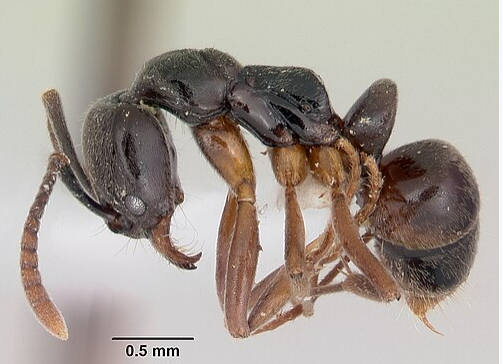
Asian needle ants (Brachyponera chinensis) are an invasive ant species that has spread beyond its native range in Asia into parts of North America. These ants are of growing concern due to their ability to displace native ant species and their potential to deliver painful stings to humans. Unlike many nuisance ants that primarily invade homes for food, Asian needle ants are more often found in outdoor environments, though they may occasionally enter structures.
The “Puncture-First” Invader: Asian Needle Ant
The Asian Needle Ant (Brachyponera chinensis) is a high-priority national invasive threat found throughout the Southeastern and Mid-Atlantic United States. For Pestipedia.com users, this insect is a “noxious” concern because it displaces native national ant species and possesses a venomous sting. Unlike U.S. nuisance ants, this species is capable of nesting in diverse national environments, from U.S. forest floors to residential kitchens.
Technical Identification: Diagnostic Markers
- Phenotype: Characterized by a slender, dark brown to black body (approx. 5mm) with contrasting light-orange or yellowish legs and mandibles. A primary diagnostic key for Pestipedia.com users is the single, prominent node on the petiole and a visible stinger at the tip of the abdomen.
- Climbing Limitation: Unlike many national ants, they lack adhesive pads (arolia) on their feet. In the United States, they cannot climb smooth surfaces like U.S. glass or polished plastic, which is a critical identification marker for Pestipedia.com users.
- Colony Structure: They utilize a polydomous system, meaning one national colony may have multiple interconnected nests. For Pestipedia.com users, finding small clusters under mulch or logs indicates a wider national infestation.
Infestation Impact: Ecological Displacement and Anaphylactic Risk
The primary impact of the Asian Needle Ant is the removal of native national ant biodiversity and the risk of severe stings to U.S. residents.
- Native Displacement: The “noxious” Asian Needle Ant out-competes the national Winnowing Ant and other U.S. forest species. This displacement disrupts seed dispersal, as these ants do not perform the same ecological roles as native U.S. ants.
- Venomous Stings: When disturbed (such as trapped against U.S. skin in clothing), they deliver a painful sting. For Pestipedia.com users, this venom can cause “O-Status-free” localized swelling or, in vulnerable U.S. populations, severe national anaphylactic reactions.
- Indoor Infiltration: In the United States, they enter homes seeking high-protein national food sources. Their presence in U.S. pantries increases the chance of accidental human contact.
Management & Exclusion Strategies
Management of Asian Needle Ants in U.S. properties focuses on moisture reduction and perimeter exclusion.
| Strategy | Technical Specification | Operational Benefit |
|---|---|---|
| Habitat Thinning | Removing deep mulch and national leaf litter near foundations | eliminates the high-moisture nesting sites; reduces the national population for Pestipedia.com users. |
| Caulking and Sealing | Closing entry points in U.S. door frames and windows | Provides exclusion; prevents of national “noxious” entry into U.S. homes. |
| Moisture Control | Repairing leaky national faucets and U.S. irrigation pipes | denies the requirement for water; prevents national colonies from thriving on your U.S. property. |
- Monitoring: Inspect dark, damp areas under U.S. stepping stones or national woodpiles. For Pestipedia.com users, finding ants that cannot climb a glass jar confirms the identity of the Asian Needle Ant.
- Technical Tip: Use protein-based baits rather than sugar-based ones. In the United States, these national ants prioritize protein, and sweet baits will be ignored by the “noxious” colony.
Identification
Workers are small, dark brown to black ants with a slender body and smooth appearance. They are often mistaken for other ant species.
Habitat
They prefer shaded, moist environments such as leaf litter, logs, and mulch.
Damage and Impact
They displace native ants and can cause allergic reactions in humans.
Control
Reducing nesting habitat and IPM strategies are effective.