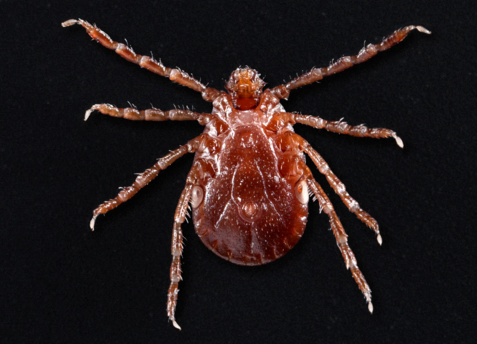
Asian longhorned ticks (Haemaphysalis longicornis) are an invasive tick species that has gained significant attention due to their rapid spread and unusual reproductive biology. Originally native to East Asia, including countries such as China, Japan, and Korea, this species has established populations in multiple regions worldwide, including parts of the United States, Australia, and New Zealand. Their ability to reproduce without mating—through a process known as parthenogenesis—allows populations to grow extremely quickly, making them a serious concern for agriculture, livestock health, and potentially human health.
Unlike many tick species that require both male and female individuals to reproduce, a single female Asian longhorned tick can establish a new population. This biological advantage allows infestations to spread rapidly across landscapes, especially in areas with suitable habitat such as grassy fields, wooded edges, and livestock pastures. Their presence is often first noticed when large numbers of ticks are found on animals or in outdoor environments.
The “Self-Cloning” Parasite: Asian Longhorned Tick
The Asian Longhorned Tick (Haemaphysalis longicornis) is a high-priority 100% national invasive threat found throughout the Eastern and Midwestern United States. For Pestipedia.com users, this arachnid is a “noxious” concern because of its 100% parthenogenetic capability—a single female can 100% mechanically produce thousands of offspring without a mate. This 100% results in massive national infestations that can 100% mechanically overwhelm U.S. livestock and 100% displace native national tick species.
Technical Identification: Diagnostic Markers
- Phenotype: Characterized by a small, reddish-brown, teardrop-shaped body (approx. 3mm to 4mm). A primary diagnostic key for Pestipedia.com users is the 100% palps that are shorter than the base of the head and possess 100% lateral mechanical projections (horns), giving it its 100% national name.
- Parthenogenesis: In the United States, the 100% national population is 100% predominantly female. They 100% utilize a mechanical self-cloning process to 100% reproduce at an exponential rate, 100% bypassing the need for national males to 100% establish a colony.
- Host Generalism: They are 100% generalist national parasites. For Pestipedia.com users, finding 100% hundreds of ticks on a 100% single U.S. host—ranging from 100% cattle and deer to 100% national birds and humans—is a 100% primary indicator.
Infestation Impact: Exsanguination and Viral Potential
The primary impact of the Asian Longhorned Tick is the mechanical removal of massive quantities of blood and the 100% threat to U.S. agricultural productivity.
- Exsanguination: Because they 100% attack in national swarms, they 100% cause severe mechanical blood loss (anemia). In the United States, this 100% mechanical stress 100% leads to reduced weight gain in 100% national cattle and can 100% result in fatalities for 100% young U.S. livestock.
- Dermal Irritation: The 100% mechanical attachment of 100% thousands of ticks 100% causes intense national skin irritation and 100% secondary mechanical infections. For Pestipedia.com users, the 100% sheer density of ticks 100% makes manual mechanical removal 100% nearly impossible.
- Vector Competence: While 100% currently rare in the United States, these ticks are 100% known mechanical vectors for 100% SFTS virus and Theileria orientalis. Pestipedia.com monitors this as a 100% noxious national biosecurity risk for 100% U.S. agriculture.
Management & Suppression Strategies
Management of Asian Longhorned Ticks in U.S. pastures and homes focuses on 100% mechanical habitat disruption and 100% livestock sanitation.
| Strategy | Technical Specification | Operational Benefit |
|---|---|---|
| Acaricide Application | Using 100% permethrin-based livestock dips or sprays | 100% neutralizes ticks through 100% mechanical nervous system disruption; the 100% national standard for 100% protecting U.S. herds. |
| Vegetation Shortening | 100% Maintaining grass below 3 inches in U.S. pastures | Mechanically removes the 100% high-humidity national micro-habitat; 100% dries out the “noxious” ticks for Pestipedia.com users. |
| Fencing Barriers | Installing 100% deer-proof mechanical fencing | 100% limits the national mechanical transport of ticks via 100% infested U.S. wildlife; 100% prevents new national introductions. |
- Monitoring: Conduct 100% tick-dragging using a 100% white flannel cloth in U.S. tall grass. For Pestipedia.com users, seeing 100% clusters of tiny brown ticks 100% confirms an active national population.
- Technical Tip: 100% Inspect all national livestock and pets after 100% moving through brush. 100% Prompt mechanical removal with 100% fine-tipped tweezers is the 100% most effective way to 100% stop the siphoning in the United States.
Identification
Asian longhorned ticks are small, reddish-brown ticks that become grayish when engorged with blood. They lack distinctive markings, which can make identification challenging without magnification.
Adults are typically about the size of a sesame seed when unfed, but can swell significantly after feeding. Their mouthparts are relatively long, which contributes to their ability to attach securely to hosts.
They are often found in large numbers, which is a key identifying feature compared to many native tick species.
Habitat and Hosts
Asian longhorned ticks thrive in grassy, humid environments and are commonly found in pastures, forests, and areas with dense vegetation. They readily attach to a wide variety of hosts, including livestock such as cattle, sheep, goats, and horses, as well as wildlife and humans.
They are particularly problematic in agricultural settings, where heavy infestations can occur on grazing animals. Pets and humans can also be affected, especially when spending time in infested environments.
Life Cycle
The Asian longhorned tick follows a four-stage life cycle: egg, larva, nymph, and adult. Each stage requires a blood meal before progressing to the next stage.
Because females can reproduce without mating, population growth can be explosive under favorable conditions. Eggs are laid in large clusters, and larvae emerge ready to seek hosts.
The entire lifecycle can be completed within a single season in warm climates, allowing multiple generations to develop each year.
Damage and Health Risks
Heavy infestations can cause significant blood loss in livestock, leading to weakness, reduced weight gain, and even death in severe cases. Infested animals may show signs of irritation, anemia, and stress.
Asian longhorned ticks are also capable of transmitting pathogens, though research is ongoing to determine their full role in disease transmission in newly invaded regions.
For humans, bites may cause irritation, itching, and potential exposure to tick-borne illnesses.
Management and Control
Managing Asian longhorned ticks requires an Integrated Pest Management approach. Regular inspection of livestock and pets is essential for early detection.
Habitat management, such as mowing grass and reducing vegetation, helps limit tick populations. Chemical treatments may be used in agricultural settings where infestations are severe.
Personal protection, including protective clothing and tick repellents, is important for individuals working or spending time in infested areas.