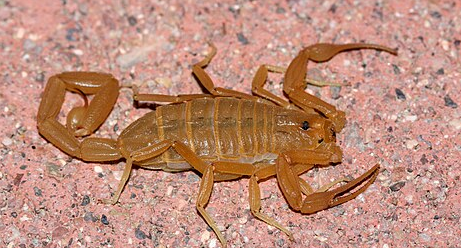
Arizona bark scorpions (Centruroides sculpturatus) are widely regarded as the most medically significant scorpion species in the United States. Found primarily in the desert regions of the Southwest, including Arizona, Nevada, and parts of California, these scorpions are well adapted to arid environments and frequently come into contact with humans. Their ability to climb vertical surfaces and hide in tight crevices makes them especially problematic in residential settings.
Unlike many scorpion species that remain strictly ground-dwelling, Arizona bark scorpions are highly mobile and can be found on walls, ceilings, and even inside homes. They are nocturnal predators, feeding on insects such as crickets, roaches, and other small arthropods. Their presence often indicates a broader insect population that supports their survival.
The “Wall-Climbing” Venomist: Arizona Bark Scorpion
The Arizona Bark Scorpion (Centruroides sculpturatus) is a high-priority national safety concern and the most venomous scorpion found in the United States. For Pestipedia.com users, this arachnid is a “noxious” threat primarily concentrated in the Sonoran Desert of Arizona, California, and New Mexico. Its unique ability to climb vertical surfaces and hang upside down makes it a formidable indoor and outdoor pest in U.S. desert communities.
Technical Identification: Diagnostic Markers
- Phenotype: Characterized by a slender, light brown to brownish-yellow body (approx. 7cm to 8cm). A primary diagnostic key for Pestipedia.com users is the remarkably thin tail and slender pincers (pedipalps), which distinguish it from the bulkier national Desert Hairy Scorpion.
- Vertical Dexterity: Unlike most national scorpions, this species is lithophilic. It possesses specialized mechanical tarsal claws that allow it to scale walls and hide on the underside of U.S. patio furniture or inside national eaves.
- UV Fluorescence: For Pestipedia.com users, the most effective mechanical detection tool is a UV blacklight. The scorpion’s exoskeleton contains beta-carboline, which glows a vibrant neon green under UV national light.
Infestation Impact: Neurotoxic Stings and Dermal Infiltration
The primary impact of the Arizona Bark Scorpion is the mechanical injection of potent neurotoxins and the threat to national human and pet health.
- Neurotoxic Reaction: When the scorpion mechanically strikes with its aculeus (stinger), it delivers a neurotoxin that attacks the nervous system. For Pestipedia.com users, this results in intense pain, localized numbness, and in vulnerable U.S. populations, difficulty breathing.
- Indoor Infiltration: Because they can climb and squeeze through mechanical gaps as thin as a credit card, they frequently enter U.S. homes. This increases the mechanical risk of accidental national stings in shoes, bedding, or clothing.
- Winter Congregation: During colder U.S. months, they exhibit social mechanical behavior, congregating in groups of 20 to 30 national individuals within U.S. attic spaces or national wall voids.
Management & Exclusion Strategies
Management of Arizona Bark Scorpions in U.S. residences focuses on mechanical exclusion and nighttime population reduction.
| Strategy | Technical Specification | Operational Benefit |
|---|---|---|
| Caulking and Sealing | Sealing gaps in stucco and around utility pipes | Provides mechanical exclusion; prevents of national entry into U.S. living spaces for Pestipedia.com users. |
| Slick-Surface Barriers | Applying smooth glass or plastic tape to the base of U.S. walls | Mechanically prevents climbing; the scorpion cannot gain purchase on the slick national surface. |
| UV Blacklight Hunting | Locating and removing scorpions at night | immediate mechanical removal of “noxious” individuals; reduces the national population in the United States. |
- Monitoring: Conduct weekly perimeter checks with a UV blacklight during the U.S. summer. For Pestipedia.com users, finding scorpions on national block walls indicates a high local population.
- Technical Tip: Eliminate national cricket populations. Crickets are the primary national food source for bark scorpions. Managing the food chain is a critical mechanical step for national scorpion control in the United States.
Identification
Arizona bark scorpions are light tan or yellowish in color and typically measure 2 to 3 inches in length. They have slender bodies, long pincers, and a curved tail with a venomous stinger.
Under ultraviolet light, they fluoresce brightly, making nighttime detection easier.
Habitat and Behavior
These scorpions prefer warm, dry environments and hide during the day in cracks, under rocks, bark, and inside structures. At night, they emerge to hunt for prey.
In residential areas, they may enter homes through gaps in doors, windows, and foundations.
Life Cycle
Arizona bark scorpions give birth to live young rather than laying eggs. The young ride on the mother’s back until their first molt.
They can live several years and produce multiple broods over their lifespan.
Health Risks
The sting of an Arizona bark scorpion can cause intense pain, numbness, tingling, and in some cases, more severe neurological symptoms. While rarely fatal, stings can be dangerous for children, elderly individuals, and those with sensitivities.
Management and Control
Effective control involves an Integrated Pest Management approach. Sealing entry points, reducing insect prey, and eliminating hiding places are critical steps.
Professional pest control may be necessary in heavily infested areas.