Overview
Turf Webworms are the caterpillar stage of several small lawn-infesting moths, most commonly Crambus species (Sod Webworms) and Herpetogramma species (Tropical Sod Webworms). These insects are among the most common turfgrass pests in North America and can cause significant damage to residential lawns, golf courses, sports fields, parks, and commercial landscapes.
The destructive stage is the larva, which feeds on grass blades and stems near the soil surface. As populations increase, feeding activity creates irregular brown patches that often resemble drought stress, fungal disease, or nutrient deficiencies. Because the larvae feed primarily at night and remain hidden during the day, infestations may go unnoticed until extensive damage has occurred.
Turf Webworms are particularly troublesome because they can complete multiple generations each year. Warm temperatures, dense thatch layers, and favorable environmental conditions allow populations to build rapidly, resulting in widespread turf decline if not properly managed.
Quick Facts
- Common Names: Turf Webworms, Sod Webworms, Tropical Sod Webworms
- Scientific Family: Crambidae
- Order: Lepidoptera
- Size: 1/2 to 1 inch long (larvae)
- Primary Hosts: Turfgrass species
- Main Damage: Brown patches and thinning turf
- Activity: Night-feeding caterpillars
- Status: Major turfgrass pest
Taxonomy and Classification
Turf Webworms belong to the moth family Crambidae, which contains numerous grass-feeding species worldwide.
- Kingdom: Animalia
- Phylum: Arthropoda
- Class: Insecta
- Order: Lepidoptera
- Family: Crambidae
Like all moths and butterflies, Turf Webworms undergo complete metamorphosis consisting of egg, larva, pupa, and adult stages.
Identification
Larvae
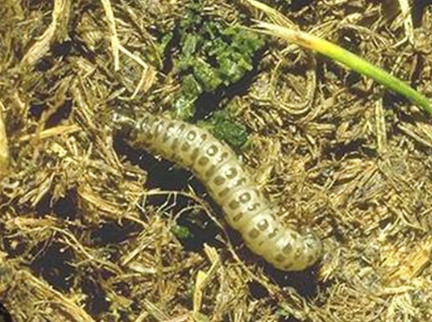
The caterpillar stage is responsible for turf damage.
- Gray, greenish, tan, or brown coloration
- Approximately 1/2 to 1 inch long
- Small dark spots distributed across the body
- Smooth appearance with sparse hairs
- Curl into a distinctive “C” shape when disturbed
Larvae remain hidden in silk-lined tunnels within the thatch layer during daylight hours.
Adult Moths
Adult Turf Webworms are small, slender moths commonly observed flying over lawns at dusk.
- Buff, tan, or straw-colored wings
- Narrow body shape
- Wings folded tightly around the body while resting
- Erratic flight pattern close to the grass surface
Homeowners often notice clouds of small moths emerging from the lawn when walking through infested turf.
Life Cycle
Turf Webworms complete four developmental stages:
- Egg
- Larva
- Pupa
- Adult Moth
Adult females lay eggs directly on grass blades. After hatching, young larvae move into the thatch layer and begin feeding on turfgrass.
As they mature, larvae construct silk-lined tunnels and protective webbing within the turf. These structures provide shelter from predators and environmental stress.
Depending on climate, Turf Webworms may produce several generations annually, allowing populations to increase rapidly during the growing season.
Distribution and Habitat
Turf Webworms are found throughout North America and many other regions where turfgrass is cultivated.
Common habitats include:
- Residential lawns
- Golf courses
- Athletic fields
- Parks
- Cemeteries
- Sod farms
- Commercial landscapes
They are especially common in lawns with thick thatch layers, which provide ideal shelter and feeding sites.
Feeding Behavior
Turf Webworm larvae feed primarily at night, chewing grass blades just above the soil surface.
Young larvae consume small amounts of foliage, but older caterpillars can remove significant quantities of grass tissue in a short period.
During daylight hours, larvae retreat into silk-lined burrows within the thatch, making detection difficult.
This hidden feeding behavior often allows damage to develop extensively before infestations are discovered.
Signs of Infestation
Several symptoms may indicate a Turf Webworm infestation.
Brown Patches
- Small irregular brown areas develop.
- Patches gradually enlarge over time.
- Damage often appears during warm weather.
Thinning Turf
- Grass becomes sparse and weak.
- Large sections may appear drought stressed.
Silk Webbing
- Fine silk tubes appear within the thatch.
- Webbing may be visible during heavy infestations.
Increased Bird Activity
Birds often feed on Turf Webworm larvae. Unusual bird activity on a lawn can sometimes indicate an infestation.
Adult Moths
Numerous small moths flying above the lawn at dusk often signal active breeding populations.
Economic Importance
Turf Webworms can create significant maintenance costs in both residential and commercial settings.
Damage may require:
- Reseeding
- Overseeding
- Sodding
- Additional irrigation
- Pest management treatments
Golf courses and sports fields are particularly vulnerable because even minor turf damage can affect playability and appearance.
Monitoring Techniques
Proper monitoring is essential for determining whether treatment is necessary.
Soap Flush Test
The soap flush remains one of the most effective diagnostic tools.
- Mix 2 tablespoons of dish soap in 1 gallon of water.
- Pour the solution over 1 square foot of damaged turf.
- Observe for 10 minutes.
- Count emerging caterpillars.
If 15 or more larvae emerge, treatment is generally justified.
Management and Prevention
Integrated Pest Management (IPM) offers the most effective long-term strategy.
Proper Lawn Care
- Maintain recommended mowing heights.
- Avoid excessive thatch accumulation.
- Provide adequate irrigation.
- Follow balanced fertilization programs.
Biological Control
Several biological options can effectively suppress Turf Webworms.
- Bacillus thuringiensis (Bt): Targets caterpillars specifically.
- Entomopathogenic Nematodes: Such as Steinernema carpocapsae.
- Natural Predators: Birds, ground beetles, and parasitic wasps.
Chemical Control
When populations exceed economic thresholds, insecticides may be necessary.
- Apply treatments late in the day.
- Target actively feeding larvae.
- Follow all label directions.
- Rotate active ingredients to reduce resistance.
Natural Enemies
Many beneficial organisms help suppress Turf Webworm populations naturally.
- Ground beetles
- Parasitic wasps
- Predatory ants
- Birds
- Spiders
- Beneficial nematodes
Protecting these natural enemies can significantly reduce pest pressure.
Conservation and Research
Research continues to focus on sustainable Turf Webworm management. Scientists are evaluating resistant turfgrass cultivars, improved biological control agents, and precision monitoring techniques that reduce reliance on conventional insecticides.
Current studies also investigate how environmental stress influences infestation severity and how integrated management programs can improve turf resilience.
Conclusion
Turf Webworms are among the most destructive caterpillar pests of lawns and turfgrass systems. Their hidden feeding habits, rapid reproduction, and ability to create extensive brown patches make them a significant challenge for homeowners and turf managers. Early detection, proper monitoring, biological controls, and sound lawn management practices remain the most effective methods for preventing serious damage and maintaining healthy turf.