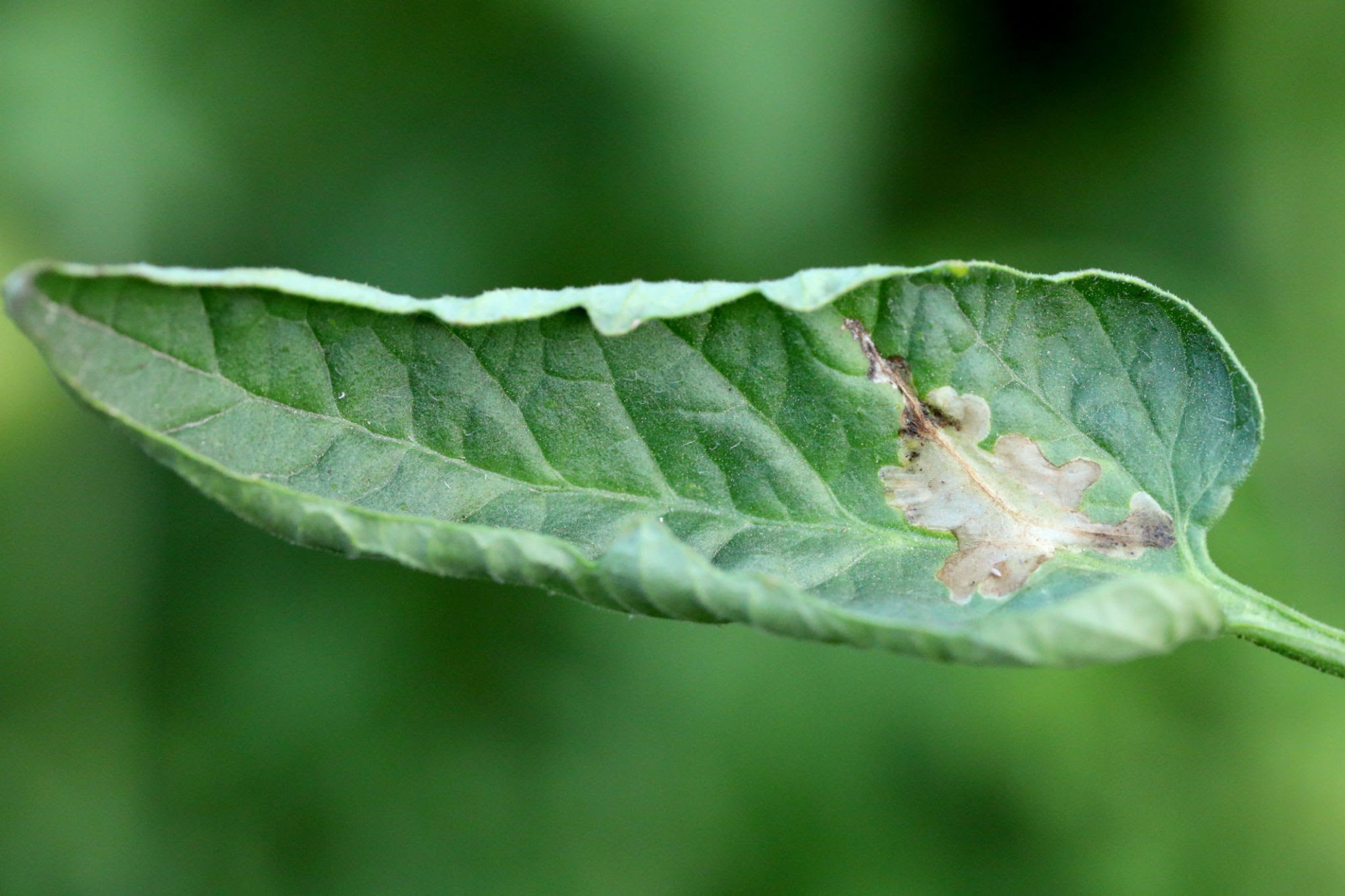
Tomato Leafminers, most notably Tuta absoluta, are among the most destructive pests of tomato crops worldwide. Native to South America, this invasive moth has spread across Europe, Africa, Asia, and parts of North America, becoming a major threat to both commercial and home-grown tomatoes. The larvae feed internally within leaves, stems, flowers, and fruits, making infestations difficult to detect and control. Severe outbreaks can result in significant crop losses, reduced fruit quality, and complete plant failure if left unmanaged.
Tomato Leafminers are particularly dangerous because of their rapid reproductive rate, concealed feeding behavior, and ability to develop resistance to insecticides. Unlike many caterpillar pests that feed openly on foliage, leafminer larvae remain protected inside plant tissues for most of their development. This hidden lifestyle allows populations to build rapidly before symptoms become obvious.
Taxonomy and Classification
Tomato Leafminers belong to the order Lepidoptera and the family Gelechiidae, commonly known as twirler moths.
- Order: Lepidoptera
- Family: Gelechiidae
- Genus: Tuta
- Species: Tuta absoluta
This species is commonly referred to as the tomato leafminer or tomato pinworm. It is considered one of the most economically significant pests of tomato production worldwide.
Identification
Successful management begins with accurate identification.
Adult Moths
- Size: Approximately 6–7 mm long.
- Wingspan: About 10 mm.
- Color: Grayish-brown or silver-gray.
- Antennae: Long and thread-like.
- Activity: Primarily nocturnal.
Eggs
- Color: Cream to yellow.
- Shape: Cylindrical and elongated.
- Location: Deposited on leaves, stems, flowers, and fruit.
Larvae
- Size: Up to 8 mm long.
- Color: Cream-colored, pale green, or pinkish when mature.
- Head: Distinct dark head capsule.
- Behavior: Feed internally within plant tissues.
Pupae
- Color: Brown to dark brown.
- Location: Found in leaves, crop debris, or soil.
Distribution and Habitat
Tomato Leafminers occur in many tomato-producing regions worldwide and continue expanding their range.
Common habitats include:
- Commercial tomato fields
- Greenhouses
- High tunnels
- Home gardens
- Nurseries
- Protected cultivation systems
Warm temperatures and continuous host availability allow populations to reproduce throughout much of the year.
Host Plants
Although tomatoes are the preferred host, Tomato Leafminers can attack several related plants.
- Tomatoes
- Potatoes
- Eggplants
- Peppers
- Tomatillos
- Nightshade weeds
- Other Solanaceous plants
Weedy hosts often serve as reservoirs that support populations between crop cycles.
Life Cycle
Tomato Leafminers undergo complete metamorphosis.
- Egg Stage: Females lay up to 250 eggs during their lifetime.
- Larval Stage: Larvae hatch and immediately tunnel into plant tissue.
- Pupal Stage: Mature larvae pupate in leaves, plant debris, or soil.
- Adult Stage: Moths emerge, mate, and begin a new generation.
Under favorable conditions, the complete life cycle may be completed in as little as three to four weeks. Multiple overlapping generations can occur annually.
Feeding Behavior and Damage
The larval stage is responsible for virtually all economic damage.
After hatching, larvae tunnel into:
- Leaves
- Leaf petioles
- Stems
- Flowers
- Developing fruit
Leaf Damage
- Large irregular blotch mines.
- Necrotic patches.
- Reduced photosynthesis.
- Premature leaf death.
Unlike many other leafminers that create narrow winding tunnels, Tomato Leafminers often produce large blotchy mines filled with dark frass.
Stem Damage
- Tunneling inside stems.
- Disrupted nutrient movement.
- Wilting shoots.
- Plant collapse in severe infestations.
Fruit Damage
- Small entry holes near the calyx.
- Internal galleries within fruit.
- Secondary fungal and bacterial infections.
- Unmarketable tomatoes.
Fruit damage is often the most economically significant form of injury because even minor tunneling can render tomatoes unsuitable for sale.
Signs of Infestation
Early detection is critical for successful management.
- Blotch mines on leaves.
- Dark frass within mines.
- Wilted shoots.
- Small holes in fruit.
- Internal fruit tunneling.
- Reduced plant vigor.
- Adult moth activity around plants.
Pheromone traps are often used to detect adults before visible plant damage develops.
Behavior and Conflict
Several characteristics make Tomato Leafminers particularly difficult to control.
- Internal Feeding: Larvae remain protected inside plant tissues.
- High Reproductive Potential: Females lay large numbers of eggs.
- Rapid Development: Multiple generations occur annually.
- Wide Host Range: Alternative hosts sustain populations.
- Insecticide Resistance: Resistance has developed in many regions.
Because larvae are hidden, conventional contact insecticides often provide limited control.
Monitoring and Detection
Regular scouting is essential.
- Inspect leaves for blotch mines.
- Look for dark frass accumulation.
- Monitor fruit for entry holes.
- Use pheromone traps for adult detection.
- Check greenhouse screening and entry points.
Detecting infestations early greatly improves management success.
Management and Prevention
Integrated Pest Management (IPM) provides the most effective long-term strategy.
Monitoring
- Install pheromone traps.
- Inspect crops weekly.
- Track population trends.
Sanitation
- Remove infested leaves.
- Destroy crop residues.
- Eliminate volunteer tomatoes.
- Control host weeds.
Physical Controls
- Insect-Proof Screening: Prevent moth entry into greenhouses.
- Mass Trapping: Reduce breeding populations.
- Crop Exclusion: Limit movement into protected systems.
Biological Control
- Parasitic wasps.
- Predatory mirid bugs.
- Predatory beetles.
- Beneficial nematodes.
Biological control has become an important component of commercial greenhouse management programs.
Chemical Control
- Use selective insecticides when thresholds are exceeded.
- Rotate active ingredients to prevent resistance.
- Target young larvae before deep tunneling occurs.
- Combine chemical treatments with monitoring and sanitation.
Chemical control alone is rarely sufficient because of the pest’s resistance potential and concealed feeding habits.
Conservation and Research
Tomato Leafminers remain a major focus of agricultural research worldwide. Scientists continue investigating biological control agents, resistant tomato varieties, improved pheromone systems, and sustainable management programs that reduce pesticide dependence.
Early detection, sanitation, exclusion, biological control, and integrated pest management remain the most effective tools for minimizing the impact of this destructive tomato pest.