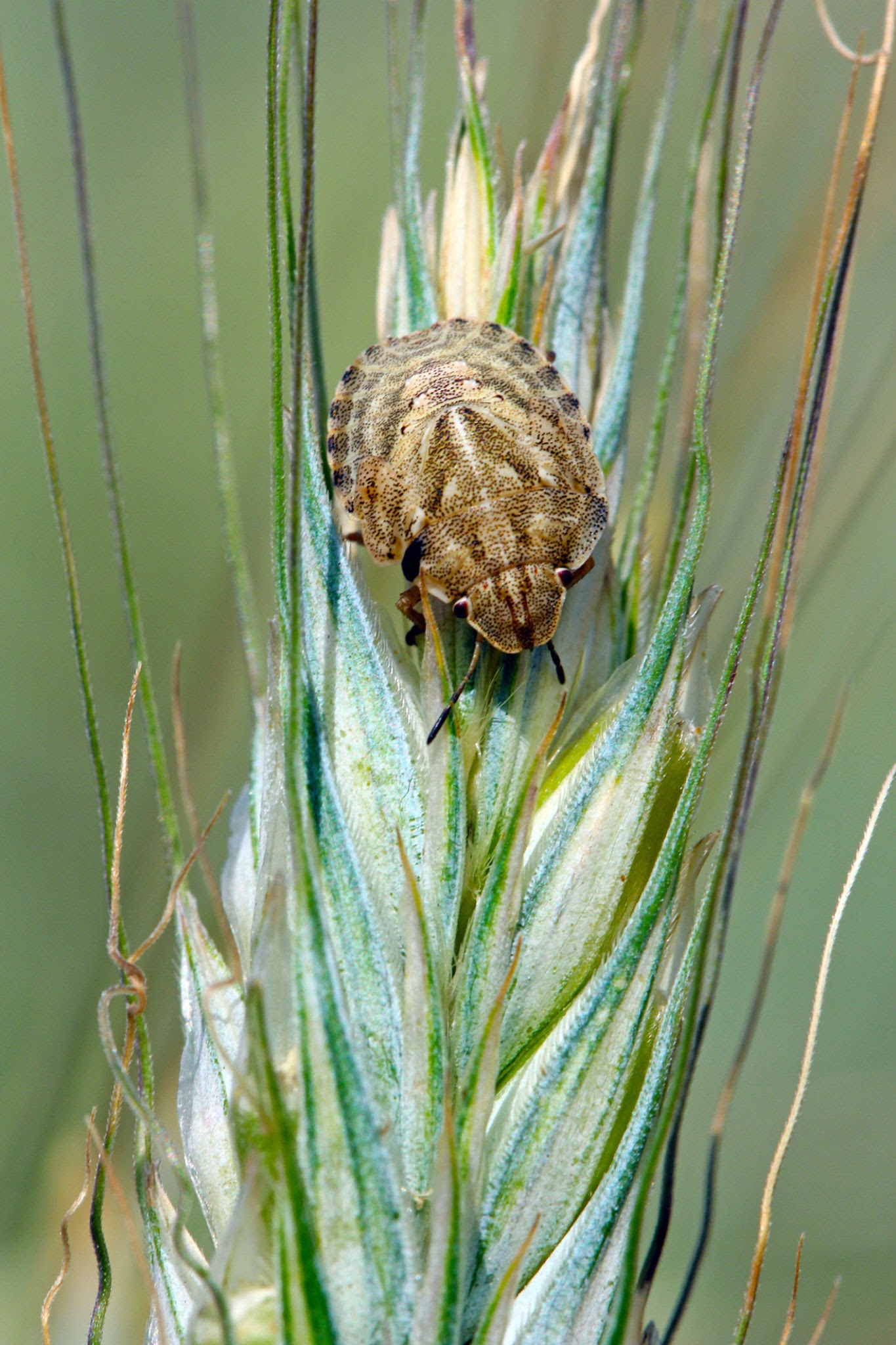
Overview
Sunn Pests (Eurygaster integriceps and related species), often called Wheat Bugs, are among the most destructive cereal crop pests in parts of Europe, the Middle East, Central Asia, and North Africa. These shield-shaped insects attack wheat, barley, and other grains by feeding on plant sap and developing kernels. Their damage extends beyond yield reduction, as they inject digestive enzymes into grain that can severely reduce flour quality and baking performance.
Unlike many agricultural pests that primarily damage leaves or stems, Sunn Pests target developing grain heads. Even relatively low infestation levels can result in substantial economic losses because damaged kernels produce flour with poor dough-forming properties, making the crop less valuable for milling and baking.
Taxonomy and Classification
- Kingdom: Animalia
- Phylum: Arthropoda
- Class: Insecta
- Order: Hemiptera
- Family: Scutelleridae
- Genus: Eurygaster
- Species: Eurygaster integriceps
Sunn Pests belong to a group of shield-backed bugs characterized by a large scutellum that covers most of the abdomen. They are closely related to other grain-feeding true bugs but are considered among the most economically significant cereal pests in their range.
Physical Description
Adult Sunn Pests typically measure 10–13 mm in length.
- Appearance (Key ID): Broad, shield-shaped body with colors ranging from sandy yellow and tan to dark brown.
- Scutellum: Large shield-like structure covering most of the back.
- Mouthparts: Piercing-sucking beak used to extract plant fluids and inject digestive enzymes.
- Nymphs: Wingless immature stages that resemble smaller versions of adults.
- Conflict: Grain damage, reduced yield, and deterioration of flour quality.
Distribution and Habitat
Sunn Pests are widely distributed throughout major wheat-growing regions of:
- Turkey
- Iran
- Iraq
- Syria
- Kazakhstan
- Ukraine
- Russia
- North Africa
- Parts of Eastern Europe
Adults spend winter in sheltered habitats such as forests, hillsides, grasslands, and leaf litter. In spring, they migrate into cereal fields where reproduction and feeding occur.
Life Cycle
Sunn Pests undergo incomplete metamorphosis consisting of three stages:
- Egg
- Nymph
- Adult
Overwintering Adults
Adults survive winter in protected locations and emerge in spring as temperatures increase.
Egg Stage
Females lay clusters of eggs on cereal leaves shortly after arriving in fields.
Nymph Stage
Nymphs pass through five developmental instars while feeding on plant tissues and developing grain.
Adult Stage
New adults emerge in early summer and continue feeding before migrating back to overwintering sites. Most populations produce one generation annually.
Damage and Symptoms
Sunn Pests damage crops throughout the growing season.
Vegetative Damage
Early-season feeding on stems and leaves may cause:
- Yellowing
- Wilting
- Stunted growth
- Reduced vigor
Grain Damage
The most significant damage occurs when insects feed on developing kernels.
- Reduced grain weight
- Shriveled kernels
- Discolored grain
- Lower yields
Protein Degradation
While feeding, Sunn Pests inject digestive enzymes into grain. These enzymes break down gluten proteins, reducing dough elasticity and baking quality.
Even a small percentage of damaged kernels can result in:
- Weak dough formation
- Poor bread volume
- Sticky dough
- Reduced milling value
Signs of Infestation
- Shield-shaped bugs present in cereal fields
- Feeding punctures on stems and grain heads
- Shriveled kernels
- White or partially sterile grain heads
- Reduced flour quality
- Lower grain test weights
Economic Importance
Sunn Pests are among the most important cereal crop pests in affected regions because they impact both quantity and quality.
- Reduced wheat yields
- Lower grain market value
- Poor flour performance
- Increased production costs
- Significant economic losses for farmers and millers
In severe outbreaks, entire wheat-growing regions may experience major reductions in crop quality and profitability.
Behavior and Conflict
The primary threat posed by Sunn Pests comes from their unique feeding behavior.
- Enzyme Injection: Feeding introduces enzymes that degrade grain proteins.
- Migratory Behavior: Adults move between overwintering habitats and crop fields annually.
- Hidden Quality Loss: Grain may appear normal externally while suffering severe internal quality degradation.
- Concentrated Feeding: Large populations can rapidly reduce grain quality across entire fields.
Management and Control (IPM)
Effective management requires integrated pest management strategies focused on monitoring and timely intervention.
Monitoring
- Scout fields regularly during spring and early summer.
- Monitor adult migration into cereal fields.
- Assess nymph populations during grain development.
Cultural Control
- Maintain healthy crop stands.
- Use appropriate planting schedules.
- Reduce favorable overwintering habitats near production areas where practical.
Biological Control
- Encourage egg parasitoids such as Trissolcus species.
- Conserve beneficial predators through selective pesticide use.
Chemical Control
- Apply insecticides when economic thresholds are exceeded.
- Target early nymph stages for maximum effectiveness.
- Follow local agricultural recommendations regarding timing and product selection.
Harvest Management
- Timely harvest can help reduce prolonged feeding on mature grain.
- Monitor grain quality before storage and marketing.
Research and Conservation
Current research focuses on improving monitoring programs, enhancing biological control through parasitoid wasps, developing resistant cereal varieties, and reducing dependence on broad-spectrum insecticides.
Scientists also continue studying the biochemical mechanisms responsible for grain quality degradation in order to improve detection and management methods.
Conclusion
Sunn Pests are among the most economically damaging cereal crop pests in the world. Their ability to reduce both grain yield and baking quality makes them particularly destructive to wheat production. Through careful monitoring, biological control, cultural practices, and targeted treatments, growers can reduce losses and protect the quality of valuable cereal crops.