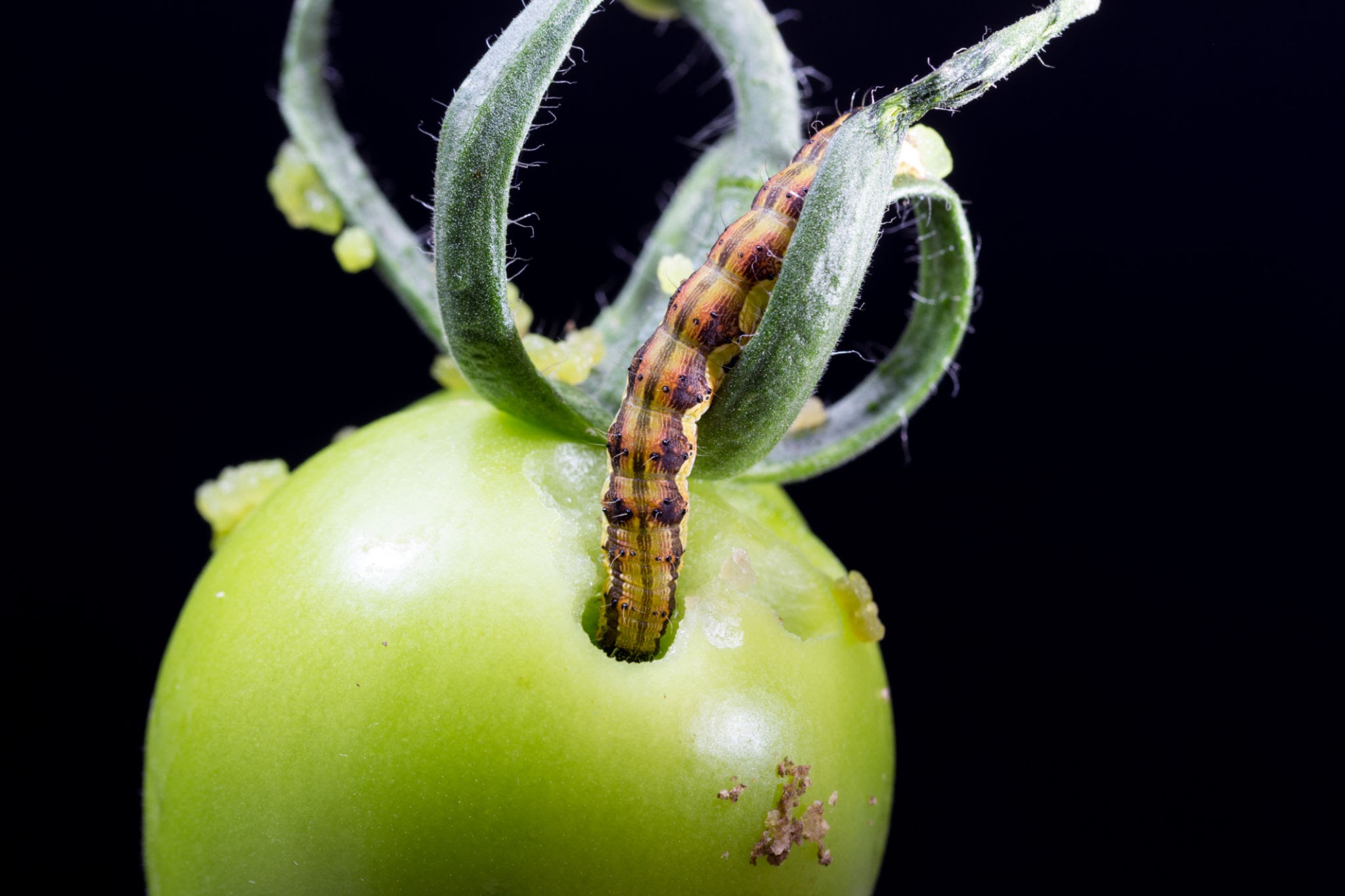
Overview
Tomato Fruitworms (Helicoverpa zea) are among the most destructive pests of tomatoes and many other agricultural crops throughout North America. Also known as the Corn Earworm or Cotton Bollworm, this highly adaptable caterpillar attacks a wide variety of host plants and is responsible for millions of dollars in crop losses each year.
The primary damage occurs when the larvae bore directly into developing or ripening tomato fruit. Once inside, they consume the flesh, contaminate the fruit with frass (fecal material), and create entry points for bacteria and fungi that cause rot. Even a single caterpillar can ruin multiple tomatoes during its development.
Because Tomato Fruitworms are capable of feeding on more than 100 plant species and can migrate long distances, they are among the most challenging caterpillar pests for both commercial growers and home gardeners. Effective management requires careful monitoring, timely intervention, and an integrated pest management approach.
Quick Facts
- Common Name: Tomato Fruitworm
- Scientific Name: Helicoverpa zea
- Other Names: Corn Earworm, Cotton Bollworm
- Order: Lepidoptera
- Family: Noctuidae
- Primary Hosts: Tomato, corn, cotton, peppers, soybeans
- Damage: Fruit boring, contamination, yield loss
- Status: Major agricultural pest
Taxonomy and Classification
Tomato Fruitworms belong to a group of moths commonly known as owlet moths.
- Kingdom: Animalia
- Phylum: Arthropoda
- Class: Insecta
- Order: Lepidoptera
- Family: Noctuidae
- Genus: Helicoverpa
- Species: Helicoverpa zea
This species is highly polyphagous, meaning it feeds on a wide range of plants. Its ability to switch between hosts allows populations to remain active throughout the growing season.
Identification
Tomato Fruitworms vary considerably in color and appearance depending on age and food source.
Larvae
- Grow to 1–1.75 inches long.
- Colors include green, yellow, pink, brown, reddish, and nearly black.
- Possess faint longitudinal stripes.
- Body appears rough or slightly spiny under magnification.
- Head capsule is usually tan or brown.
The color variation often causes confusion with other caterpillar species.
Adult Moths
- Wingspan of approximately 1.25–1.5 inches.
- Forewings are tan, olive, or yellowish-brown.
- Hindwings are pale with a dark outer margin.
- Active primarily at night.
Adult females lay eggs individually on leaves, flowers, and developing fruit.
Distribution and Habitat
Tomato Fruitworms occur throughout North and South America and are particularly abundant in warm agricultural regions.
They are common in:
- Home vegetable gardens
- Commercial tomato fields
- Corn fields
- Cotton-growing regions
- Pepper and bean plantings
- Weedy field margins
Populations are generally highest during warm summer months when multiple host plants are available.
Life Cycle
Tomato Fruitworms undergo complete metamorphosis.
- Egg
- Larva (Caterpillar)
- Pupa
- Adult Moth
Egg Stage
Females deposit tiny cream-colored eggs singly on foliage, flowers, or fruit. Eggs hatch within several days depending on temperature.
Larval Stage
Newly hatched caterpillars initially feed on leaves, buds, and blossoms before boring into fruit. This stage causes nearly all economic damage.
Pupal Stage
Mature larvae leave the plant and pupate in the soil. The pupal stage may last several weeks or overwinter in cooler climates.
Adult Stage
Adults emerge, mate, and begin a new generation. Multiple generations occur annually in warmer regions.
Damage and Economic Importance
Tomato Fruitworms are capable of causing severe losses in both commercial and backyard plantings.
Fruit Boring
The most recognizable damage is a round entry hole on the fruit surface, often near the stem.
After entering the tomato, the caterpillar feeds internally where it is protected from predators and many pesticides.
Contamination
Large amounts of moist, reddish-brown frass accumulate inside the fruit.
This contamination makes tomatoes unsuitable for sale or consumption.
Secondary Rot
The feeding tunnel allows bacteria and fungi to enter the fruit, accelerating decay and increasing losses.
Flower and Bud Damage
Young larvae may destroy flowers and developing fruit before boring into larger tomatoes.
Signs of Infestation
Several symptoms indicate Tomato Fruitworm activity.
- Round holes in tomatoes.
- Frass near fruit openings.
- Partially consumed fruit.
- Chewed leaves and flowers.
- Large caterpillars hidden among foliage.
- Premature fruit drop.
Often the caterpillar remains partially concealed inside the fruit while feeding.
Behavior and Feeding Habits
Tomato Fruitworms are highly mobile and adaptable pests.
Adult moths can travel long distances and rapidly colonize new fields or gardens.
One important characteristic is their tendency to move between crops. Populations frequently develop first in corn, then migrate to tomatoes as corn matures.
This host-switching behavior often results in sudden late-season infestations.
Because larvae spend much of their development inside fruit, they become difficult to control once established.
Natural Enemies
Many beneficial organisms help suppress Tomato Fruitworm populations.
- Braconid wasps
- Trichogramma egg parasitoids
- Predatory stink bugs
- Lacewings
- Minute pirate bugs
- Birds
- Spiders
Protecting these natural enemies can significantly reduce pest pressure.
Management and Prevention
Successful control depends on targeting larvae before they enter the fruit.
Monitoring
Pheromone traps are highly effective for detecting adult moth activity.
- Monitor trap catches weekly.
- Watch for increased moth flights.
- Time treatments based on egg hatch periods.
Hand Removal
Home gardeners can remove eggs and small caterpillars before they enter fruit.
Infested tomatoes should be discarded immediately.
Biological Control
Bacillus thuringiensis var. kurstaki (Bt) provides excellent control of young larvae.
Applications must occur before caterpillars bore into fruit.
Bt is highly selective and safe for beneficial insects, humans, and pets.
Cultural Control
- Remove damaged fruit promptly.
- Control nearby weeds that serve as hosts.
- Rotate crops when possible.
- Destroy crop residue after harvest.
Chemical Control
Registered insecticides may be necessary in severe infestations.
Applications are most effective against newly hatched larvae before fruit penetration occurs.
Integrated Pest Management (IPM)
The most effective strategy combines multiple management techniques.
- Use pheromone monitoring.
- Preserve natural enemies.
- Apply Bt when larvae are young.
- Remove infested fruit.
- Maintain field sanitation.
- Apply insecticides only when thresholds are exceeded.
This approach minimizes environmental impact while maximizing crop protection.
Conservation and Research
Tomato Fruitworms remain one of the most extensively studied agricultural pests in North America. Research focuses on improving biological controls, refining pheromone-based monitoring systems, developing resistant crop varieties, and managing insecticide resistance.
Scientists also continue evaluating beneficial predators and parasitoids that can naturally suppress populations while reducing reliance on conventional insecticides.
Conclusion
Tomato Fruitworms are among the most destructive caterpillar pests affecting tomatoes and many other crops. Their ability to bore into fruit, contaminate produce, and evade treatment makes them particularly challenging to manage. Through early monitoring, biological controls, proper sanitation, and integrated pest management practices, growers can significantly reduce losses and protect valuable harvests from this highly adaptable pest.