Overview
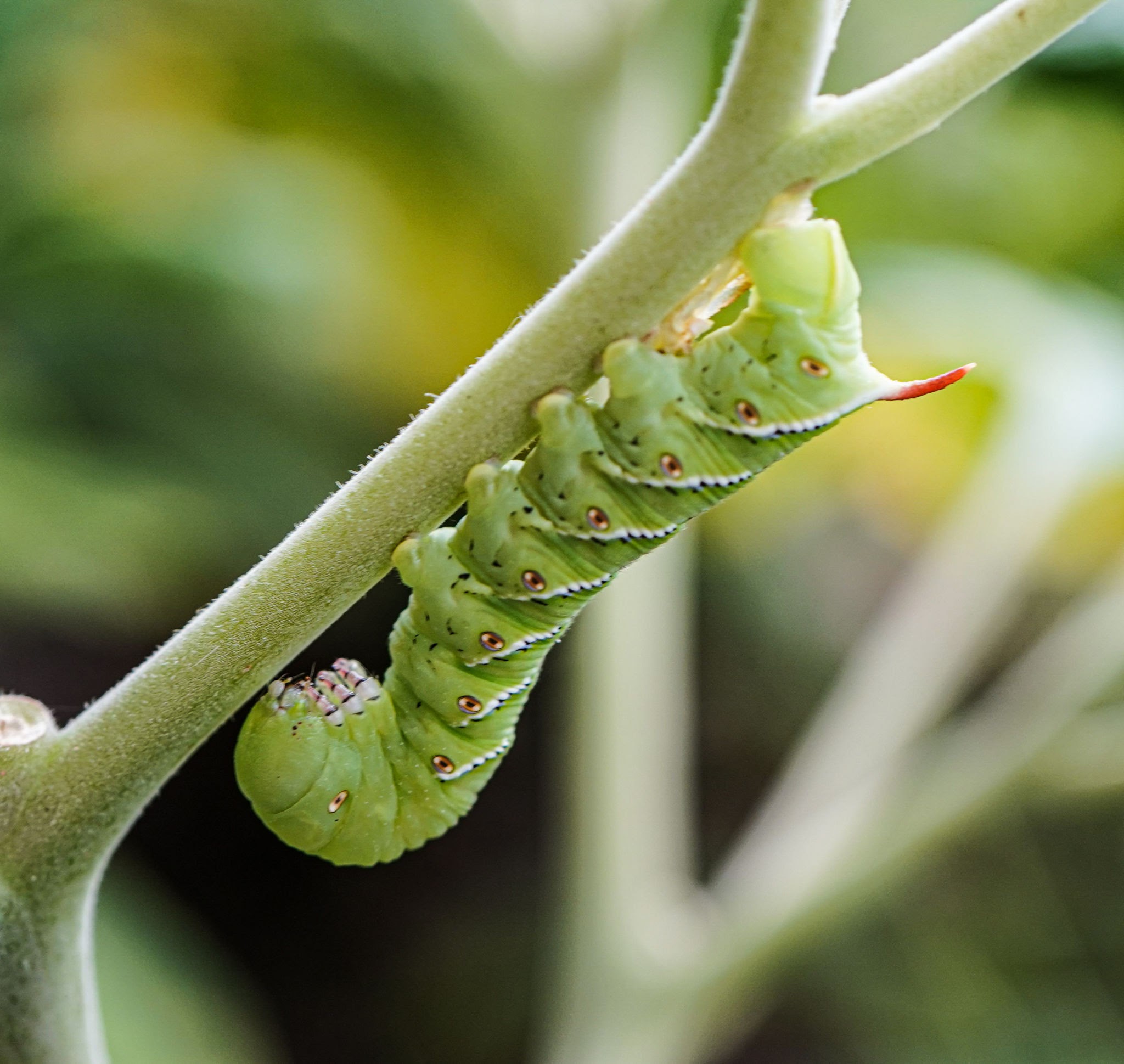
Tobacco Hornworms (Manduca sexta) are among the largest and most destructive caterpillar pests found in North America. These striking green larvae are the immature stage of the Carolina Sphinx Moth and are notorious for their ability to rapidly defoliate plants in the nightshade family (Solanaceae). Their preferred hosts include tobacco, tomatoes, potatoes, peppers, eggplants, and several wild solanaceous plants.
Although tobacco hornworms are natural components of many ecosystems, they become serious agricultural pests when populations build on cultivated crops. A single mature larva can consume substantial amounts of foliage in only a few days. Large infestations can strip entire plants, reduce crop quality, and significantly impact yields.
Their bright green coloration provides excellent camouflage among leaves, allowing them to remain hidden despite reaching lengths of more than four inches. Many gardeners discover an infestation only after noticing extensive feeding damage or finding the large, dark droppings known as frass beneath affected plants.
Tobacco hornworms are closely related to Tomato Hornworms and are frequently confused with them. While the two species share many similarities, tobacco hornworms can be distinguished by their diagonal white stripes and characteristic red horn located at the rear of the body.
Quick Facts
- Common Name: Tobacco Hornworm
- Scientific Name: Manduca sexta
- Family: Sphingidae
- Order: Lepidoptera
- Length: Up to 4 inches
- Primary Hosts: Tobacco, tomato, potato, pepper, eggplant
- Damage: Severe defoliation and crop loss
- Status: Major agricultural pest
Taxonomy and Classification
Tobacco hornworms belong to the sphinx moth family, a group known for powerful flight and large caterpillars. The adult moth is commonly referred to as the Carolina Sphinx Moth.
- Kingdom: Animalia
- Phylum: Arthropoda
- Class: Insecta
- Order: Lepidoptera
- Family: Sphingidae
- Genus: Manduca
- Species: Manduca sexta
The species is one of the most extensively studied insects in the world and serves as a model organism for research in insect physiology, development, and toxicology.
Identification
Tobacco hornworms are among the easiest caterpillars to identify due to their enormous size and distinctive markings.
Larvae
- Bright green body coloration
- Six to seven diagonal white stripes along each side
- Prominent red, orange, or reddish horn on the rear
- Soft, cylindrical body
- Length of 3 to 4 inches when mature
The horn is completely harmless and serves only as a defensive feature intended to deter predators.
Adult Moths
The adult Carolina Sphinx Moth is a large, fast-flying hawkmoth with a wingspan of 4 to 5 inches.
Key identifying features include:
- Gray-brown coloration
- Long, narrow forewings
- Six pairs of yellow or orange abdominal spots
- Rapid hovering flight
- Long proboscis used for nectar feeding
Adults are active primarily at dusk and during nighttime hours.
Distribution and Habitat
Tobacco hornworms occur throughout much of North America, Central America, and portions of South America.
They are particularly common in:
- Agricultural regions
- Home vegetable gardens
- Tobacco-growing areas
- Suburban landscapes
- Wild habitats containing native host plants
Warm temperatures favor rapid development, making the species especially abundant throughout the southern United States.
Life Cycle
Tobacco hornworms undergo complete metamorphosis.
Egg Stage
Female moths lay smooth, pale-green eggs individually on the undersides of host plant leaves.
Eggs generally hatch within three to five days.
Larval Stage
Newly emerged caterpillars begin feeding immediately and pass through five larval stages known as instars.
This stage causes all significant plant damage.
As larvae mature, their food consumption increases dramatically, with most feeding occurring during the final instars.
Pupal Stage
When fully developed, caterpillars burrow into the soil and form large brown pupae.
Pupation may last several weeks or, in cooler climates, continue through winter.
Adult Stage
Adult moths emerge from the soil, mate, and begin searching for host plants on which to lay eggs.
Multiple generations may occur annually in warm regions.
Behavior and Feeding
Tobacco hornworms are voracious herbivores capable of consuming remarkable amounts of foliage.
Preferred host plants include:
- Tobacco
- Tomatoes
- Potatoes
- Peppers
- Eggplants
- Jimsonweed
- Nightshade species
Young larvae feed on tender leaves, while mature caterpillars consume entire leaf sections, stems, flowers, and occasionally fruit.
Their camouflage makes them difficult to locate despite their large size.
Damage and Impact
Defoliation
The most obvious damage is extensive leaf loss. Heavy infestations can completely strip plants of foliage.
Reduced Crop Yields
Loss of foliage reduces photosynthesis and weakens plant growth, resulting in smaller yields and reduced quality.
Fruit Damage
Although leaves are preferred, hornworms may feed directly on tomatoes and other fruits when populations are high.
Economic Losses
Commercial tobacco and tomato producers may experience significant economic losses if infestations are not detected early.
Signs of Infestation
- Large holes in leaves
- Missing foliage
- Bare stems
- Large dark frass pellets beneath plants
- Chewed flowers and fruit
- Visible green caterpillars
Frass accumulation is often the easiest way to locate hidden hornworms.
Natural Enemies
Tobacco hornworms face numerous predators and parasitoids.
The most important natural enemy is the Braconid Wasp (Cotesia congregata).
Parasitized hornworms often display dozens of white cocoons attached to their backs.
These caterpillars should be left undisturbed because the emerging wasps help suppress future hornworm populations.
Other natural enemies include:
- Birds
- Predatory bugs
- Spiders
- Ground beetles
- Parasitic flies
Prevention and Control
Hand Removal
Hand-picking is one of the most effective methods for home gardens.
Inspect plants regularly and remove caterpillars when found.
Biological Control
Bacillus thuringiensis var. kurstaki (Bt) is highly effective against young larvae.
Bt targets caterpillars while remaining safe for humans, pets, and most beneficial insects.
Cultural Practices
- Rotate crops annually
- Remove plant debris after harvest
- Till soil to expose pupae
- Monitor plants frequently
Commercial Management
Large-scale agricultural operations often use pheromone monitoring, biological controls, and targeted insecticide applications when economic thresholds are exceeded.
Interesting Facts
- Tobacco hornworms can grow to more than 4 inches long.
- Their horn cannot sting or bite.
- They are closely related to tomato hornworms.
- Adult moths are powerful pollinators.
- They can consume entire tomato plants in only a few days.
- Manduca sexta is widely used in scientific research laboratories.
Conservation and Research
Tobacco hornworms remain important agricultural pests throughout much of their range. Researchers study their physiology, feeding behavior, genetics, and interactions with host plants.
The species is particularly valuable in scientific research because of its large size, ease of laboratory rearing, and well-understood biology. Studies involving tobacco hornworms have contributed significantly to our understanding of insect development, immunity, toxicology, and plant-insect interactions.
Related Pestipedia Articles
“`