Overview
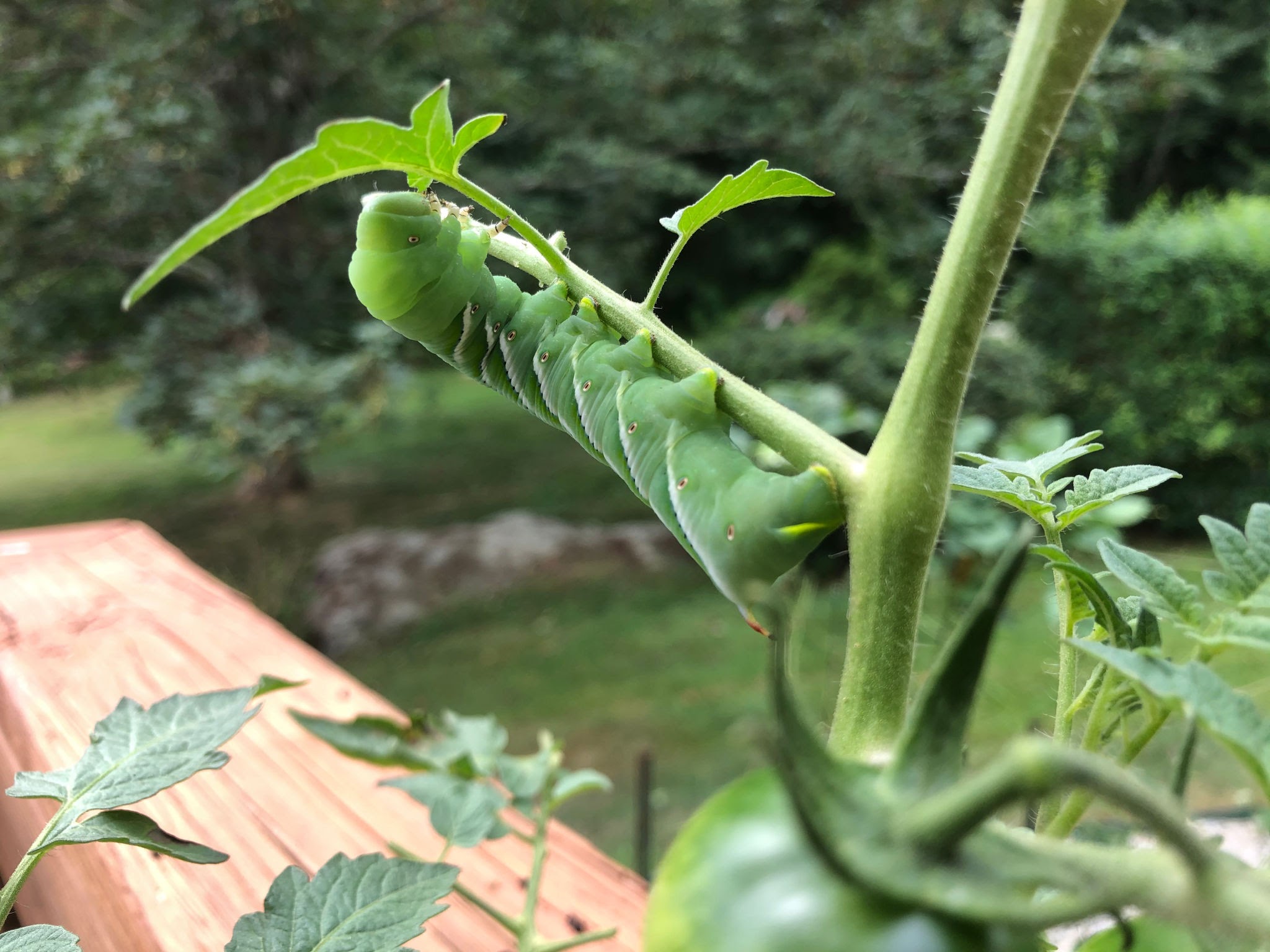
Tomato Hornworms (Manduca quinquemaculata) are among the largest and most destructive caterpillar pests found in North American vegetable gardens. These bright green larvae are the immature stage of the Five-spotted Hawkmoth and are notorious for their ability to rapidly strip foliage from tomato plants and other members of the nightshade family. Despite their impressive size, tomato hornworms are remarkably difficult to spot because their coloration blends perfectly with plant foliage.
Tomato hornworms primarily attack tomatoes, peppers, eggplants, potatoes, and various wild nightshade plants. A single large caterpillar can consume significant amounts of foliage in just a few days, while multiple hornworms can completely defoliate a plant. In addition to feeding on leaves, they may chew stems, flowers, and developing fruit, reducing both plant vigor and crop production.
Although they are considered major garden pests, tomato hornworms are also an important part of the ecosystem. Their adult stage, the Five-spotted Hawkmoth, serves as a valuable nocturnal pollinator for many flowering plants. Effective management often involves balancing pest control with conservation of beneficial insects that naturally suppress hornworm populations.
Quick Facts
- Common Name: Tomato Hornworm
- Scientific Name: Manduca quinquemaculata
- Order: Lepidoptera
- Family: Sphingidae
- Primary Hosts: Tomatoes, potatoes, peppers, eggplants
- Size: Up to 4 inches long
- Damage: Severe defoliation and fruit feeding
- Status: Major garden and agricultural pest
Taxonomy and Classification
Tomato hornworms belong to the family Sphingidae, commonly known as sphinx moths or hawkmoths. Members of this family are known for their rapid flight, hovering ability, and large size.
- Kingdom: Animalia
- Phylum: Arthropoda
- Class: Insecta
- Order: Lepidoptera
- Family: Sphingidae
- Genus: Manduca
- Species: Manduca quinquemaculata
The species is closely related to the Tobacco Hornworm (Manduca sexta), which appears similar but can be distinguished by differences in body markings and horn coloration.
Identification
Tomato hornworms are among the largest caterpillars encountered in gardens, reaching lengths of 3 to 4 inches when fully mature.
- Body Color: Bright green
- Markings: White V-shaped markings along both sides
- Horn: Black or dark blue horn at the rear end
- Head: Green with small dark markings
- Texture: Smooth body with minimal hair
The characteristic horn is completely harmless and cannot sting or inject venom. Its purpose is believed to be defensive, helping deter predators.
Adult moths are large gray-brown insects with wingspans approaching five inches. They possess five pairs of yellow spots along the abdomen, giving rise to the common name “Five-spotted Hawkmoth.”
Distribution and Habitat
Tomato hornworms occur throughout much of North America and are especially common in regions where tomatoes and related crops are cultivated.
They are found in:
- Home vegetable gardens
- Commercial tomato fields
- Potato farms
- Greenhouses
- Urban landscapes
- Wild habitats containing native nightshade plants
Populations are most abundant during warm summer months when host plants are actively growing.
Life Cycle
Tomato hornworms undergo complete metamorphosis consisting of four stages:
- Egg
- Larva (Hornworm)
- Pupa
- Adult Moth
Egg Stage
Female moths lay smooth, pale green eggs individually on the undersides of leaves.
Larval Stage
After hatching, caterpillars begin feeding immediately. This stage lasts several weeks and accounts for nearly all plant damage.
Pupal Stage
Mature hornworms burrow into the soil and form large brown pupae. In warmer regions, adults may emerge within weeks, while northern populations often overwinter in the soil.
Adult Stage
The adult Five-spotted Hawkmoth emerges and feeds on flower nectar. Females then seek host plants for egg laying, beginning the cycle again.
Most regions experience one to two generations annually.
Behavior and Feeding
Tomato hornworms are voracious feeders. Their rapid growth requires enormous amounts of food, and they consume foliage continuously both day and night.
Young larvae feed on outer leaves, while larger caterpillars move throughout the plant and consume:
- Leaves
- Flower buds
- Stems
- Green tomatoes
- Developing fruit
Their green coloration makes them extremely difficult to detect. Many gardeners discover an infestation only after noticing significant defoliation.
Damage and Economic Impact
Tomato hornworms can cause severe damage in a short period.
Common symptoms include:
- Large holes in leaves
- Missing foliage
- Bare stems
- Chewed fruit
- Reduced yields
- Plant stress
One of the easiest ways to identify an infestation is by locating the large black droppings, known as frass, beneath feeding sites.
Heavy infestations can expose fruit to direct sunlight, resulting in sunscald and reduced market quality.
Natural Enemies
Several beneficial insects help regulate tomato hornworm populations.
The most important natural enemy is the Braconid Wasp (Cotesia congregata).
Parasitized hornworms are easily recognized by the white, rice-like cocoons attached to their backs.
Gardeners should leave these hornworms undisturbed because they will soon die and release dozens of beneficial wasps.
Other natural enemies include:
- Predatory bugs
- Ground beetles
- Paper wasps
- Birds
- Spiders
Management and Prevention
Integrated Pest Management (IPM) provides the most effective approach for controlling tomato hornworms.
Hand-Picking
Manual removal remains one of the most effective control methods for home gardens.
- Inspect plants regularly.
- Look for large frass pellets.
- Remove caterpillars by hand.
- Drop them into soapy water.
Biological Control
Apply Bacillus thuringiensis var. kurstaki (Bt) to foliage when caterpillars are young.
Bt is highly selective and affects caterpillars while remaining safe for humans, pets, and most beneficial insects.
Cultural Control
- Rotate crops annually.
- Remove weeds in the nightshade family.
- Till soil to expose overwintering pupae.
- Inspect transplants before planting.
Chemical Control
In severe commercial infestations, labeled insecticides may be used according to local regulations and integrated pest management guidelines.
Conservation and Research
Tomato hornworms remain important research organisms in insect physiology, toxicology, and developmental biology. Scientists frequently study Manduca quinquemaculata and related species because of their large size and well-understood life cycles.
Current research focuses on biological control agents, improved pheromone monitoring systems, and environmentally sustainable methods of reducing crop damage while preserving beneficial insects.
Conclusion
Tomato hornworms are among the most recognizable and destructive caterpillar pests affecting tomatoes and other nightshade crops. Their large size, camouflage, and voracious appetite allow them to cause significant damage before being detected. Fortunately, regular monitoring, hand removal, biological controls such as Bt, and conservation of natural enemies provide highly effective management options. By understanding their life cycle and behavior, gardeners and growers can protect crops while maintaining a healthy and balanced garden ecosystem.