Overview
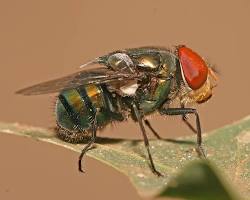
Blow Flies (family Calliphoridae) are medium to large flies best known for their metallic blue, green, bronze, or black coloration. They are among the first insects to locate dead animals and decaying organic matter, making them important decomposers in natural ecosystems. While blow flies play a valuable ecological role, they are also considered nuisance and sanitation pests when they develop in garbage, animal carcasses, pet waste, or other decaying materials near homes and businesses.
Blow flies are particularly important in forensic entomology because their predictable life cycle helps investigators estimate the time since death in criminal investigations. Certain species can also cause myiasis, a condition in which fly larvae infest the tissues of living animals or humans.
In residential environments, the sudden appearance of numerous blow flies indoors often indicates the presence of a dead rodent, bird, or other animal hidden within a wall void, attic, chimney, or crawl space. Because they reproduce rapidly and are strongly attracted to decaying organic material, blow flies are often among the first insects to colonize a suitable breeding site.
Quick Facts
- Common Name: Blow Flies
- Scientific Family: Calliphoridae
- Order: Diptera
- Size: 1/4 to 5/8 inch long
- Color: Metallic green, blue, bronze, or black
- Diet: Decaying organic matter
- Importance: Decomposition, forensic science, sanitation concerns
- Development: Complete metamorphosis
Taxonomy and Classification
Blow flies belong to the order Diptera, the group that includes all true flies. Members of the family Calliphoridae are commonly known as blow flies because early observers associated them with animals that had become “blown” or swollen during decomposition.
- Kingdom: Animalia
- Phylum: Arthropoda
- Class: Insecta
- Order: Diptera
- Family: Calliphoridae
Common species include:
- Blue Bottle Fly (Calliphora vicina)
- Black Blow Fly (Phormia regina)
- Green Bottle Fly (Lucilia sericata)
- Bronze Bottle Fly (Lucilia cuprina)
Identification
Blow flies are among the easiest flies to identify due to their metallic appearance.
Adult Characteristics
- Metallic blue, green, bronze, or black body
- Large reddish or brown compound eyes
- Single pair of wings
- Robust body structure
- Rapid, noisy flight
- Strong attraction to odors
Most species are noticeably larger than common house flies and often produce a loud buzzing sound when flying.
Larval Characteristics
The larval stage consists of cream-colored maggots that feed on decaying organic material. These larvae are legless, cylindrical, and highly efficient decomposers.
Distribution and Habitat
Blow flies occur worldwide and can be found in nearly every terrestrial environment.
Common habitats include:
- Garbage collection areas
- Animal carcasses
- Compost piles
- Livestock facilities
- Pet waste areas
- Food processing facilities
- Urban and suburban environments
- Forests and grasslands
Adults are highly mobile and can travel considerable distances while searching for breeding sites.
Life Cycle
Blow flies undergo complete metamorphosis consisting of four stages.
Egg Stage
Female blow flies lay clusters of eggs on decaying organic material. A single female may lay hundreds of eggs during her lifetime.
Larval Stage
Eggs typically hatch within 8 to 24 hours. The emerging maggots immediately begin feeding and pass through several developmental stages known as instars.
This stage causes most of the visible activity associated with blow fly infestations.
Pupal Stage
After completing development, larvae leave the feeding source and move to a dry, protected location where they pupate.
The pupal case is dark brown and capsule-shaped.
Adult Stage
Adult flies emerge from the pupae and begin searching for mates and new breeding sites. Under ideal conditions, the entire life cycle may be completed in as little as two weeks.
Behavior and Feeding
Adult blow flies feed primarily on liquid organic materials.
Common food sources include:
- Decaying animal tissue
- Nectar
- Garbage
- Animal waste
- Food residues
- Wound secretions
Their highly developed sense of smell allows them to locate decomposing material from considerable distances.
Some species can detect a carcass within minutes of death, making them among the first colonizers of dead animals.
Damage and Impact
Nuisance Infestations
Large numbers of adult blow flies can become extremely annoying around homes, restaurants, farms, and commercial facilities.
Food Contamination
Blow flies frequently visit garbage, animal waste, and decaying matter before landing on food preparation surfaces. This behavior can spread bacteria and other pathogens.
Myiasis
Certain species are capable of causing myiasis in livestock, wildlife, pets, and occasionally humans.
These infestations occur when larvae feed on living or damaged tissue.
Economic Losses
Blow fly infestations can result in significant losses for livestock producers due to reduced animal health and treatment costs.
Signs of Infestation
- Large numbers of metallic-colored flies
- Persistent buzzing around windows
- Maggots developing in waste materials
- Strong odor of decomposition
- Clusters of flies around wall voids or attics
- Sudden indoor fly emergence
One of the most common indicators is a sudden appearance of dozens of blow flies indoors, often signaling a dead rodent hidden within the structure.
Forensic Importance
Blow flies are among the most important insects in forensic investigations.
Because they arrive quickly after death and develop at predictable rates, forensic entomologists can use their life stages to estimate the postmortem interval.
Their importance in criminal investigations has made them one of the most extensively studied insect groups in forensic science.
Prevention and Control
Sanitation
- Remove garbage regularly
- Clean trash containers frequently
- Store waste in sealed bins
- Promptly remove animal carcasses
- Clean pet waste routinely
Exclusion
- Maintain window screens
- Seal structural gaps
- Install door sweeps
- Keep doors closed when possible
Source Elimination
If blow flies are appearing indoors, locate and remove the breeding source. Common sources include dead rodents, birds, squirrels, or other animals trapped within structures.
Monitoring
Sticky traps, light traps, and baited fly traps can help monitor and reduce adult populations.
Interesting Facts
- Blow flies can detect odors from miles away.
- Some species are used in medical maggot therapy.
- They are among the first insects to arrive at a carcass.
- Their metallic coloration comes from microscopic structures rather than pigments.
- Forensic scientists use blow fly development to estimate time of death.
- Many species complete development in less than three weeks.
Conservation and Research
Although frequently regarded as pests, blow flies provide essential ecological services by recycling nutrients and accelerating decomposition. Research continues to explore their applications in medicine, forensic science, livestock management, and environmental monitoring.
Understanding blow fly biology remains important for both pest management professionals and scientists studying decomposition processes throughout the natural world.
Related Pestipedia Articles
“`