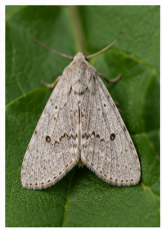
Porcelain Gray Moths (Protoboarmia porcelaria) are elegant geometer moths admired for their soft gray coloration and finely detailed wing patterns. Their subtle appearance provides excellent camouflage against tree bark, lichens, and weathered wood, allowing them to remain virtually invisible during daylight hours. Like many members of the geometer moth family, their caterpillars are known as inchworms because of their distinctive looping method of movement.
Found throughout much of North America, Porcelain Gray Moths inhabit deciduous forests, woodland edges, parks, and suburban landscapes where mature hardwood trees are abundant. Although the larvae feed on the leaves of various deciduous trees, they rarely occur in numbers large enough to cause measurable damage. As a result, this attractive moth is considered an important native species that contributes to healthy forest ecosystems rather than a significant pest.
Taxonomy and Classification
Porcelain Gray Moths belong to the family Geometridae, one of the largest and most diverse families of moths. Members of this family are named after the characteristic “earth-measuring” movement of their caterpillars, which lack several middle abdominal prolegs.
- Order: Lepidoptera
- Family: Geometridae
- Genus: Protoboarmia
- Species: Protoboarmia porcelaria
The genus Protoboarmia includes several woodland moths that rely heavily on camouflage to avoid predation.
Physical Description
Adult Porcelain Gray Moths display beautiful muted colors that blend seamlessly into their surroundings.
- Wingspan: Approximately 30–40 mm.
- Color: Pale gray to silvery gray with darker wavy crosslines and fine mottled markings.
- Body: Slender and lightweight, typical of geometer moths.
- Antennae: Feathered in males and thread-like in females.
- Larvae: Thin, twig-like inchworms capable of remarkable camouflage while resting.
The combination of pale coloration and intricate wing markings allows adults to disappear against bark, making them difficult for predators to detect.
Distribution and Habitat
Porcelain Gray Moths occur across much of North America, especially where deciduous forests dominate the landscape.
Typical habitats include:
- Deciduous woodlands
- Mixed forests
- Forest edges
- Suburban parks
- Tree-lined neighborhoods
- Natural woodland preserves
Adults are commonly encountered during the warmer months and are frequently attracted to porch lights and outdoor lighting.
Behavior and Life Cycle
Like all moths, Porcelain Gray Moths undergo complete metamorphosis consisting of egg, larva, pupa, and adult stages.
Females lay eggs on the foliage of suitable deciduous host trees. After hatching, inchworm caterpillars feed on leaves while remaining well hidden by their twig-like appearance. During daylight hours, the larvae often extend their bodies rigidly away from branches, perfectly mimicking small twigs.
Once fully developed, the caterpillars pupate among leaf litter or beneath loose bark before emerging as adults. Adults are nocturnal and spend the night searching for mates and nectar sources.
Ecological Importance
Porcelain Gray Moths contribute significantly to healthy woodland ecosystems.
- Native Herbivores: Caterpillars feed on native deciduous trees without causing significant damage.
- Wildlife Food Source: Eggs, larvae, pupae, and adults provide food for birds, bats, spiders, and predatory insects.
- Biodiversity: Support balanced forest food webs.
- Camouflage Research: Their coloration provides excellent examples of natural protective coloration.
- Healthy Forests: Contribute to the diversity of native woodland insects.
Because populations generally remain low, Porcelain Gray Moths are not considered economically important pests.
Management and Prevention
No control measures are normally necessary.
- No Treatment Required: Feeding rarely causes noticeable injury to healthy trees.
- Protect Beneficial Wildlife: Birds and predatory insects naturally regulate populations.
- Avoid Unnecessary Insecticides: Preserving native moths benefits woodland biodiversity.
- Maintain Healthy Trees: Vigorous forests support balanced insect populations.
Conservation and Research
Researchers study Porcelain Gray Moths and related geometer moths to better understand insect camouflage, forest biodiversity, and predator-prey interactions. Their inchworm larvae are valuable indicators of healthy deciduous forests, while adults contribute to the remarkable diversity of North American moth species.
Conclusion
Porcelain Gray Moths are beautifully camouflaged woodland insects whose delicate gray wings allow them to blend almost perfectly with tree bark. Their inchworm caterpillars rarely damage host trees, and both life stages play valuable ecological roles within North American forests. Rather than being pests, these moths are beneficial native insects that contribute to healthy woodland ecosystems and biodiversity.