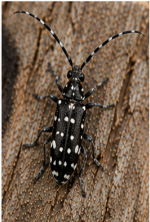
Poplar Borer Beetles (Saperda calcarata) are large longhorn beetles that attack poplar, cottonwood, and aspen trees throughout North America. While the adults are harmless foliage feeders, their larvae tunnel deep into the trunks and major branches of host trees, creating extensive galleries that weaken structural integrity and reduce timber value. Infestations are most common in stressed, injured, or aging trees, although healthy trees may also be attacked under favorable conditions.
Poplar Borer Beetles are considered important forest pests because repeated infestations can significantly reduce tree growth, increase susceptibility to diseases, and create entry points for decay fungi. Although they rarely kill mature trees outright, extensive larval tunneling can lead to branch breakage, trunk defects, and long-term declines in tree health. Effective management focuses on maintaining vigorous trees and reducing environmental stress that attracts egg-laying females.
Taxonomy and Classification
Poplar Borer Beetles belong to the family Cerambycidae, commonly known as longhorn beetles because of their exceptionally long antennae. Many members of this family develop as wood-boring larvae inside living or dead trees.
- Order: Coleoptera
- Family: Cerambycidae
- Genus: Saperda
- Species: Saperda calcarata
Saperda calcarata is one of the largest and most economically important native wood-boring beetles associated with poplar and aspen forests.
Physical Description
Adult Poplar Borer Beetles are attractive insects whose coloration provides excellent camouflage on tree bark.
- Length: Approximately 20–30 mm.
- Color: Gray to pale brown with distinctive black spots and markings.
- Antennae: Long, segmented antennae characteristic of longhorn beetles, often approaching body length.
- Body: Elongated and cylindrical with a slightly rough surface.
- Larvae: Cream-colored, legless borers with dark brown heads capable of reaching over 40 mm in length.
Adults are most active during summer and are commonly observed resting on the trunks of host trees.
Distribution and Habitat
Poplar Borer Beetles occur throughout much of North America wherever susceptible host trees are present.
Common habitats include:
- Aspen forests
- Poplar woodlands
- Cottonwood stands
- Riparian forests
- Shelterbelts
- Urban landscapes containing poplar trees
The species is especially abundant in mature forests where aging or stressed trees provide favorable breeding sites.
Behavior and Life Cycle
Poplar Borer Beetles undergo complete metamorphosis consisting of egg, larva, pupa, and adult stages. Their life cycle typically requires two to three years to complete depending on climate and host tree condition.
Females deposit eggs individually within cracks, wounds, or rough bark on susceptible trees. Newly hatched larvae bore beneath the bark before tunneling deeply into the sapwood and heartwood, creating large winding galleries that expand as the larvae grow.
After completing development, mature larvae construct pupal chambers near the bark surface. Adults emerge through characteristic oval exit holes during late spring or summer before mating and beginning a new generation.
Damage and Economic Importance
Nearly all economic damage results from larval tunneling.
- Wood Galleries: Extensive tunnels reduce timber quality.
- Structural Weakness: Internal damage increases the likelihood of trunk and branch breakage.
- Reduced Growth: Heavy infestations slow tree development.
- Disease Entry: Boring wounds allow fungi and decay organisms to invade.
- Landscape Damage: Infested ornamental trees may decline in health and appearance.
Although healthy mature trees often survive infestation, repeated attacks can significantly shorten tree lifespan and reduce commercial timber value.
Management and Prevention
Integrated Pest Management (IPM) focuses primarily on maintaining healthy host trees.
- Maintain Tree Vigor: Proper watering and fertilization help trees resist attack.
- Avoid Mechanical Injury: Protect trunks from mower and equipment damage that attracts egg-laying females.
- Remove Severely Infested Trees: Eliminate breeding sites before adults emerge.
- Inspect Regularly: Look for fresh sawdust, sap flow, exit holes, and branch dieback.
- Promote Forest Diversity: Mixed-species plantings reduce large concentrations of susceptible hosts.
Conservation and Research
Forest entomologists continue studying Poplar Borer Beetles to improve methods of protecting commercial timber and urban forests. Research includes monitoring adult emergence, understanding host selection, and developing sustainable management practices that preserve forest biodiversity while minimizing economic losses. Although damaging in managed forests, these beetles also contribute to natural forest succession by accelerating the breakdown of weakened trees and creating habitat for numerous wildlife species.
Conclusion
Poplar Borer Beetles are important native wood-boring insects that play both beneficial and destructive roles in North American forests. While their larvae contribute to natural decomposition processes, they can also weaken living poplar, cottonwood, and aspen trees, reducing timber quality and increasing the risk of structural failure. Maintaining vigorous trees and monitoring for early signs of infestation remain the most effective strategies for long-term management.