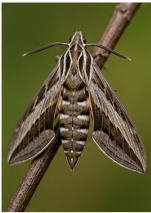
Plebeian Sphinx Moths (Paratrea plebeja) are large, fast-flying hawk moths recognized for their streamlined bodies, camouflage-colored wings, and remarkable hovering ability. Active primarily at dusk and during the night, these moths are important pollinators of many flowering plants. Their long proboscis allows them to reach nectar deep within tubular flowers, making them valuable contributors to woodland and garden ecosystems throughout the eastern United States.
Despite their impressive size and powerful flight, Plebeian Sphinx Moths are harmless to humans. The caterpillars feed primarily on trumpet creeper and related vines, rarely causing enough damage to threaten healthy plants. As both pollinators and wildlife food sources, they play an important role in maintaining ecological balance.
Taxonomy and Classification
Plebeian Sphinx Moths belong to the family Sphingidae, commonly known as hawk moths or sphinx moths. Members of this family are among the strongest flying moths in the world and are well known for their hummingbird-like hovering behavior.
- Order: Lepidoptera
- Family: Sphingidae
- Genus: Paratrea
- Species: Paratrea plebeja
Paratrea plebeja is the sole species within its genus and is closely related to other North American sphinx moths that serve as important nocturnal pollinators.
Physical Description
Plebeian Sphinx Moths are medium to large moths with an aerodynamic body built for sustained flight.
- Wingspan: Approximately 60–90 mm.
- Color: Brown, gray, and olive camouflage with subtle dark markings that resemble tree bark.
- Body: Thick, muscular, and tapered for rapid flight.
- Proboscis: Long, coiled feeding tube adapted for extracting nectar from deep flowers.
- Larvae: Large green hornworms with a characteristic horn at the rear of the abdomen.
When at rest, the mottled wing pattern provides excellent camouflage against tree trunks and branches.
Distribution and Habitat
Plebeian Sphinx Moths are widely distributed across the eastern United States wherever suitable host plants occur.
Common habitats include:
- Deciduous forests
- Woodland edges
- Gardens
- Parks
- River corridors
- Residential landscapes containing trumpet creeper vines
Adults are frequently attracted to flowering plants blooming during the evening and nighttime hours.
Behavior and Life Cycle
Plebeian Sphinx Moths undergo complete metamorphosis consisting of egg, larva, pupa, and adult stages.
Females lay eggs on host plants, primarily trumpet creeper (Campsis radicans). After hatching, hornworm caterpillars feed on foliage while passing through several growth stages before entering the soil to pupate.
Adults emerge during the warmer months and become active shortly after sunset. They hover effortlessly while feeding on nectar, much like hummingbirds, using their exceptionally long proboscis to reach nectar hidden within deep flowers.
Their powerful flight enables them to travel considerable distances in search of food and mates.
Ecological Importance
Plebeian Sphinx Moths provide several valuable ecological services.
- Nocturnal Pollination: Transfer pollen between night-blooming flowers while feeding on nectar.
- Wildlife Food Source: Adults and caterpillars provide food for birds, bats, spiders, and predatory insects.
- Plant Diversity: Support reproduction of numerous native flowering plants.
- Healthy Ecosystems: Contribute to woodland biodiversity through pollination and nutrient cycling.
- Minimal Plant Damage: Caterpillar feeding rarely threatens healthy host plants.
Unlike many agricultural caterpillars, Plebeian Sphinx Moths seldom reach populations large enough to require management.
Management and Prevention
Because Plebeian Sphinx Moths are beneficial pollinators, control is rarely necessary.
- No Treatment Required: Adults are harmless and do not damage structures or stored products.
- Tolerate Light Feeding: Healthy trumpet creeper vines usually recover quickly from occasional caterpillar feeding.
- Avoid Broad-Spectrum Insecticides: Protect pollinators and natural enemies by minimizing unnecessary pesticide applications.
- Plant Native Flowers: Night-blooming nectar plants help support local hawk moth populations.
Conservation and Research
Researchers study Plebeian Sphinx Moths as part of broader investigations into nocturnal pollination, insect flight mechanics, and plant-pollinator relationships. Like many hawk moths, they are considered important indicators of healthy native habitats containing abundant flowering plants and suitable larval host species.
Conclusion
Plebeian Sphinx Moths are impressive nighttime pollinators whose powerful flight and hovering ability make them among the most fascinating moths in eastern North America. Although their caterpillars feed on trumpet creeper vines, they rarely become significant pests. Their contributions to pollination and ecosystem health make them valuable members of native landscapes.