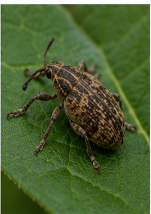
Plum Curculios (Conotrachelus nenuphar) are among the most destructive insect pests of stone fruit orchards in North America. These small snout beetles attack peaches, plums, cherries, apricots, nectarines, and even apples, causing significant crop losses through feeding and egg-laying activities. Female Plum Curculios are especially well known for cutting distinctive crescent-shaped scars into developing fruit before depositing their eggs beneath the skin. The resulting larvae feed inside the fruit, causing premature fruit drop and making infested fruit unmarketable.
Plum Curculios are considered major orchard pests throughout eastern North America and are carefully monitored by commercial fruit growers. Successful management depends on early detection, orchard sanitation, and Integrated Pest Management (IPM) practices that target adults before they lay eggs.
Taxonomy and Classification
Plum Curculios belong to the family Curculionidae, the largest family of beetles, commonly known as true weevils. Members of this family are distinguished by their elongated snouts, which they use for feeding and egg-laying.
- Order: Coleoptera
- Family: Curculionidae
- Genus: Conotrachelus
- Species: Conotrachelus nenuphar
Conotrachelus nenuphar is one of the most economically important orchard pests in eastern North America due to its ability to infest numerous commercially valuable fruit crops.
Physical Description
Adult Plum Curculios are small, rough-textured beetles that blend well with tree bark.
- Length: Approximately 4–6 mm.
- Color: Dark brown to grayish-brown with mottled scales.
- Body: Oval, compact, and rough-textured.
- Snout: Long, curved rostrum typical of true weevils.
- Larvae: Legless, creamy white grubs with brown heads that develop inside fruit.
Their camouflage and nocturnal habits often make adults difficult to detect in orchards.
Distribution and Habitat
Plum Curculios are native to eastern North America and occur wherever susceptible fruit trees are grown.
Common habitats include:
- Commercial orchards
- Backyard fruit trees
- Woodland edges
- Abandoned orchards
- Fruit-growing regions
Adults often overwinter in nearby wooded areas before moving into orchards during spring.
Behavior and Life Cycle
Plum Curculios complete one generation annually in most northern regions, while southern populations may produce multiple generations.
Adults emerge from overwintering sites during spring as fruit trees begin blooming. After mating, females chew small crescent-shaped cuts into developing fruit and deposit a single egg beneath the fruit’s skin.
The characteristic crescent scar prevents the growing fruit from crushing the egg as it enlarges. After hatching, larvae feed internally on the fruit flesh until maturity. Infested fruit often drops prematurely, allowing larvae to enter the soil where they pupate before emerging as adults later in the season.
Damage and Economic Importance
Plum Curculios damage fruit during both adult and larval stages.
- Egg-Laying Scars: Crescent-shaped cuts permanently scar developing fruit.
- Internal Feeding: Larvae tunnel through fruit flesh, making fruit unsuitable for consumption.
- Premature Fruit Drop: Infested fruit often falls before harvest.
- Reduced Crop Yield: Heavy infestations can significantly reduce commercial production.
- Multiple Host Plants: Attack peaches, plums, cherries, nectarines, apricots, apples, and other fruits.
Because even small infestations can reduce fruit quality, Plum Curculios are considered one of the most serious orchard pests in eastern North America.
Management and Prevention
Integrated Pest Management (IPM) provides the most effective long-term control.
- Orchard Monitoring: Inspect fruit regularly during spring for adult activity and fresh egg-laying scars.
- Sanitation: Collect and destroy fallen fruit to eliminate developing larvae.
- Remove Wild Hosts: Eliminate nearby neglected fruit trees that support breeding populations.
- Encourage Natural Enemies: Predatory insects, birds, and beneficial nematodes help suppress populations.
- Targeted Insecticides: Apply labeled products during the adult activity period when monitoring indicates treatment is necessary.
Conservation and Research
Plum Curculios remain a major focus of orchard entomology research. Scientists continue developing improved monitoring systems, biological controls, pheromone-based management techniques, and reduced-risk insecticide programs that protect beneficial insects while minimizing crop losses. Integrated Pest Management has become the preferred approach for sustainable fruit production.
Conclusion
Plum Curculios are highly destructive orchard pests capable of causing significant losses in stone fruit and apple production. Their distinctive crescent-shaped egg scars and internal larval feeding make early detection essential. Through careful monitoring, orchard sanitation, and Integrated Pest Management, growers can effectively reduce damage while protecting beneficial insects and maintaining productive orchards.