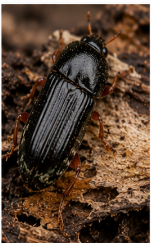
Pleasing Fungus Beetles (Megalodacne species) are attractive woodland beetles recognized for their glossy black bodies marked with bright orange, red, or yellow bands. Unlike many beetles that feed on living plants or stored products, these insects spend their lives on large bracket fungi growing on dead and decaying trees. Both adults and larvae feed on fungal tissue, making them important contributors to the decomposition process in healthy forest ecosystems.
Although their bold coloration may draw attention, Pleasing Fungus Beetles are beneficial insects that do not damage homes, crops, ornamental plants, or healthy trees. Instead, they help recycle nutrients by consuming fungi that colonize fallen logs and dead wood, supporting the natural breakdown of forest debris.
Taxonomy and Classification
Pleasing Fungus Beetles belong to the family Erotylidae, commonly known as pleasing fungus beetles. Most members of this family specialize in feeding on mushrooms and bracket fungi.
- Order: Coleoptera
- Family: Erotylidae
- Genus: Megalodacne
Several Megalodacne species occur throughout North America, including the commonly encountered Big-Lipped Pleasing Fungus Beetle (Megalodacne heros) and the Banded Pleasing Fungus Beetle (Megalodacne fasciata).
Physical Description
Pleasing Fungus Beetles are among the most colorful beetles found on woodland fungi.
- Length: Approximately 10–20 mm.
- Color: Glossy black wing covers marked with bright orange, yellow, or reddish transverse bands.
- Body Shape: Oval, slightly flattened, and smooth.
- Antennae: Short with enlarged clubbed tips used to detect fungal hosts.
- Larvae: Cream-colored, elongated grubs that develop inside bracket fungi.
Their vivid markings make them easy to identify while walking across large shelf fungi on fallen logs.
Distribution and Habitat
Pleasing Fungus Beetles are widely distributed throughout wooded regions of North America wherever large wood-decaying fungi are present.
Common habitats include:
- Deciduous forests
- Mixed woodlands
- State parks
- Nature preserves
- Dead and fallen hardwood logs
- Areas with abundant bracket fungi
They are most frequently encountered on shelf fungi growing from fallen trunks, stumps, and standing dead trees.
Behavior and Life Cycle
Pleasing Fungus Beetles complete their entire life cycle in close association with large fungal fruiting bodies.
Females lay eggs directly on suitable bracket fungi. After hatching, larvae tunnel through the fungal tissue while feeding and growing. Pupation occurs within the fungus or nearby protected locations before adults emerge to continue feeding and reproduce.
Adults remain active on fungal surfaces where they feed, mate, and seek additional fungal hosts. Because fungi can persist for months or even years, several generations may occupy the same fungal colony.
Ecological Importance
Pleasing Fungus Beetles are considered highly beneficial members of forest ecosystems.
- Fungal Feeders: Consume bracket fungi and mushrooms growing on dead wood.
- Nutrient Recycling: Help accelerate decomposition within forest ecosystems.
- Food Source: Serve as prey for birds, amphibians, reptiles, and predatory insects.
- Biodiversity: Contribute to the complex communities associated with decaying logs.
- Forest Health: Participate in natural nutrient cycling that supports healthy woodland habitats.
Unlike wood-boring beetles, they do not attack healthy trees or structural lumber.
Management and Prevention
No pest management is normally necessary because Pleasing Fungus Beetles are harmless and beneficial.
- No Chemical Control Needed: They pose no threat to homes, gardens, or crops.
- Leave Woodland Habitat Intact: Fallen logs support healthy populations and overall forest biodiversity.
- Remove Indoor Fungi: If beetles appear indoors, eliminate moisture problems and remove fungal growth rather than targeting the insects.
- Avoid Disturbing Natural Populations: These beetles provide valuable ecological services in forests.
Conservation and Research
Pleasing Fungus Beetles are important indicators of healthy woodland ecosystems containing abundant dead wood and fungal diversity. Entomologists study their relationships with wood-decaying fungi, nutrient cycling, and forest biodiversity. Their presence often reflects mature forests where natural decomposition processes remain intact.
Conclusion
Pleasing Fungus Beetles are colorful, harmless beetles that spend their lives feeding on bracket fungi growing on dead wood. Rather than being pests, they are valuable decomposers that contribute to nutrient recycling and forest health. Preserving natural woodland habitats ensures these beneficial insects continue playing an important ecological role.