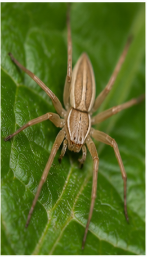
Parson Spiders (Herpyllus ecclesiasticus) are fast-moving ground spiders commonly found throughout North America. They belong to the family Gnaphosidae, a large group of hunting spiders that actively pursue prey instead of relying on webs to capture insects. Although they are frequently encountered inside homes, particularly in basements, garages, crawl spaces, and along baseboards, Parson Spiders are considered beneficial predators because they help control populations of nuisance insects and other small arthropods.
The species gets its unusual common name from the distinctive white marking on the abdomen, which resembles the traditional cravat or collar once worn by members of the clergy. Despite their somewhat intimidating appearance and rapid movements, Parson Spiders are not aggressive toward humans and rarely bite unless accidentally trapped or handled.
Overview
Unlike orb-weaving spiders that spend most of their lives suspended in webs, Parson Spiders are active hunters that roam across floors, walls, and outdoor surfaces searching for prey. They remain hidden during the day beneath rocks, logs, mulch, or household clutter before emerging after dark to hunt.
Because they frequently wander indoors while searching for insects, homeowners often mistake them for more dangerous spider species. Fortunately, Parson Spiders pose very little risk to people and provide valuable natural pest control.
Taxonomy and Classification
- Order: Araneae
- Family: Gnaphosidae
- Genus: Herpyllus
- Species: Herpyllus ecclesiasticus
- Common Name: Eastern Parson Spider
Ground spiders comprise one of the largest spider families worldwide, with thousands of species occupying forests, grasslands, deserts, and urban environments.
Identification
Parson Spiders are medium-sized spiders with smooth bodies and long running legs.
- Length: Approximately 10–20 mm.
- Color: Dark brown to nearly black.
- Abdomen: Distinctive white or gray stripe resembling a clerical collar.
- Legs: Long, slender, and well adapted for running.
- Body: Velvety appearance with relatively little body hair.
- Eyes: Eight eyes arranged in two rows.
The bold white abdominal marking is one of the easiest ways to distinguish this species from other common house spiders.
Life Cycle
Parson Spiders undergo a simple life cycle consisting of egg, spiderling, and adult stages.
Females produce silk egg sacs that are hidden beneath rocks, logs, loose bark, or sheltered indoor locations. After hatching, the young spiderlings disperse to establish their own hunting territories.
Spiderlings molt repeatedly as they grow before reaching adulthood. Most individuals live approximately one year, although lifespan varies with environmental conditions.
Distribution and Habitat
Parson Spiders are widely distributed throughout the United States, southern Canada, and parts of Mexico.
Typical habitats include:
- Woodlands
- Forest edges
- Grasslands
- Gardens
- Mulched landscape beds
- Under rocks and logs
- Basements
- Crawl spaces
- Garages
- Storage rooms
Indoors they usually remain close to the floor where insect prey is abundant.
Behavior and Ecology
Parson Spiders are nocturnal hunters that rely on speed, stealth, and excellent eyesight rather than webs to capture prey.
Unlike web-building spiders, they actively patrol their surroundings searching for insects and other small arthropods.
Common prey includes:
- Cockroaches
- Ants
- Silverfish
- Earwigs
- Small crickets
- Flies
- Other spiders
During daylight hours they hide beneath objects or inside narrow cracks until nighttime hunting begins.
Human Interaction
Although Parson Spiders occasionally wander through homes, they are not considered aggressive.
Bites are uncommon and generally occur only when the spider becomes trapped against skin or is accidentally handled.
Symptoms of a bite may include:
- Temporary pain.
- Localized redness.
- Mild swelling.
- Short-lived irritation.
Serious medical complications are extremely rare, and most bites resolve without treatment.
Damage and Pest Status
Parson Spiders do not damage structures, furniture, clothing, food, or stored products.
Their presence is considered primarily an aesthetic nuisance when they appear indoors.
Unlike cobweb spiders, they produce very little silk except for egg sacs and temporary retreats, so they do not create large accumulations of webs inside buildings.
Integrated Pest Management (IPM)
Management focuses on preventing indoor entry rather than eliminating these beneficial predators.
Exclusion
- Seal cracks around foundations.
- Repair damaged door sweeps.
- Install weather stripping.
- Seal utility penetrations.
- Repair window screens.
Sanitation
- Reduce indoor clutter.
- Vacuum regularly.
- Store firewood away from buildings.
- Remove debris around foundations.
Reduce Prey
Lowering indoor insect populations naturally reduces the number of hunting spiders that enter homes.
Chemical Control
Insecticides are rarely necessary for Parson Spiders. If management is required, physical removal and exclusion are usually more effective than routine pesticide applications.
Ecological Importance
Parson Spiders are valuable natural predators that help regulate insect populations in forests, gardens, and residential landscapes.
By feeding on numerous nuisance insects and even other spiders, they contribute to healthier ecosystems and reduce reliance on chemical pest control.
Conservation and Research
Researchers continue studying ground spiders to better understand their hunting behavior, habitat preferences, and ecological importance in controlling pest insects. Because they consume a wide variety of arthropods, they are considered valuable components of integrated pest management programs and natural biological control systems.
Maintaining diverse habitats and minimizing unnecessary insecticide use helps conserve beneficial ground spider populations.
Conclusion
Parson Spiders (Herpyllus ecclesiasticus) are harmless, fast-moving ground spiders that frequently wander into homes while hunting insects. Their distinctive white abdominal marking makes them one of North America’s easiest ground spiders to identify. Although their sudden appearance can surprise homeowners, they provide valuable natural pest control and rarely require management beyond simple exclusion and sanitation practices.