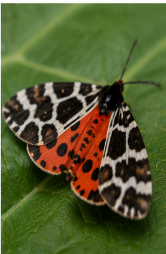
Parthenice Tiger Moths (Apantesis parthenice) are attractive members of the tiger moth family (Erebidae) and are among the many colorful moth species found throughout North America. While their brown and cream forewings provide excellent camouflage during the day, the bright orange hindwings hidden beneath them are revealed when the moth is startled, creating a dramatic flash of color that can confuse predators. Their fuzzy caterpillars, commonly called woolly bears, are equally recognizable and feed on a wide variety of herbaceous plants.
Unlike many agricultural caterpillars that become destructive pests, the Parthenice Tiger Moth is rarely abundant enough to cause significant plant damage. Instead, it is considered an important component of meadow and woodland ecosystems where both larvae and adults contribute to local biodiversity. Adult moths also serve as prey for birds, bats, and other wildlife while visiting flowers for nectar.
Overview
The Parthenice Tiger Moth belongs to the colorful tiger moth subfamily Arctiinae, a group known for striking wing patterns, fuzzy caterpillars, and fascinating chemical defenses. Many tiger moth species advertise their unpleasant taste to predators using bright warning colors, particularly on their hindwings.
Although adults are mostly nocturnal, they are sometimes observed resting on vegetation during the day. When disturbed, they suddenly expose their vivid orange hindwings before flying away, startling predators long enough to escape.
Taxonomy and Classification
- Order: Lepidoptera
- Family: Erebidae
- Subfamily: Arctiinae
- Genus: Apantesis
- Species: Apantesis parthenice
- Common Name: Parthenice Tiger Moth
Like all moths, the Parthenice Tiger Moth undergoes complete metamorphosis, progressing through egg, caterpillar, pupa, and adult stages.
Identification
Adult Parthenice Tiger Moths are medium-sized with distinctive coloration.
- Wingspan: Approximately 35–45 mm.
- Forewings: Brown with cream or pale tan markings.
- Hindwings: Bright orange with scattered black spots.
- Body: Hairy with orange and dark coloration.
- Antennae: Moderately feathery, especially in males.
The bright hindwings remain concealed while the moth rests, making the insect appear much less conspicuous until disturbed.
Caterpillar Identification
The larval stage resembles other woolly bear caterpillars.
- Body: Thick and densely covered with bristles.
- Color: Dark brown to black with reddish or orange hairs.
- Length: Up to 40 mm.
- Defense: Dense hairs discourage predators from feeding.
Although the hairs appear intimidating, they are generally not dangerous to humans, though sensitive individuals may experience mild skin irritation after handling them.
Distribution and Habitat
Parthenice Tiger Moths occur throughout much of eastern and central North America.
Typical habitats include:
- Meadows
- Prairies
- Grasslands
- Woodland edges
- Roadsides
- Old fields
- Open forests
- Gardens
Adults are frequently attracted to porch lights and other artificial lighting during warm summer evenings.
Life Cycle
Adult females deposit eggs on suitable host plants during late spring and summer.
After hatching, the woolly bear caterpillars begin feeding immediately on surrounding vegetation. As they grow, they molt several times before constructing loose silk cocoons where pupation occurs.
Adults emerge several weeks later to mate and continue the life cycle. In northern portions of their range, caterpillars may overwinter before completing development the following spring.
Host Plants
The larvae feed on a wide variety of herbaceous plants rather than specializing on a single species.
Common host plants include:
- Dandelions
- Plantains
- Goldenrods
- Asters
- Clover
- Various wildflowers
- Numerous native weeds
This broad diet helps the species occupy diverse habitats throughout its range.
Behavior and Ecology
Adult Parthenice Tiger Moths are primarily nocturnal and spend daylight hours hidden among vegetation.
Common behaviors include:
- Visiting flowers for nectar.
- Flying shortly after sunset.
- Using bright hindwings to startle predators.
- Resting quietly beneath leaves during daylight.
The caterpillars rely on dense hairs and chemical compounds obtained from host plants to discourage predators.
Damage and Pest Status
The Parthenice Tiger Moth is generally not considered an economic pest.
While caterpillars consume leaves, they rarely occur in numbers capable of causing significant injury to crops, ornamentals, or native vegetation.
Healthy plants typically recover quickly from the limited feeding that occurs.
Integrated Pest Management (IPM)
Control measures are almost never necessary because the species provides ecological benefits and causes minimal damage.
Monitoring
- Inspect host plants if caterpillars become abundant.
- Observe adults around outdoor lighting during summer.
Mechanical Control
- Hand-remove caterpillars from ornamental plants if desired.
- Relocate larvae rather than destroy them whenever possible.
Biological Control
Numerous natural enemies regulate populations.
- Birds
- Parasitic wasps
- Predatory insects
- Spiders
- Small mammals
These natural predators help keep populations well below damaging levels.
Ecological Importance
Parthenice Tiger Moths contribute to healthy ecosystems by serving as pollinators, herbivores, and prey for numerous wildlife species.
Their caterpillars provide food for beneficial predators, while adults visit flowering plants and contribute to nighttime pollination.
The striking coloration of adults also makes them valuable examples of warning coloration and predator-prey evolution.
Conservation and Research
Scientists study tiger moths extensively because of their chemical defenses, ultrasonic communication used to evade bats, and remarkable warning coloration. Research involving Apantesis species continues to improve our understanding of insect evolution, mimicry, and predator avoidance.
Maintaining native grasslands, reducing unnecessary pesticide applications, and preserving flowering habitats all support healthy populations of these beneficial moths.
Conclusion
Parthenice Tiger Moths (Apantesis parthenice) are beautiful native moths recognized for their camouflaged forewings, brilliant orange hindwings, and fuzzy woolly bear caterpillars. Although they occasionally feed on herbaceous plants during the larval stage, they rarely become pests and instead contribute to biodiversity, pollination, and healthy natural ecosystems across North America.