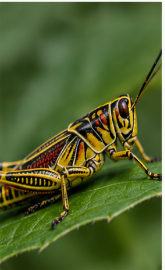
Painted Grasshoppers (Dactylotum bicolor) are among the most striking insects found in North America. Often called the Rainbow Grasshopper, this colorful species is instantly recognizable by its brilliant combination of red, yellow, orange, black, and blue markings. Unlike many grasshopper species that blend into their surroundings, the Painted Grasshopper advertises its presence with vivid warning colors that discourage predators.
Although it belongs to the same family as several destructive agricultural grasshoppers, the Painted Grasshopper is rarely considered a major pest. It generally occurs in relatively low numbers and seldom reaches outbreak populations capable of causing widespread crop damage. Instead, it is best known for its unusual appearance, fascinating behavior, and role within native prairie and desert ecosystems.
Overview
The Painted Grasshopper belongs to the family Acrididae, the short-horned grasshoppers. It is native to the western and southwestern United States and northern Mexico, where it inhabits dry grasslands, prairies, open shrublands, and desert habitats.
Unlike many grasshoppers that readily fly away when disturbed, Painted Grasshoppers have relatively short wings and are poor fliers. They rely primarily on hopping and their bright warning coloration to avoid predators. Their slow movements and distinctive appearance make them one of the easiest grasshopper species to identify.
Taxonomy and Classification
- Order: Orthoptera
- Family: Acrididae
- Genus: Dactylotum
- Species: Dactylotum bicolor
- Common Names: Painted Grasshopper, Rainbow Grasshopper
Dactylotum bicolor is the only species within its genus, making it unique among North American grasshoppers. Its combination of vivid colors, shortened wings, and slow-moving behavior distinguishes it from nearly every other native grasshopper.
Identification
Painted Grasshoppers are medium-sized insects with a thick, robust body and exceptionally bright coloration.
- Length: Approximately 20–35 mm (0.8–1.4 inches).
- Coloration: Bright combinations of red, yellow, orange, black, blue, and sometimes green.
- Body: Heavy-bodied with a rough, textured appearance.
- Legs: Strong hind legs adapted for jumping.
- Wings: Shortened and generally incapable of supporting sustained flight.
- Antennae: Short, typical of short-horned grasshoppers.
Individual coloration varies depending on age, location, and subspecies, but the bold warning pattern remains one of the species’ defining characteristics.
Distribution and Habitat
Painted Grasshoppers occur throughout much of the western United States, especially in:
- Arizona
- New Mexico
- Colorado
- Utah
- Texas
- Oklahoma
- Kansas
- Nebraska
- Northern Mexico
They prefer open habitats with abundant sunlight and sparse vegetation, including:
- Native prairies
- Shortgrass plains
- Semi-arid rangelands
- Desert grasslands
- Sagebrush habitats
- Roadsides and disturbed fields
Unlike many pest grasshoppers, Painted Grasshoppers are generally associated with native vegetation rather than intensively managed agricultural fields.
Life Cycle
Painted Grasshoppers undergo incomplete metamorphosis, developing through egg, nymph, and adult stages.
Females deposit eggs in the soil during late summer and fall using their ovipositor. The eggs remain dormant throughout winter and hatch the following spring when soil temperatures increase.
The young nymphs resemble miniature wingless adults. As they grow, they molt several times before reaching maturity. Each molt reveals increasingly brighter coloration and larger wing pads.
Adults are usually most abundant during mid to late summer, although activity varies depending on rainfall and local climate.
Behavior
Unlike many grasshopper species that quickly fly away when approached, Painted Grasshoppers typically rely on short jumps and walking to escape danger. Their reduced wings limit long-distance flight.
Their brilliant colors are believed to advertise that they contain defensive chemicals obtained from certain plants they consume. Many predators learn to avoid these brightly colored insects after unpleasant feeding experiences.
Adults are active during warm daylight hours, spending much of their time feeding, basking in the sun, and searching for mates.
Feeding Habits
Painted Grasshoppers are herbivores that feed on a variety of broadleaf plants, wildflowers, shrubs, and grasses.
Common food sources include:
- Native prairie grasses
- Sunflowers
- Composite wildflowers
- Forbs
- Desert shrubs
- Various herbaceous plants
Unlike migratory grasshopper species, Painted Grasshoppers generally remain localized and feed within relatively small areas throughout their lives.
Damage and Economic Importance
Painted Grasshoppers are not usually considered serious agricultural pests.
While they feed on vegetation like other grasshoppers, their populations rarely reach densities capable of causing significant economic losses. In most years, feeding damage is minimal and limited to scattered chewing on leaves and stems.
Occasionally, localized populations may feed on:
- Garden flowers
- Native landscaping plants
- Range vegetation
- Young ornamental plants
Even in these situations, damage is generally cosmetic and temporary compared to outbreaks caused by migratory grasshopper species.
Natural Predators
Despite their warning coloration, Painted Grasshoppers are preyed upon by several animals.
- Birds
- Lizards
- Small mammals
- Praying mantises
- Robber flies
- Spiders
Their bright coloration reduces—but does not eliminate—the risk of predation. Some predators have evolved tolerance to the defensive compounds present in these insects.
Management and Prevention
Because Painted Grasshoppers rarely become significant pests, management is seldom necessary.
Monitoring
Inspect ornamental plants and gardens during summer if feeding damage is observed. Most infestations consist of only a few individuals.
Mechanical Removal
Individual grasshoppers can be removed by hand or relocated when found feeding on valuable ornamentals.
Encourage Natural Predators
Maintaining healthy bird populations and preserving natural predator habitat helps keep grasshopper numbers balanced.
Habitat Management
Reducing excessive weeds and maintaining healthy vegetation can make landscapes less attractive to unusually large grasshopper populations while preserving beneficial native habitats.
Chemical insecticides are rarely justified for this species because outbreaks are uncommon and treatments may harm beneficial insects.
Ecological Importance
Painted Grasshoppers contribute to prairie ecosystems by serving as herbivores and prey for wildlife. Their feeding helps influence plant communities, while they provide food for numerous predators.
They also serve as an excellent example of aposematic coloration, where bright colors warn predators of potential chemical defenses. This makes them important subjects for ecological and evolutionary research.
Because they are native insects with relatively stable populations, they are generally considered beneficial components of healthy grassland ecosystems rather than pests requiring control.
Conclusion
Painted Grasshoppers (Dactylotum bicolor) are among the most colorful insects in North America. Their brilliant warning coloration, shortened wings, and fascinating defensive behaviors make them easy to recognize and popular among naturalists and photographers.
Although they occasionally feed on ornamental plants or crops, they rarely cause significant economic damage. In most situations, Painted Grasshoppers should be appreciated as native members of healthy prairie and desert ecosystems rather than treated as serious pests.