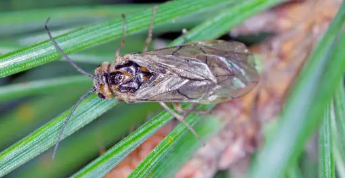
Fir Sawflies are defoliating insects belonging primarily to the genus Neodiprion, a group of primitive stingless wasps whose larvae resemble caterpillars. These insects are among the most important defoliators of fir trees and other coniferous hosts in forests, nurseries, Christmas tree plantations, and landscaped environments. During severe outbreaks, Fir Sawfly larvae can rapidly strip needles from branches and significantly weaken host trees.
Unlike many solitary forest pests, Fir Sawfly larvae are highly social and feed together in dense colonies. Their synchronized feeding behavior allows large numbers of larvae to consume foliage quickly, leaving branches thin, brown, and partially defoliated. Although healthy trees may survive occasional infestations, repeated defoliation over multiple seasons can reduce growth, weaken root systems, and increase vulnerability to secondary pests such as bark beetles and fungal diseases.
Fir Sawflies are especially problematic in Christmas tree plantations and ornamental landscapes where tree appearance and needle density are economically important.
Taxonomy and Classification
- Kingdom: Animalia
- Phylum: Arthropoda
- Class: Insecta
- Order: Hymenoptera
- Family: Diprionidae
- Genus: Neodiprion
- Common Name: Fir Sawflies
Fir Sawflies belong to the insect order Hymenoptera, the same order that includes:
- Wasps
- Bees
- Ants
Unlike true caterpillars, which belong to moths and butterflies (Lepidoptera), sawfly larvae are actually immature wasps.
They undergo complete metamorphosis with four developmental stages:
- Egg
- Larva
- Pupa
- Adult sawfly
The name “sawfly” comes from the female’s saw-like egg-laying structure used to cut slits into needles for egg deposition.
Physical Description
Fir Sawfly larvae resemble caterpillars but possess several key differences.
Common larval characteristics include:
- Green, yellow, or olive coloration
- Dark head capsule
- Multiple abdominal prolegs
- Cylindrical segmented body
- Group-feeding behavior
One of the easiest ways to distinguish sawfly larvae from true caterpillars is by counting the number of prolegs.
Sawfly larvae possess:
- Six or more pairs of prolegs
while true caterpillars typically possess five or fewer.
Adult Fir Sawflies resemble small non-stinging wasps and are usually:
- Black, brown, or reddish
- Short-bodied
- Thick-waisted
- Slow-flying
Adults are rarely noticed because they are short-lived and spend most of their time mating and laying eggs.
Distribution and Habitat
Fir Sawflies are found in coniferous forests and cultivated fir-growing regions throughout North America and parts of Europe.
Common host trees include:
- Balsam fir
- Fraser fir
- Douglas fir
- White fir
- Other conifer species
Preferred habitats include:
- Natural forests
- Christmas tree farms
- Tree nurseries
- Landscaped properties
- Mountain forests
- Mixed conifer stands
Outbreaks are especially common in dense fir plantations where host trees grow close together.
Life Cycle
The life cycle of Fir Sawflies is closely synchronized with the seasonal growth of host trees.
Egg Stage
Adult females emerge during late summer or autumn and use their saw-like ovipositor to cut small slits into fir needles where eggs are deposited.
The eggs usually overwinter within the needles.
Larval Stage
Larvae hatch during spring as new tree growth begins to harden.
This timing ensures access to tender nutrient-rich foliage.
Young larvae feed in tightly grouped colonies along branches.
As they grow, feeding intensity increases dramatically.
Defensive Behavior
When threatened, groups of larvae often display synchronized defensive movements by raising the front portion of their bodies simultaneously.
This coordinated behavior may help deter predators and parasitoids.
Pupal Stage
Mature larvae eventually drop to the ground or seek protected sites where they spin cocoons and pupate.
Pupation may occur:
- In leaf litter
- Within soil
- Under bark
- In protected debris
Adult Stage
Adults emerge to mate and continue the cycle.
Many species produce one generation annually, though climate conditions may influence development timing.
Behavior and Feeding
Fir Sawfly larvae are voracious foliage feeders.
They primarily consume:
- Fir needles
- Older foliage
- Tender new growth
Larvae often begin feeding on older needles first before moving to younger foliage.
Heavy infestations can leave behind:
- Brown skeletonized needles
- Bare branch sections
- Thin crowns
- Sparse foliage
The social feeding behavior of sawfly colonies allows large numbers of larvae to strip branches rapidly.
Damage and Impact
Fir Sawflies are important forest and ornamental pests because of their defoliating activity.
Common impacts include:
- Needle loss
- Reduced tree vigor
- Branch dieback
- Slowed growth
- Poor tree appearance
- Stress-related decline
While a single year of feeding may not kill healthy trees, repeated infestations can:
- Reduce photosynthesis
- Exhaust stored energy reserves
- Increase drought sensitivity
- Predispose trees to bark beetles
- Encourage fungal disease
In Christmas tree plantations, even moderate defoliation may reduce market value because dense healthy foliage is essential for commercial sales.
Signs of Infestation
- Clusters of caterpillar-like larvae
- Defoliated fir branches
- Brown or brittle needles
- Accumulations of frass (droppings)
- Sparse tree canopies
- Damaged new growth
- Larvae rearing up defensively when disturbed
Infestations are often most noticeable during late spring and early summer.
Management and Control (IPM)
Management of Fir Sawflies relies on monitoring and early intervention before severe defoliation develops.
Hand Removal
Small infestations can often be controlled manually by pruning or removing larval colonies from branches.
Larvae are relatively easy to spot because they feed in visible groups.
Monitoring
Inspect fir trees regularly during spring and early summer for:
- Larval colonies
- Needle feeding
- Frass accumulation
- Defoliation symptoms
Early detection greatly improves management success.
Biological Control
Many natural enemies help suppress Fir Sawfly populations, including:
- Birds
- Parasitic wasps
- Predatory beetles
- Small mammals
- Pathogenic fungi and viruses
Encouraging biodiversity around forests and landscapes can improve natural suppression.
Horticultural Oils and Insecticides
Horticultural oils and selective insecticides may be used against young larvae during early feeding stages.
Treatment timing is important because older larvae are more difficult to control.
Applications are often targeted during:
- Early spring larval emergence
- Young colony development
Tree Health Maintenance
Maintaining healthy trees through:
- Proper irrigation
- Mulching
- Reduced stress
- Balanced fertilization
can improve resistance and recovery from defoliation.
Ecological Importance
Despite their pest status during outbreaks, Fir Sawflies play roles within forest ecosystems.
They provide food for:
- Birds
- Predatory insects
- Small mammals
- Parasitoids
Their feeding activity also contributes to nutrient cycling by returning organic material to forest soils.
Outbreak cycles are often naturally regulated by predators, parasites, and environmental conditions.
Research and Scientific Importance
Researchers study Fir Sawflies because of their impact on forestry and Christmas tree production.
Current research areas include:
- Outbreak prediction
- Biological control programs
- Forest health management
- Sustainable pest control
- Climate influences on sawfly populations
Scientists also study the synchronized defensive behavior of larval colonies and their interactions with natural predators.
Conclusion
Fir Sawflies are defoliating insects belonging to the wasp family Diprionidae whose larvae feed heavily on fir tree needles. These social larvae feed in dense colonies and can rapidly strip foliage from branches during outbreaks. Although healthy trees may survive occasional infestations, repeated defoliation can weaken trees, reduce growth, and increase susceptibility to bark beetles and disease. Effective management includes monitoring, hand removal, encouraging natural predators, and applying treatments during early larval stages when necessary.