Overview
Sawflies are plant-feeding insects belonging to the order Hymenoptera and suborder Symphyta. Although they are related to bees, ants, and wasps, sawflies differ significantly in appearance and behavior. Their larvae resemble caterpillars and are among the most important defoliating pests of trees, shrubs, ornamental plants, and agricultural crops throughout North America.
Common species include Pine Sawflies (Neodiprion spp.), Rose Sawflies (Endelomyia aethiops), Elm Sawflies, Willow Sawflies, and Oak Sawflies. Large infestations can rapidly strip foliage from host plants, reducing growth, weakening plants, and diminishing ornamental value.
The name “sawfly” comes from the female’s specialized egg-laying organ, which resembles a tiny saw. Females use this structure to cut into leaves, needles, or stems and deposit eggs inside plant tissue.
Taxonomy and Classification
- Kingdom: Animalia
- Phylum: Arthropoda
- Class: Insecta
- Order: Hymenoptera
- Suborder: Symphyta
- Common Families: Tenthredinidae, Diprionidae, Cimbicidae, Argidae
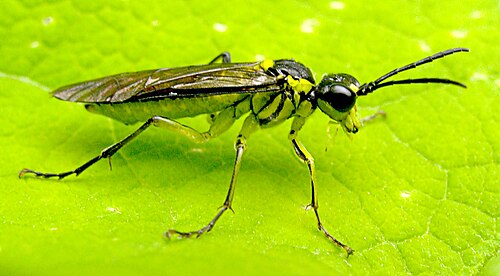
Sawflies represent some of the most primitive members of Hymenoptera. Unlike true wasps, they lack the narrow “waist” that separates the thorax and abdomen.
They undergo complete metamorphosis consisting of egg, larva, pupa, and adult stages.
Identification
Correct identification is important because sawfly larvae are frequently mistaken for caterpillars.
Adult Sawflies
- Typically 1/4 to 1 inch long.
- Wasp-like appearance without a narrow waist.
- Usually black, yellow, orange, or metallic in color.
- Possess two pairs of clear wings.
- Generally harmless to humans.
Adults rarely cause damage and are often unnoticed.
Larvae
The larval stage causes nearly all plant injury.
- Measure 1/2 to 1 inch long.
- Often green, yellow, brown, or black.
- Have six or more pairs of abdominal prolegs.
- Frequently feed in clusters.
- May be smooth, fuzzy, or covered with spines.
A key identification feature is the number of prolegs. Caterpillars have five or fewer pairs, while sawfly larvae usually possess six or more.
Many species raise their heads and tails simultaneously when disturbed, creating a synchronized defensive posture.
Distribution and Habitat
Sawflies occur throughout North America, Europe, Asia, and other temperate regions.
They are commonly found wherever suitable host plants grow.
Typical habitats include:
- Forests
- Woodlands
- Urban landscapes
- Parks
- Gardens
- Nurseries
- Agricultural fields
Many species are highly host-specific and feed only on certain plants.
Examples include:
- Pine Sawflies on pine trees.
- Rose Sawflies on roses.
- Willow Sawflies on willow species.
- Elm Sawflies on elm trees.
- Oak Sawflies on oaks.
Life Cycle
Egg Stage
Females use their saw-like ovipositors to insert eggs directly into plant tissue. Eggs are commonly laid in rows along leaf margins, stems, or needles.
Larval Stage
After hatching, larvae begin feeding immediately.
This stage causes the majority of damage.
Depending on the species, larvae may:
- Feed alone.
- Feed in large colonies.
- Consume entire leaves.
- Skeletonize foliage.
- Strip conifer needles.
Larval development usually lasts several weeks.
Pupal Stage
Mature larvae drop to the soil or seek protected locations where they spin cocoons.
Pupation may last weeks or months depending on environmental conditions.
Adult Stage
Adults emerge, mate, and begin the cycle again.
Many species produce one generation annually, while others may have multiple generations in warmer climates.
Damage and Economic Importance
Sawflies are among the most destructive foliage-feeding insects affecting ornamental and forest plants.
Leaf Skeletonization
Many species consume soft leaf tissue while leaving veins intact.
This creates a lace-like appearance known as skeletonization.
Defoliation
Heavy infestations can remove nearly all foliage from a plant.
Repeated defoliation weakens plants and reduces growth.
Conifer Damage
Pine Sawflies are particularly destructive because they consume entire needles.
Young trees may experience:
- Reduced growth.
- Branch dieback.
- Increased susceptibility to disease.
- Tree mortality following repeated attacks.
Ornamental Injury
In landscapes, sawfly feeding greatly reduces aesthetic value.
Rose Sawflies, commonly called rose slugs, can quickly skeletonize rose foliage and ruin ornamental displays.
Behavior and Conflict
The primary conflict associated with sawflies is rapid defoliation.
- Group Feeding: Many species feed in large colonies that can strip branches within days.
- Host Specificity: Most species target specific plant groups.
- Rapid Damage: Infestations often become severe before being noticed.
- Plant Stress: Repeated defoliation weakens host plants over time.
One important management consideration is that sawflies are not caterpillars.
Because of this distinction, Bacillus thuringiensis (Bt), a common caterpillar treatment, does not control sawfly larvae.
Management and Control (IPM)
Integrated Pest Management focuses on early detection and targeted control methods.
Monitoring
- Inspect susceptible plants regularly.
- Look for feeding damage and egg-laying scars.
- Check branch tips and leaf undersides.
Physical Removal
Because many species feed in groups, manual removal can be highly effective.
- Prune heavily infested branches.
- Knock larvae into soapy water.
- Remove egg-bearing foliage when practical.
Biological Control
Numerous natural enemies help regulate sawfly populations.
- Parasitic wasps
- Tachinid flies
- Birds
- Predatory beetles
- Spiders
Protecting beneficial insects often prevents severe outbreaks.
Horticultural Oils and Soaps
Young larvae can be managed using insecticidal soaps or horticultural oils.
Coverage must directly contact the larvae for effectiveness.
Targeted Insecticides
When infestations become severe, labeled insecticides may be necessary.
Treatments are most effective when larvae are small and actively feeding.
Always follow product labels and local regulations.
Conservation and Research
Sawflies remain important subjects of forestry and agricultural research.
Current studies focus on:
- Population forecasting.
- Natural enemy conservation.
- Host plant resistance.
- Biological control programs.
- Climate impacts on outbreak cycles.
Researchers continue to investigate environmentally responsible methods for managing sawfly populations while minimizing impacts on beneficial organisms.
Conclusion
Sawflies are significant defoliating pests capable of causing rapid and extensive damage to trees, shrubs, roses, pines, and other host plants. Their caterpillar-like larvae often feed in large groups, leading to severe foliage loss and plant stress. Early detection, proper identification, and integrated pest management strategies are essential for minimizing damage and maintaining healthy landscapes, gardens, and forests.