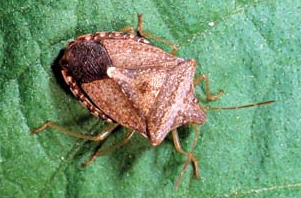
Euschistus stink bugs are a group of brown, shield-shaped insects that feed on seeds, fruits, pods, stems, and other plant tissues. Several species are economically important pests of corn, soybeans, cotton, beans, tomatoes, peaches, pecans, and other crops in the United States. The most widely recognized member is the brown stink bug (Euschistus servus).
These insects use piercing-sucking mouthparts to puncture plant tissue and remove fluids. Their feeding may kill young plants, deform fruit, damage developing seeds, reduce germination, and create openings for decay organisms. Euschistus species are also among the native brown stink bugs commonly mistaken for the invasive brown marmorated stink bug.
Taxonomy and Classification
- Common name: Euschistus stink bugs or brown stink bugs
- Genus: Euschistus
- Order: Hemiptera
- Suborder: Heteroptera
- Family: Pentatomidae
- Tribe: Carpocorini
- Type: Plant-feeding true bugs
Members of the genus Euschistus are true bugs rather than beetles. Their forewings are leathery near the base and membranous at the tips, and the wings overlap when folded. They also have a long, jointed beak called a rostrum that rests beneath the body when it is not being used for feeding.
Common Euschistus Species
- Brown stink bug (Euschistus servus): A widespread agricultural pest, particularly important in the southern United States.
- One-spotted stink bug (Euschistus variolarius): A common brown species that attacks corn, soybeans, tree fruit, and other crops.
- Dusky stink bug (Euschistus tristigmus): A dark brown species found in orchards, woodlands, and cultivated areas.
- Consperse stink bug (Euschistus conspersus): A western species that damages fruit, vegetables, and field crops.
- Euschistus quadrator: A southern species associated with cotton and other agricultural crops.
Species within the genus can be difficult to distinguish because many are similar in size, color, and body shape. Identification may require examination of shoulder shape, antennal color, underside markings, and reproductive structures.
Identification
Adult Euschistus stink bugs are broad, flattened, and shield-shaped. Most measure approximately 3/8 to 5/8 inch long. Their color ranges from yellowish-brown and gray-brown to dark brown. The body may be finely speckled, roughened, or marked with small dark spots.
The area immediately behind the head is called the pronotum. Its outer corners form the insect’s shoulders. Depending on the species, these shoulders may be rounded, pointed, or tipped with a slightly different color. The triangular plate in the center of the back, called the scutellum, extends over part of the folded wings.
Euschistus species generally lack the bold white bands on the antennae that help identify the brown marmorated stink bug. They also usually lack its sharply alternating light and dark bands along the exposed edge of the abdomen. Because patterns vary, suspected specimens should be compared with reliable regional identification guides.
Eggs and Nymphs
Female stink bugs place clusters of barrel-shaped or kettle-shaped eggs on leaves, stems, or other plant surfaces. Brown stink bug eggs are pale or translucent when first deposited and may become pinkish as they approach hatching.
Newly hatched nymphs commonly remain grouped around the empty eggs. First-stage nymphs generally do not feed on plants. Feeding begins after they molt into the second developmental stage.
Euschistus nymphs pass through five instars before becoming adults. They are wingless, oval, and smaller than mature bugs. Young nymphs may be pale green or marked with dark and reddish areas. Wing pads become increasingly visible during the later instars.
Distribution and Habitat
Euschistus stink bugs occur throughout much of North and South America. Different species occupy different regions, but the genus is represented across most of the continental United States. Brown and one-spotted stink bugs are widespread, while consperse stink bugs are especially important in western fruit-growing areas.
Typical habitats include crop fields, orchards, gardens, woodland edges, roadsides, pastures, and weedy areas. Many species develop on uncultivated host plants before moving into crops when fruit, pods, kernels, or seeds become available.
Life Cycle
Euschistus stink bugs undergo incomplete metamorphosis with egg, nymph, and adult stages. Adults commonly survive winter beneath fallen leaves, bark, weeds, crop residue, or other protected material. They become active during spring and begin feeding on early-season vegetation.
After mating, females lay egg clusters on suitable plants. The nymphs hatch and complete five instars over several weeks. Their rate of development depends on temperature, food quality, and species. Brown stink bug nymphs may complete their development in approximately one month under favorable conditions.
One or more generations may develop each year. In warm southern areas, several generations and overlapping life stages may occur. Adults are strong fliers and regularly move between wild hosts and cultivated crops as food becomes available.
Feeding Behavior
Euschistus stink bugs insert their needle-like mouthparts into plant tissue and inject saliva. Enzymes in the saliva begin breaking down cells before the insect draws the liquefied material into its digestive system. Injury results from both the physical puncture and the chemical action of the saliva.
Developing seeds, kernels, nuts, pods, and fruits are especially attractive. The damage may remain hidden for days after the insect has moved away. This delay can make it difficult to connect later symptoms with earlier stink bug feeding.
Damage to Field Crops
Corn
Stink bugs feeding on young corn may injure the growing point, causing stunting, twisted leaves, excessive tillering, or plant death. Small holes may appear in a repeating pattern as injured leaves unfold. Later feeding can damage developing ears and kernels, reducing grain quality and yield.
Soybeans and Beans
Euschistus stink bugs puncture pods and feed directly on developing seeds. Damaged seeds may become flattened, shriveled, discolored, or undersized. Feeding can reduce yield, oil content, and seed germination. Young pods may abort or fail to fill properly.
Cotton
Adults and nymphs feed through cotton boll walls and damage developing seeds and lint. Internal symptoms may include stained lint, hardened wart-like growths, damaged seed, and boll rot. Young bolls may shed, while older injured bolls can open poorly or produce lower-quality fiber.
Damage to Fruits, Vegetables, and Nuts
Feeding on peaches, apples, pears, and other fruit may cause dimples, depressions, corky tissue, or distorted growth known as catfacing. Fruit attacked early in development may become severely misshapen. Later feeding can create discolored areas beneath the skin and increase susceptibility to decay.
On tomatoes, feeding may produce cloudy spot. The affected area appears pale beneath the skin and may have a soft or corky texture. Beans, peas, peppers, and okra may develop deformed pods, damaged seeds, or discolored feeding sites.
In pecans and other nuts, stink bug feeding can cause dark kernel spots, shriveled tissue, premature nut drop, or poorly developed kernels. Damage that occurs before the shell hardens may be especially serious.
Signs of Euschistus Stink Bugs
- Brown, shield-shaped insects on plants
- Clusters of pale barrel-shaped eggs
- Groups of small, oval nymphs near empty eggs
- Punctures, dimples, or corky spots on fruit
- Cloudy white or yellow areas beneath tomato skins
- Deformed fruit, pods, or developing seeds
- Shriveled beans or poorly filled soybean pods
- Stunted or tillered young corn plants
- Dark spots or shriveled areas inside nuts
- A strong odor when the insects are disturbed or crushed
Odor and Defensive Behavior
Euschistus species produce defensive chemicals from glands on the underside of the body. When threatened, handled, or crushed, they release a strong odor that may discourage predators. The smell can remain on hands, clothing, fruit, or harvesting equipment for a short period.
These plant-feeding stink bugs are not considered dangerous to people or pets. They do not infest homes, consume stored food, or damage building materials. Adults may occasionally enter structures while looking for protected overwintering sites.
Monitoring
Inspect field edges and areas bordering weeds, woods, or recently harvested crops. Euschistus stink bugs often enter plantings from surrounding vegetation, producing concentrated damage near the perimeter before spreading farther inward.
Monitoring methods include sweep nets, beat sheets, visual plant inspections, fruit examinations, and pheromone-baited traps. The most appropriate technique depends on the crop and growth stage. Sampling should continue while seeds, fruit, nuts, or bolls are developing.
Stink bug treatment thresholds vary considerably among corn, soybeans, cotton, vegetables, tree fruit, and nut crops. Growers should use crop-specific recommendations from their state Extension service rather than relying on a single general threshold.
Management and Control
Manage Alternative Hosts
Broadleaf weeds and plants producing seeds can support stink bug populations before they enter crops. Managing weeds around fields may reduce local breeding sites. However, mowing or removing heavily infested vegetation can force adults into the crop, so nearby plants should be monitored closely afterward.
Conserve Natural Enemies
Stink bug eggs and nymphs are attacked by parasitic wasps, tachinid flies, spiders, assassin bugs, predatory stink bugs, and other natural enemies. Fungal diseases may also reduce populations under favorable conditions. Avoiding unnecessary broad-spectrum insecticides helps conserve these beneficial organisms.
Use Targeted Treatments
Because infestations frequently begin at field edges, border treatments may sometimes provide control without treating an entire field. This approach should be based on careful sampling and current crop recommendations.
When an insecticide is necessary, select a product labeled for the crop and stink bugs. Euschistus species can be difficult to suppress, and repeated applications made without scouting may provide poor economic return while harming natural enemies. Follow all directions concerning rates, protective equipment, pollinator safety, reentry, and harvest intervals.
Managing Stink Bugs Indoors
Individual Euschistus stink bugs found indoors can be captured in a container or removed with a vacuum. Seal gaps around windows, doors, siding, vents, pipes, and utility openings to prevent additional entry. Crushing the insects should be avoided because it releases their defensive odor.
Conclusion
Euschistus stink bugs are native brown stink bugs that can become serious pests of grains, seeds, fruits, vegetables, cotton, and nuts. Adults and nymphs damage plants by puncturing tissue and removing liquefied cell contents. Injury may appear as stunting, deformed fruit, cloudy spots, shriveled seeds, boll damage, or kernel discoloration. Accurate identification, regular scouting, weed management, conservation of natural enemies, and threshold-based treatments form the foundation of effective control.