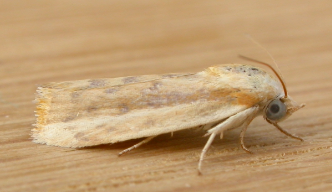
Earias bollworm moths are small agricultural moths whose caterpillars bore into cotton shoots, flower buds, bolls, okra pods, and other plants in the mallow family. The most economically important species are the Egyptian spiny bollworm (Earias insulana) and the spotted bollworm (Earias vittella).
These pests are especially important in Africa, southern Europe, the Middle East, South Asia, Southeast Asia, and parts of the Pacific. Their caterpillars damage both vegetative growth and reproductive structures. Because the larvae quickly enter shoots, buds, or fruit, infestations become difficult to control after boring begins.
Taxonomy and Classification
- Common name: Earias bollworm moth, spiny bollworm, or spotted bollworm
- Genus: Earias
- Order: Lepidoptera
- Family: Nolidae
- Subfamily: Eariadinae
- Primary pest species: Earias insulana and Earias vittella
- Primary crops: Cotton and okra
Older publications often place Earias species in the family Noctuidae. Modern classifications generally place them in Nolidae. The caterpillars are called bollworms because they enter and feed within cotton bolls, although young larvae often attack tender shoots before bolls become available.
Important Earias Species
Egyptian Spiny Bollworm
The Egyptian spiny bollworm (Earias insulana) is also called the spiny bollworm. It is widely distributed through warm regions of Africa, the Mediterranean, the Middle East, and Asia. The species attacks cotton, okra, hibiscus, and several wild plants in the mallow family.
Spotted Bollworm
The spotted bollworm (Earias vittella) is a major pest of cotton and okra in South and Southeast Asia. It may also attack hibiscus and other malvaceous plants. The caterpillars bore into shoots, flowers, and fruit, producing symptoms similar to those of the Egyptian spiny bollworm.
Other Species
Other economically significant members include Earias biplaga, an African species associated with cotton and related plants. Several additional Earias species feed on trees or shrubs but are not equally important as crop pests.
Adult Moth Identification
Earias bollworm moths are relatively small, narrow-winged moths. Adult size and color vary by species, temperature, season, and geographic population. Their forewings may be green, yellow-green, cream, brown, or silver-green, while the hindwings are generally pale or white.
Adult Earias insulana moths commonly have pale green to yellowish forewings, sometimes with faint darker lines. Brown seasonal forms can occur and may be difficult to recognize without close examination. The hindwings are whitish and less strongly marked.
Earias vittella adults usually have pale green forewings with a broad cream or white band extending lengthwise across each wing. This light band creates a more distinctly patterned appearance than that of many E. insulana adults. Reliable identification may require examination by a moth specialist.
Egg and Larval Identification
Female moths deposit small, rounded eggs on tender shoots, leaves, flower buds, bracts, bolls, or okra pods. The eggs are finely ridged and may appear pale blue-green when newly laid before darkening as the caterpillars develop.
Young larvae are small and initially feed on exposed plant tissue. Older caterpillars develop short, fleshy projections or raised tubercles bearing hairs, which produce the spiny appearance behind the common name. Their bodies may be greenish, gray, brown, or reddish with pale and dark markings.
Mature larvae generally remain concealed inside shoots, buds, bolls, or pods during feeding. Their hidden behavior makes them easy to overlook and protects them from weather, predators, and contact insecticides.
Distribution and U.S. Significance
The main Earias bollworm pests are associated with the Eastern Hemisphere and tropical or subtropical Pacific regions. They are not considered routine established cotton or okra pests in the continental United States. Their economic importance is greatest in overseas cotton- and okra-growing regions.
Because the larvae can travel inside buds, bolls, pods, flowers, or other plant material, Earias species have biosecurity significance. A suspected Earias bollworm associated with imported produce, flowers, seed cotton, or nursery plants should not be moved. In the United States, the specimen and affected material should be reported to a state agriculture department, county Extension office, or USDA plant-health authority.
Host Plants
Earias bollworms strongly favor plants in the mallow family, Malvaceae. Their most important cultivated hosts include cotton and okra. Other reported hosts include hibiscus, hollyhock, kenaf, jute, and wild Abutilon species.
- Cotton: Larvae attack shoots, squares, flowers, and bolls.
- Okra: Caterpillars bore into growing tips, flower buds, and pods.
- Hibiscus: Larvae may damage shoots, buds, and flowers.
- Kenaf and jute: Feeding can injure stems and reproductive structures.
- Wild mallows: Alternative hosts help maintain populations between crops.
Life Cycle
Earias bollworm moths undergo complete metamorphosis with egg, larval, pupal, and adult stages. Adults are primarily active at night. After mating, females locate suitable host plants and place eggs on young growth or reproductive structures.
The caterpillars hatch and begin feeding on tender tissue. Early in the crop’s development, larvae commonly enter terminal shoots. As flower buds and fruit become available, later larvae move into squares, flowers, cotton bolls, or okra pods.
A fully developed larva leaves its feeding site or moves to a protected part of the plant. It spins a tough, boat-shaped silken cocoon on dry leaves, plant debris, stems, bracts, or other sheltered surfaces. Pupation occurs inside the cocoon.
Development is rapid during warm weather, and several overlapping generations can occur during a growing season. In tropical locations, suitable host plants may allow reproduction to continue for much of the year.
Damage to Cotton
Young Earias larvae bore into cotton terminals and kill the growing point. The damaged shoot may droop, wilt, or dry above the entry point. The plant may respond by producing several side branches, creating an unusually bushy appearance and delaying normal growth.
As cotton begins producing squares and bolls, larvae attack these reproductive structures. Damaged squares and flowers may drop prematurely. Bored bolls can contain injured seeds, stained or weakened lint, larval waste, and decaying tissue.
Feeding holes allow fungi and bacteria to enter. Secondary rot may enlarge the damaged area and make the boll unsuitable for harvest. Severe infestations reduce boll formation, lint quality, seed viability, and overall yield.
Damage to Okra
On young okra plants, larvae bore into the growing tips and cause wilting or death of the terminal shoot. Affected plants may become stunted or produce multiple side branches.
Older larvae enter flower buds and developing pods. Infested pods may become curved, scarred, discolored, or filled with caterpillar waste. A small entry hole surrounded by frass may be visible on the surface. Damaged okra pods are generally unmarketable and may rot before harvest.
Signs of Earias Bollworm Moths
- Wilted or dried terminal shoots
- Small entry holes in shoots, buds, bolls, or pods
- Frass collected around a feeding hole
- Prematurely dropping cotton squares or flowers
- Cotton plants producing excessive side branches
- Damaged seeds or stained lint inside bolls
- Curved, scarred, or rotting okra pods
- Spiny caterpillars concealed inside plant tissue
- Boat-shaped cocoons attached to plants or debris
- Small green or cream-patterned moths in monitoring traps
Monitoring
Inspect cotton and okra regularly from the seedling stage through harvest. Examine terminal shoots for wilting and split suspicious stems to look for larvae. Check flower buds, cotton squares, bolls, and okra pods for holes, frass, webbing, or premature shedding.
Species-specific pheromone traps can help detect adult male moths and track seasonal activity. Trap captures should be combined with direct crop inspection because the presence of moths does not always equal damaging larval density.
Management and Control
Field Sanitation
Remove and destroy infested shoots, buds, bolls, and okra pods before larvae complete development. After harvest, manage crop residue and volunteer host plants according to regional recommendations. Remove wild mallows near production areas when they are known to maintain pest populations.
Crop Planning
Timely planting and synchronized crop development can reduce the period during which vulnerable plant stages are available. Crop rotation, host-free periods, and resistant or locally recommended cultivars may form part of regional management programs.
Biological Control
Earias eggs and larvae are attacked by parasitic wasps, flies, lacewings, predatory bugs, spiders, and other natural enemies. Egg parasitoids such as Trichogramma species may contribute to suppression. Avoid unnecessary broad-spectrum insecticides that eliminate these beneficial organisms.
Biological and Chemical Treatments
Young larvae are the most vulnerable stage because they have not yet entered protected plant tissue. Regionally registered products containing Bacillus thuringiensis may affect small caterpillars that consume treated surfaces, but performance declines after larvae bore into shoots or fruit.
Where insecticides are required, applications should be based on scouting, economic thresholds, and local crop recommendations. Rotate insecticide groups to slow resistance, since some Earias populations have developed reduced susceptibility after repeated exposure. Follow all label directions, harvest intervals, worker-protection requirements, and pollinator precautions.
Conclusion
Earias bollworm moths are significant overseas pests of cotton, okra, and related plants. Their caterpillars first attack tender shoots and later bore into buds, flowers, bolls, and pods. Wilted terminals, entry holes, frass, dropped flowers, and damaged fruit are key warning signs. Early monitoring, sanitation, conservation of natural enemies, pheromone trapping, and treatment before larvae enter plant tissue provide the strongest control. Suspected Earias bollworms found in the continental United States should be reported for professional identification.