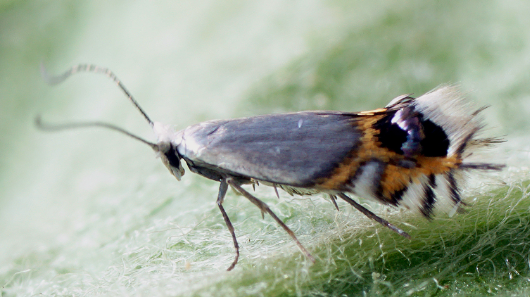
Coffee leaf miners are tiny moth larvae that tunnel between the outer layers of coffee leaves. The principal species affecting coffee in the Americas is Leucoptera coffeella, a member of the family Lyonetiidae. Although the adult moths are inconspicuous, heavy larval infestations can reduce photosynthesis, cause premature leaf drop, and weaken coffee plants.
Taxonomy and Classification
- Order: Lepidoptera
- Family: Lyonetiidae
- Genus: Leucoptera
- Primary American species: Leucoptera coffeella
- Common name: Coffee leaf miner
Other Leucoptera species attack coffee in parts of Africa and Asia. Because their geographic ranges differ, suspected specimens should be identified by a qualified agricultural or Extension specialist.
Identification
Adult coffee leaf miners are extremely small moths with narrow, fringed wings. Adult L. coffeella have brownish-white or silvery-white coloration and a wingspan of approximately 6.5 millimeters. They commonly rest beneath coffee leaves during daylight hours.
The larvae are pale, flattened caterpillars that live inside leaf tissue. They are difficult to see without opening a mine. The most recognizable evidence is an irregular pale-yellow trail that gradually becomes a dry, brown blotch. Bending an infested leaf may cause the thin epidermal layer over the mine to separate from the damaged tissue.
Distribution and Host Plants
Leucoptera coffeella occurs throughout many coffee-producing areas of Central America, South America, and the Caribbean, including Puerto Rico. Its principal hosts are cultivated coffee plants, especially Coffea arabica. The pest is not known to occur in Hawaii and should be reported immediately if suspected there.
Life Cycle and Behavior
Females deposit tiny eggs on coffee leaves. Newly hatched larvae enter the leaf and feed on the internal mesophyll, remaining protected between its surfaces. After completing several larval stages, they leave the mine and form small silken cocoons, often on leaves in the lower portion of the plant. Development can be rapid under warm conditions, allowing several generations annually.
Coffee Plant Damage
Each larva destroys a portion of the leaf’s photosynthetic tissue. A few mines generally cause limited harm, but severe infestations can produce extensive brown patches, premature defoliation, reduced plant vigor, and lower coffee yields. Young plants and stressed trees may be especially vulnerable. Damage can resemble leaf scorch, disease, or nutritional problems, so examining leaves for mines and larvae is important.
Scouting and Monitoring
Inspect coffee plants regularly, particularly during warm or dry periods. Sample leaves from multiple plants and different canopy levels. Record the percentage of leaves with active mines rather than counting old, empty blotches. An active mine may contain a living larva, fresh feeding tissue, or moist material. Empty brown mines do not necessarily indicate that treatment is needed.
Management and Control
An integrated pest management program should combine monitoring, plant care, biological control, and carefully selected treatments:
- Maintain appropriate irrigation and balanced nutrition to reduce plant stress.
- Avoid unnecessary broad-spectrum insecticides that kill parasitoid wasps, predatory wasps, and other natural enemies.
- Remove heavily infested nursery plants when practical, but do not rely on leaf removal across large plantations.
- Use locally established action thresholds before considering insecticide applications.
- Select only products registered for coffee and coffee leaf miners in the relevant jurisdiction.
- Rotate insecticide modes of action to reduce resistance pressure and follow every label requirement.
Larvae are protected inside leaves, so poorly timed contact sprays may provide limited control. Growers should consult their Cooperative Extension service or crop adviser for regional monitoring methods and current treatment options.
Conclusion
Coffee leaf miners are small insects capable of causing substantial damage when populations are allowed to build. Correct identification, routine scouting, healthy plants, and protection of natural enemies provide the foundation for sustainable management. In areas where the pest is not established, rapid reporting and restrictions on moving infested coffee material are essential.