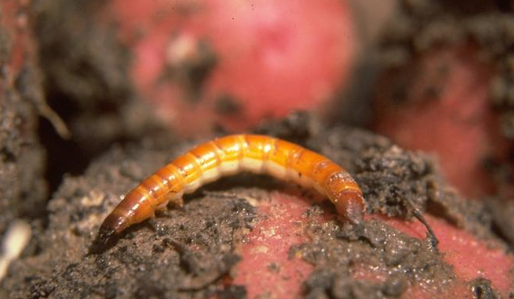
Click beetle larvae, commonly called wireworms, are slender, soil-dwelling insects that feed on seeds, roots, underground stems, and tubers. They are the immature stage of click beetles in the family Elateridae. Although many wireworm species feed primarily on decaying organic material or cause little noticeable injury, several are important pests of agricultural crops and garden vegetables.
Wireworms are particularly difficult to manage because they remain concealed in soil and may live as larvae for several years. By the time poor emergence, wilted seedlings, or tunnels in harvested potatoes become visible, the opportunity for effective treatment has often passed. Scouting and management decisions therefore need to occur before planting.
Taxonomy and Classification
- Kingdom: Animalia
- Phylum: Arthropoda
- Class: Insecta
- Order: Coleoptera
- Superfamily: Elateroidea
- Family: Elateridae
The name wireworm applies to the larvae of numerous click beetle species rather than one individual insect. Economically important genera in North America include Limonius, Melanotus, Agriotes, Conoderus, and Selatosomus. Species distribution, preferred habitat, life-cycle length, and crop-damage potential vary considerably.
Wireworm Identification
Wireworms have elongated, cylindrical or slightly flattened bodies with three pairs of short legs immediately behind the head. Young larvae may be soft, white, or cream-colored. As they mature, most pest species develop a hard, smooth, shiny exterior that ranges from straw-yellow to reddish-brown or nearly black.
- Approximately one-quarter to 1.25 inches long
- Slender, segmented, wire-like body
- Yellow, tan, brown, cream, or occasionally dark coloration
- Hard and shiny exterior in many mature species
- Three pairs of legs located close to the head
- Dark, hardened head capsule
- Distinctive terminal abdominal segment that varies by species
Wireworms are sometimes confused with millipedes, centipedes, mealworms, and false wireworms. Millipedes and centipedes have many pairs of legs along the body, while wireworms have only six legs. False wireworms are the larvae of darkling beetles and may require examination of the head, legs, and final abdominal segment for accurate separation.
Identifying Adult Click Beetles
Adult click beetles are narrow, elongated beetles with bodies that often taper toward the rear. Most are brown, gray, or black, although some species have colorful markings. The rear corners of the pronotum, the shield-like section behind the head, extend backward as pointed projections.
A click beetle placed on its back can flex a spine-and-groove mechanism between its body segments. This produces a clicking sound and throws the beetle into the air, helping it escape predators or return to its feet. Adult click beetles attracted to lights or found indoors are generally temporary nuisance visitors and do not damage furniture, clothing, stored food, or buildings.
Distribution and Habitat
Click beetles and their larvae occur throughout the United States. Wireworms inhabit agricultural fields, gardens, turf, pastures, rangeland, nurseries, and other locations containing suitable soil moisture and plant roots.
Risk is often elevated when land that previously supported pasture, sod, grass, clover, weedy alfalfa, cereal crops, or conservation vegetation is converted to an annual crop. Adult females are attracted to grassy or weedy areas for egg-laying, and the long-lived larvae may remain after the vegetation is removed.
Some species prefer moist, irrigated soil with abundant organic matter. Others are adapted to dryland production and previously undisturbed rangeland. Identifying the wireworm species and understanding a field’s history can help determine which crops are at risk.
Host Plants
Wireworms have broad feeding habits and may damage numerous field, vegetable, and ornamental crops. Germinating seeds and young seedlings are especially vulnerable.
- Corn
- Wheat and barley
- Potatoes and sweet potatoes
- Sugarbeets
- Dry beans and soybeans
- Carrots and other root vegetables
- Tomatoes
- Leafy vegetables
- Clover and alfalfa
- Onions
- Melons and squash
- Strawberries
The presence of a wireworm does not automatically mean that serious crop injury will occur. Damage depends on species, larval density, crop, planting conditions, soil temperature, moisture, and the speed at which seedlings become established.
Life Cycle
Click beetles undergo complete metamorphosis through egg, larval, pupal, and adult stages. Females generally place their eggs in soil during spring or early summer, often choosing moist, grassy, or weedy areas. Depending on the species, one female may deposit dozens or hundreds of eggs.
After hatching, the larvae begin feeding on roots, seeds, organic material, and small soil organisms. The wireworm stage may last from one to six years. Several of the most troublesome species require three or four years to complete development, spending most of their lives underground.
Wireworms move vertically through the soil in response to temperature and moisture. They approach the root zone during cool, moist periods in spring and fall. During hot, dry weather or freezing conditions, they may move several inches or even feet below the surface.
Mature larvae form earthen cells and become pale, soft-bodied pupae. Adults may emerge during the same season or remain protected in their cells until the following spring. Because generations overlap, eggs, larvae of different ages, pupae, and adults may be present within the same field.
Wireworm Damage
Seeds and Seedlings
Wireworms bore into planted seeds and consume the interior, leaving hollow seed coats and preventing germination. They may also clip underground shoots, tunnel into young stems, or prune roots. Damage produces thin stands, irregular bare patches, wilted seedlings, and plants that die shortly after emergence.
Roots, Crowns, and Stalks
Larvae feeding on established plants can tunnel through roots, crowns, and lower stalks. Injured plants may become stunted or display nutrient- and water-stress symptoms. Feeding wounds can provide entry points for fungi and bacteria that cause secondary decay.
Tubers and Root Vegetables
Wireworms create narrow, round tunnels in potatoes, sweet potatoes, carrots, and other underground produce. Even when feeding does not reduce total weight, holes and associated decay can lower grade, shorten storage life, and make produce unmarketable.
Scouting and Monitoring
Fields should be evaluated before a susceptible crop is planted. Inspect soil exposed during plowing or cultivation, particularly when converting old pasture, sod, clover, alfalfa, or grassy land. Examine any slender larvae carefully because not every soil-dwelling insect is a crop pest.
Bait stations are commonly used to detect wireworms. Soaked, untreated corn and wheat seed can be buried about four to six inches deep and covered with soil. A piece of dark plastic over the station helps warm the soil and stimulate seed germination, producing carbon dioxide that attracts wireworms.
Mark each station and recover the bait after approximately one week. Potato pieces, carrots, or whole-wheat flour may also be used, depending on regional recommendations. Baits work best when soil at the sampling depth is approximately 50°F or warmer and contains adequate moisture.
Thresholds vary by crop, location, wireworm species, and sampling method. A count suggesting high risk in soybeans may not be appropriate for potatoes or vegetables. Consult the local Extension service when interpreting bait results.
Management and Control
Plan Before Planting
There are generally no dependable rescue treatments once wireworm injury appears. Record previous infestations and sample high-risk fields before planting. Avoid placing a valuable susceptible crop immediately after long-term sod, pasture, weedy alfalfa, or grass when wireworms are detected.
Use Cultural Controls
Crop rotation may reduce damage when a locally suitable nonhost or less-susceptible crop is available. However, broad host ranges and long larval lives mean that a short rotation will not always eliminate the population.
Plant into warm, properly prepared soil so seeds germinate and seedlings establish quickly. Cold, wet soil delays emergence and gives wireworms more time to feed. Use the recommended planting depth and vigorous, high-quality seed.
In appropriate production systems, fallow periods or cultivation can expose larvae to predators and drying. These practices must be balanced against soil erosion, moisture loss, soil-health goals, and conservation-tillage requirements.
Preventive Insecticides
Seed treatments or at-planting, in-furrow insecticides may protect crops in fields with a documented risk. Some products repel, intoxicate, or temporarily stop wireworm feeding without killing every larva. The same population may therefore remain a concern in later seasons.
Preventive treatments should not be applied automatically to every field. Base decisions on field history, bait sampling, crop value, and current Extension recommendations. Always follow the pesticide label, including crop, rate, application method, worker-safety instructions, and environmental restrictions.
Biological Control
Ground beetles, birds, predatory insects, entomopathogenic fungi, and insect-killing nematodes may attack wireworms. Their activity contributes to natural mortality but does not consistently protect high-value crops from established populations. Biological products should be selected only when supported by reliable research for the crop, soil conditions, and wireworm species involved.
Wireworm Control in Home Gardens
Gardeners can bury sections of carrot or potato as monitoring and trapping baits. Mark each location, inspect the bait every few days, remove any larvae, and replace damaged pieces. Rotate susceptible root vegetables and avoid planting directly into recently removed turf when possible.
Remove severely damaged plant material and replant only after determining whether conditions still favor injury. Routine broadcast insecticide applications are not recommended for home gardens, especially when the pest has not been positively identified.
Conclusion
Click beetle larvae are better known as wireworms—hard-bodied, soil-dwelling insects capable of damaging seeds, seedlings, roots, crowns, and tubers. Their hidden habitat and multi-year larval stage make prevention more effective than attempted rescue treatments. Field-history records, preplant baiting, appropriate crop selection, rapid seedling establishment, and carefully justified at-planting protection provide the foundation of successful wireworm management.