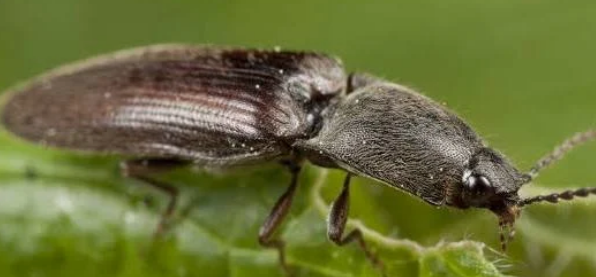
Click Beetles are elongated beetles belonging to the family Elateridae, a large group containing thousands of species worldwide. They are best known for their unusual ability to snap or “click” their bodies into the air when placed on their backs. Adult Click Beetles are generally harmless and are often attracted to outdoor lights, but their larvae, known as wireworms, include important agricultural and garden pests. Wireworms live primarily in soil, where some species feed on seeds, roots, tubers, and underground stems of crops and ornamental plants.
For homeowners, finding an adult Click Beetle indoors is usually little more than a nuisance. The beetles do not infest houses, damage furniture, bite people, or reproduce successfully inside normal living spaces. In agricultural fields and gardens, however, the presence of wireworms can be much more significant because their underground feeding may damage corn, potatoes, wheat, vegetables, and other plants before the problem is visible above ground.
Taxonomy and Classification
Click Beetles belong to the order Coleoptera and family Elateridae. The family is diverse, with species occurring in forests, grasslands, agricultural areas, deserts, wetlands, gardens, and urban landscapes.
Basic classification includes:
- Order: Coleoptera
- Family: Elateridae
- Common Names: Click Beetles, snapping beetles, skipjacks, spring beetles
- Larval Name: Wireworms
- Metamorphosis: Complete metamorphosis — egg, larva, pupa, and adult
The common name comes from a specialized mechanism between the beetle’s prothorax and mesothorax. A spine-like projection can be fitted into a corresponding groove. When released suddenly, it produces the characteristic click and launches the beetle upward.
Identification
Adult Click Beetles generally have long, narrow, somewhat flattened bodies. Depending on species, adults may range from less than 1/4 inch to more than an inch long. Many common species are brown, gray, black, or mottled, providing camouflage against soil, bark, and leaf litter.
- Body Shape: Elongated, narrow, and usually parallel-sided or slightly tapered.
- Pronotum: The shield immediately behind the head often has sharply pointed rear corners.
- Antennae: Usually moderately long and may be serrated or comb-like in some species.
- Wing Covers: Hard elytra cover the abdomen and typically show longitudinal grooves or lines.
- Click Mechanism: When overturned, the beetle may arch its body and suddenly snap into the air with an audible click.
The clicking behavior is one of the easiest ways to distinguish these insects from similarly shaped beetles. The maneuver helps an overturned beetle return to its feet and may also startle potential predators.
Wireworm Identification
The larvae of Click Beetles are called wireworms. Unlike the soft, C-shaped grubs produced by scarab beetles, wireworms are generally slender, cylindrical, and relatively hard-bodied.
Wireworms typically have:
- A yellowish, tan, orange-brown, or reddish-brown body.
- A narrow, elongated shape resembling a short piece of wire.
- A tough, shiny outer covering.
- A darker head capsule with chewing mouthparts.
- Three pairs of small legs immediately behind the head.
Wireworms are commonly discovered when gardeners dig through soil, harvest potatoes, prepare vegetable beds, or investigate plants that have unexpectedly wilted or failed to emerge.
Distribution and Habitat
Click Beetles occur throughout the United States and much of the world. Adults may be encountered in fields, forests, gardens, lawns, orchards, pastures, and around buildings. Many hide beneath bark, logs, stones, vegetation, or leaf litter during the day.
Adults of many species become active during the evening and are strongly attracted to lights. This behavior explains why Click Beetles occasionally enter homes through open doors, windows, damaged screens, or gaps around exterior lighting.
Wireworms spend most of their lives underground. Agricultural species are especially associated with grasslands, pastures, cereal fields, and land recently converted from grass to cultivated crops. Moist soil containing abundant roots and organic matter can provide favorable conditions for larval development.
Life Cycle
Click Beetles undergo complete metamorphosis. Females generally deposit eggs in or near the soil, often selecting locations containing suitable vegetation and moisture. After hatching, the young wireworms begin living within the soil.
One reason wireworms can become persistent agricultural pests is their unusually long larval period. Depending on the species and environmental conditions, the wireworm stage may last several years. Larvae molt repeatedly while feeding and gradually increasing in size.
Mature larvae eventually create small chambers in the soil and pupate. Adults emerge from these chambers and disperse to feed, mate, and begin another generation. Because larvae of different ages may coexist in the same field, wireworm problems can continue across multiple growing seasons.
What Do Click Beetles Eat?
Adult feeding habits vary considerably among species. Some adults feed on nectar, pollen, plant material, or small insects, while others feed very little during their relatively short adult lives. Adults generally cause little economically important plant damage.
The larval diet is more important from a pest management perspective. Not every wireworm is a crop pest. Some species feed on decaying organic material, while others are predatory. Pest species feed on living underground plant tissue.
Wireworm Damage
Wireworms can attack germinating seeds, seedlings, roots, underground stems, bulbs, and tubers. Because the larvae remain concealed in soil, significant damage may occur before the pest itself is discovered.
Common symptoms include:
- Poor Germination: Wireworms may hollow out planted seeds before seedlings emerge.
- Seedling Death: Feeding on underground stems or roots can kill young plants.
- Stunting: Root injury reduces the plant’s ability to absorb moisture and nutrients.
- Wilting: Severely damaged root systems may cause plants to wilt despite adequate soil moisture.
- Potato Damage: Wireworms tunnel directly into potato tubers, creating narrow holes that reduce marketability.
- Patchy Fields: Agricultural infestations frequently appear as irregular areas of missing or weakened plants.
Corn, wheat, barley, potatoes, sugar beets, carrots, onions, beans, and numerous vegetable crops can be affected by pest species of wireworms.
Are Click Beetles Dangerous?
Adult Click Beetles are not considered dangerous to people or pets. They are not blood-feeding insects, they do not sting, and they are not significant structural pests. Their dramatic jumping action sometimes alarms homeowners, but it is simply a defensive and self-righting behavior.
An occasional adult found inside a house does not indicate an infestation. It has usually flown toward a light and accidentally entered the structure.
Click Beetles Around Homes
Click Beetles can become temporary nuisance pests around houses during warm weather. Porch lights, security lights, and illuminated windows may attract flying adults after sunset.
Once indoors, the beetles may be found crawling along floors, walls, curtains, or windows. They cannot establish the type of indoor infestation associated with cockroaches, pantry beetles, or carpet beetles under normal household conditions.
Individual beetles can simply be captured and released outdoors or removed with a vacuum.
Monitoring for Wireworms
Wireworm management is more difficult because the insects remain underground. In agricultural settings, monitoring is particularly important before planting, since treating an established crop after serious root damage has occurred may provide limited benefit.
Soil sampling can help determine whether wireworms are present. Bait stations containing germinating grain may also be buried in the soil and later examined for larvae. The appropriate monitoring method and economic threshold depend on the crop and wireworm species.
Management and Control
Management should distinguish between harmless adult Click Beetles and economically important wireworms. Outdoor adults generally require no treatment. Wireworm management is best approached through Integrated Pest Management.
Cultural Control
Fields with a history of grasses or pasture can carry greater wireworm risk when converted to susceptible crops. Understanding previous land use can therefore help growers predict potential problems.
- Inspect soil before establishing susceptible crops.
- Control grassy weeds that may provide alternative hosts.
- Use appropriate crop rotations where locally recommended.
- Remove unnecessary crop residues when they contribute to pest habitat.
- Maintain healthy growing conditions so plants can better tolerate limited root feeding.
Chemical Control
Where damaging wireworm populations are confirmed, registered seed treatments or soil-applied insecticides may be used for certain agricultural crops. Because larvae are protected beneath the soil surface and may occur at different depths, control can be difficult. Product selection should be based on the crop, wireworm species, local recommendations, and pesticide label.
Routine insecticide applications around homes are generally unnecessary simply because adult Click Beetles are attracted to lights.
Exclusion Around Buildings
Homeowners experiencing repeated indoor encounters can reduce entry by repairing window screens, installing door sweeps, sealing gaps around frames and utility penetrations, and reducing unnecessary nighttime lighting near entrances. Moving bright exterior lights farther from frequently used doors can also reduce the number of beetles attracted toward the building.
Ecological Importance
Although some wireworms are significant crop pests, the enormous Click Beetle family should not be viewed entirely as harmful. Many species have little or no economic impact, and some larvae are predators of other soil-dwelling organisms. Click Beetles are also part of natural food webs and are consumed by birds, reptiles, amphibians, spiders, predatory insects, and small mammals.
Some tropical members of the broader click beetle group are even bioluminescent, producing visible light through specialized organs. These remarkable beetles demonstrate the biological diversity contained within the click beetle lineage.
Prevention
For residential properties, prevention primarily involves exclusion and exterior light management. There is usually no reason to eliminate Click Beetles living naturally in lawns, gardens, or surrounding landscapes unless wireworm damage to plants has been confirmed.
For farms and vegetable gardens, the more important concern is identifying wireworm populations before planting susceptible crops. Because larvae may remain in the soil for years, previous crop history, soil sampling, and early monitoring are much more useful than waiting for visible plant losses.
Correct identification is particularly important with Click Beetles. The strange clicking adult encountered on a porch is generally a harmless visitor, while its less conspicuous underground larval stage can include serious plant pests. Recognizing this difference allows control measures to be directed where they are actually needed while leaving harmless and beneficial species undisturbed.