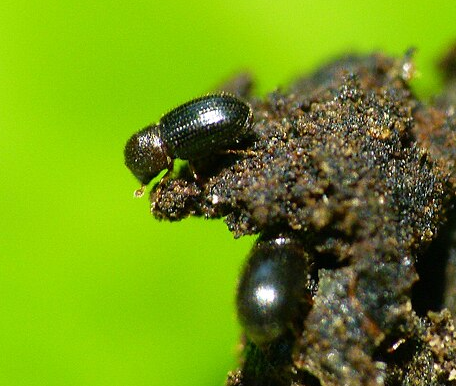
Coffee berry borers (Hypothenemus hampei) are tiny beetles that tunnel into coffee berries and reproduce inside the seeds commonly called coffee beans. They are considered the most destructive insect pests of coffee worldwide because both adults and larvae damage the harvested portion of the crop.
Once a female enters a berry, the fruit protects her and her offspring from weather, predators, and many insecticide treatments. Successful control therefore depends on frequent monitoring, careful harvesting, field sanitation, biological control, and precisely timed applications rather than relying on a single method.
Taxonomy and Classification
- Kingdom: Animalia
- Phylum: Arthropoda
- Class: Insecta
- Order: Coleoptera
- Family: Curculionidae
- Subfamily: Scolytinae
- Genus: Hypothenemus
- Species: Hypothenemus hampei
The coffee berry borer is technically a type of bark or ambrosia beetle within the weevil family. It is sometimes called the coffee bean borer or coffee broca. It should not be confused with the larger coffee bean weevil, Araecerus fasciculatus, which primarily attacks stored plant products.
Identification
Adult female coffee berry borers are extremely small, generally measuring approximately 1.4 to 1.8 millimeters long. They are dark brown to nearly black, cylindrical, and covered with fine hairs. Their heads curve downward beneath the front of the body and may be difficult to see from above.
Male beetles are smaller and cannot fly. They generally remain inside the berry, where they mate with females. Winged females leave infested berries and fly to developing coffee fruit to begin new infestations.
The eggs are small, oval, and white. Larvae are pale, legless grubs with brownish head capsules. Eggs, larvae, pupae, and adult beetles may all be present inside a single berry, but these stages are normally discovered only after the fruit or seed is opened.
Distribution and Host Plants
The coffee berry borer originated in Africa and has spread to nearly every major coffee-producing region through the movement of infested coffee. In the United States and its territories, it was detected in Puerto Rico in 2007 and on the Island of Hawai‘i in 2010. It subsequently spread to additional coffee-growing islands in Hawaii.
The pest feeds almost exclusively on coffee fruit. Commercial hosts include arabica coffee, Coffea arabica, and robusta coffee, Coffea canephora. Beetles may occasionally be recorded from other plants, but coffee berries are the primary host in which economically important populations develop.
Life Cycle
A mated female locates a suitable coffee berry and commonly enters through the blossom end, also called the disc or navel. She chews a tunnel through the skin and pulp toward one of the seeds. Her position within the berry affects how vulnerable she is to treatment.
When the female is outside the berry or has only partially entered, she remains exposed to predators and contact treatments. Once she tunnels deeply into the seed, the surrounding fruit protects her. She constructs galleries inside the bean and deposits groups of eggs.
Larvae hatch and feed on the nutrient-rich seed tissue. They pupate within the berry and emerge as adults. Females commonly mate with males inside their original berry before leaving to attack new fruit. More than one generation may develop inside berries that remain on the tree or ground, allowing unharvested fruit to maintain the population between crops.
Signs of Coffee Berry Borer Activity
The entrance hole is the most recognizable external sign. Look for a small, round opening near the blossom end of a green, ripening, or dried coffee berry. Fine boring dust or debris may surround an active hole.
Additional signs include:
- Adult beetles partly visible in entrance tunnels
- Prematurely dropped young berries
- Brown tunnels and feeding galleries inside beans
- Eggs, larvae, pupae, and adults within opened fruit
- Lightweight, broken, or partially hollowed beans
- Secondary fungal or bacterial deterioration
- Increased defects after processing and grading
Damage and Economic Importance
Female tunneling and larval feeding directly destroy coffee seed tissue. Young berries may drop prematurely, while older infested fruit can remain on the plant and produce damaged beans. Feeding reduces yield, bean weight, quality, and market value.
Damaged beans may produce undesirable flavors and physical defects that lower the grade of a coffee lot. Growers also face higher labor, sorting, sanitation, monitoring, and treatment costs. When left unmanaged, infestation can spread through most of a crop.
Monitoring Coffee Berry Borers
Begin monitoring as coffee berries develop, well before harvest. Examine berries from multiple trees and areas of the farm because infestations can be clustered. Record the percentage of berries with entrance holes and open a sample to determine the beetle’s location inside the fruit.
Alcohol-baited traps can detect flying females, reveal seasonal movement, and identify areas of increased activity. Traps do not provide complete control and should be combined with direct berry sampling. Treatment thresholds and sampling procedures differ by region, season, and production system, so growers should follow current local extension recommendations.
Integrated Pest Management
Harvest Frequently and Completely
Pick ripe berries regularly and avoid leaving overripe fruit on the trees. At the end of the main harvest, conduct a thorough final strip-pick to remove green, ripe, overripe, and dried berries. These remaining berries are major breeding reservoirs.
Remove Fallen and Residual Fruit
Collect fallen berries where practical and manage them according to local extension guidance. Clean harvesting bags, baskets, tarps, processing equipment, vehicles, and storage areas so infested berries are not carried into clean fields or retained between seasons.
Prune and Maintain Accessible Trees
Manage tree height and canopy density so workers can see and harvest the entire crop. Abandoned, unmanaged, or volunteer coffee plants can maintain beetle populations and should be included in an area-wide sanitation plan.
Use Biological Controls
The insect-killing fungus Beauveria bassiana is an important component of coffee berry borer management in Hawaii and other regions. It is most effective when applied according to the product label while female beetles are exposed outside or near the entrance of berries. Coverage, rainfall, humidity, beetle position, and application timing influence results.
Parasitoid wasps and naturally occurring predators can also contribute to suppression. Biological-control organisms should never be imported, transported, or released without the required federal and state authorization.
Apply Insecticides at the Correct Time
Contact treatments cannot reliably reach beetles protected deep inside coffee seeds. Applications should target periods when monitoring shows that females are flying or beginning to enter berries. Use only products labeled for coffee and coffee berry borer in the location, follow harvest intervals, and rotate permitted modes of action where recommended.
Preventing the Spread
Do not move fresh coffee berries, unprocessed beans, plants, harvesting equipment, or sacks from infested areas without following applicable quarantine and sanitation requirements. Regulations can change, so producers and travelers should consult current agriculture department guidance before transporting coffee materials between islands, states, or territories.
Conclusion
Coffee berry borers are tiny beetles capable of causing major losses because they live and reproduce inside coffee seeds. Small entrance holes near the blossom end are the principal external warning sign. Frequent harvesting, removal of residual berries, sanitation, sampling, trapping, biological control, and correctly timed treatments must work together to keep populations below damaging levels.