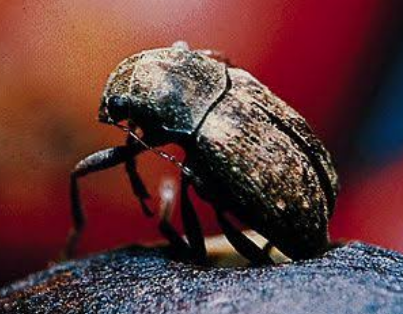
Coffee grain beetles are stored-product insects associated with dried coffee beans and other plant materials. The name most commonly refers to the coffee bean weevil (Araecerus fasciculatus), a small beetle that can develop inside green coffee beans, cocoa, maize, cassava, nuts, spices, and dried fruit.
Despite being called a weevil, this beetle belongs to the family Anthribidae rather than the family Curculionidae, which contains grain weevils such as rice and maize weevils. Coffee grain beetles are most troublesome in warm, humid warehouses, shipping facilities, processing plants, and storage areas holding susceptible commodities for extended periods.
Taxonomy and Classification
- Kingdom: Animalia
- Phylum: Arthropoda
- Class: Insecta
- Order: Coleoptera
- Family: Anthribidae
- Genus: Araecerus
- Species: Araecerus fasciculatus
Older scientific literature may use names such as Araecerus coffeae. The currently accepted name for the coffee bean weevil is Araecerus fasciculatus. “Coffee grain beetle” is an informal descriptive name rather than a separate scientifically recognized species.
Identification
Adult coffee grain beetles are approximately three to five millimeters long. They have compact, oval, dome-shaped bodies covered with a mottled pattern of dark brown, gray, tan, and pale hairs or scales. This irregular coloring helps them blend into coffee beans, dried seeds, bark, and stored plant products.
The head has a short, broad snout rather than the long, narrow rostrum seen on rice or maize weevils. The antennae are slender and end in a loose club formed by three enlarged segments. The hardened wing covers do not completely cover the abdomen, leaving the final abdominal segment exposed. Adults have long legs and are capable of strong flight.
Larvae are pale, curved, grub-like insects with brownish head capsules. They remain concealed inside coffee beans, seeds, dried roots, fruit, or other infested material. Pupation also occurs within the food source, making immature stages difficult to detect without cutting open damaged products.
Coffee Grain Beetle vs. Coffee Berry Borer
The coffee bean weevil should not be confused with the coffee berry borer (Hypothenemus hampei). Both insects can tunnel into coffee berries and beans, but they belong to different beetle families and require different agricultural management programs.
Coffee berry borers are extremely small, dark bark beetles that primarily attack coffee berries in fields. Coffee bean weevils are larger, mottled beetles with longer legs and clubbed antennae. They are best known as stored-product pests, although they can occasionally infest coffee berries and other fruits before harvest.
Distribution and Host Products
Coffee bean weevils have a worldwide distribution but are most successful in tropical and subtropical regions. International trade in coffee, cocoa, spices, dried roots, and other commodities helps transport them between countries and storage facilities.
The species has been recorded from more than 100 plant products. Important hosts include:
- Green and stored coffee beans
- Cocoa beans
- Maize and other grains
- Dried cassava and sweet potatoes
- Nutmeg and other spices
- Peanuts and tree nuts
- Dried fruit and seeds
- Stored roots and medicinal plant materials
Damage is usually more serious in products with sufficient moisture. Very dry commodities and cool storage conditions are less favorable for development.
Life Cycle
Coffee grain beetles undergo complete metamorphosis through egg, larval, pupal, and adult stages. A female chews or probes the surface of a suitable bean or other food material and inserts an egg beneath the surface. The opening may be difficult to see during a routine inspection.
After hatching, the larva tunnels into the product and consumes the interior. It passes through several growth stages before constructing a pupal chamber. The new adult then chews a round emergence hole and leaves the bean to mate and locate additional food.
Temperature, humidity, and the type and moisture content of the food strongly influence development. The beetles thrive under warm conditions and can produce repeated generations when products remain undisturbed. California agricultural authorities report that development becomes significant above approximately 82 degrees Fahrenheit and may not be completed at temperatures below approximately 72 degrees.
Signs of an Infestation
Immature beetles remain hidden, so infestations may not become obvious until adults emerge. Common signs include:
- Small, round holes in coffee beans or other products
- Mottled brown beetles crawling through stored materials
- Adults flying near windows, lights, or storage areas
- Hollowed, lightweight, or easily broken beans
- Fine powder and feeding debris beneath containers
- Larvae or pupae revealed when beans are opened
- Product discoloration, deterioration, or mold associated with moisture
Damage and Importance
Larval tunneling removes bean tissue and reduces product weight and quality. Emergence holes, insect fragments, waste, and cast skins contaminate stored commodities. Damaged beans may be more vulnerable to moisture and microorganisms, although finding mold does not by itself confirm a beetle infestation.
In commercial coffee, even a relatively limited infestation can result in rejected shipments, cleaning costs, processing delays, or loss of market value. Coffee grain beetles do not bite or sting people and do not damage furniture, clothing, or structural wood.
Household Control
Most household infestations originate in a bag or container of susceptible dried material. Inspect coffee beans, cocoa, spices, nuts, dried fruit, birdseed, pet food, decorative seeds, and dried botanical products. Seal infested materials in a bag and remove them from the home.
Vacuum shelves, corners, cracks, and areas where product debris has accumulated. Empty the vacuum outdoors after cleaning. Store replacement products in tightly sealed glass, metal, or heavy plastic containers. Use older products first and avoid keeping large amounts in warm storage for long periods.
Routine insecticide spraying inside food cupboards is usually unnecessary. Sprays cannot reach larvae protected inside beans and should never be applied directly to coffee, food, packaging, or food-contact surfaces unless the label specifically permits that use.
Commercial Storage Management
Warehouses and processing facilities should inspect incoming shipments, clean spills promptly, rotate inventory, remove old residues, and monitor vulnerable areas. Cracks, pallets, equipment, and spaces beneath storage racks can retain infested material and support recurring populations.
Maintaining appropriately cool, dry conditions reduces reproduction and product deterioration. Commercial treatments must be selected according to the commodity, destination, facility, and current regulations. Fumigation involves dangerous gases and should be performed only by trained, licensed professionals using a treatment specifically authorized for the stored product.
Conclusion
Coffee grain beetles, more accurately called coffee bean weevils, are mottled stored-product beetles whose larvae develop inside coffee beans and many other dried commodities. Their broad diet, hidden immature stages, and ability to fly make prevention especially important. Inspection, sanitation, dry storage, inventory rotation, sealed containers, and professional treatment of commercial infestations provide the foundation of effective control.