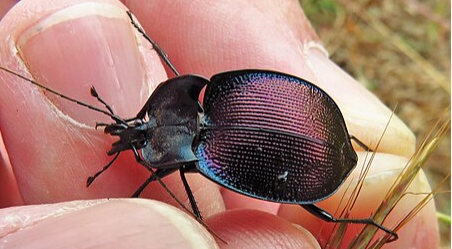
Andrew’s snail-eating beetle, Scaphinotus andrewsii, is a large, native ground beetle found primarily in the Appalachian region of the eastern United States. Its glossy black body may reflect shades of blue, violet, or purple, giving the beetle a jewel-like appearance when illuminated. Despite its impressive jaws and somewhat intimidating shape, it is harmless to people and is not considered a household, garden, or agricultural pest.
This beetle is a specialized predator of land snails and slugs. Its long, narrow head allows it to reach inside a snail’s shell, while its powerful mouthparts help it capture and consume its prey. Andrew’s snail-eating beetles contribute to forest food webs and may help limit populations of certain mollusks. They should normally be protected rather than controlled.
Taxonomy and Classification
- Kingdom: Animalia
- Phylum: Arthropoda
- Class: Insecta
- Order: Coleoptera
- Suborder: Adephaga
- Family: Carabidae
- Subfamily: Carabinae
- Tribe: Cychrini
- Genus: Scaphinotus
- Species: Scaphinotus andrewsii
The species was originally described by entomologist Thaddeus William Harris in 1839. It has previously appeared in scientific literature under several other combinations and names. A number of geographically separated subspecies have been described from different parts of the Appalachian region.
Identification
Adult Andrew’s snail-eating beetles generally measure approximately 18 to 25 millimeters long, or about 0.7 to 1 inch. They have a dark, elongated body with long legs, prominent jaws, and deeply textured wing covers. Depending on the individual and lighting, the black exoskeleton may show metallic blue, violet, or purple highlights.
- A glossy black or dark blue-purple body
- An elongated head with prominent mandibles
- A narrow, often heart-shaped pronotum behind the head
- Long legs adapted for running and searching through debris
- Strongly sculptured or ridged wing covers
- A total adult length approaching one inch
The beetle’s unusually long head and narrow front section are important feeding adaptations. They allow it to insert its head into the opening of a snail shell while keeping much of its body away from the snail’s sticky mucus.
Andrew’s snail-eating beetles can be difficult to distinguish from other members of Scaphinotus. Color alone is unreliable because several related species have black, blue, or purple bodies. Geographic location, pronotum shape, leg structure, wing-cover sculpture, and other small anatomical features may be needed for a confident identification.
Distribution
Scaphinotus andrewsii is native to North America and is most strongly associated with the middle and southern Appalachian Mountains. Records and described subspecies extend through portions of North Carolina, Tennessee, Virginia, West Virginia, Kentucky, Georgia, Ohio, and Pennsylvania.
Individual subspecies may have much smaller ranges within this broader distribution. Mountain ridges, valleys, river systems, and separated forest habitats can isolate flightless beetle populations. As a result, outwardly similar beetles found in neighboring regions may represent different subspecies or related Scaphinotus species.
Habitat
Andrew’s snail-eating beetles inhabit moist forests where snails and slugs are available. Suitable environments include hardwood and mixed forests, wooded ravines, mountain slopes, streamside areas, seepages, and shaded locations with deep leaf litter.
During the day, adults commonly shelter under fallen logs, loose bark, stones, moss, and decaying vegetation. They become active after dark and during damp weather. Some eastern snail-eating beetles also climb tree trunks at night while searching for prey.
Moisture is an important habitat feature because both the beetles and their mollusk prey are vulnerable to drying. Forest-floor cover moderates temperature, conserves humidity, and supplies protected spaces for hunting, resting, egg-laying, and overwintering.
Diet and Hunting Behavior
As its common name suggests, Andrew’s snail-eating beetle primarily hunts terrestrial snails. Slugs and other small invertebrates may also be consumed. It does not feed on wood, clothing, stored food, structural materials, or healthy garden plants.
The beetle searches through leaf litter and other moist locations after dark. When it encounters a snail, it uses its narrow head and strong jaws to reach the animal inside its shell. Long legs allow the beetle to position its body away from defensive slime while pursuing the snail.
This feeding behavior makes members of Scaphinotus highly specialized predators. Snail populations are influenced by many environmental factors, however, so one beetle should not be expected to eliminate every snail or slug from a garden or woodland.
Life Cycle
Andrew’s snail-eating beetles undergo complete metamorphosis, progressing through egg, larval, pupal, and adult stages. Detailed timing varies with elevation, weather, and location, but snail-eating ground beetles generally place their eggs beneath debris or in protected soil during late spring or early summer.
The larvae are elongated, active predators that live in soil or forest litter. They pass through several growth stages before forming pupae in protected earthen chambers. Adults emerge after pupal development and continue hunting on the forest floor.
Activity is greatest during mild, moist periods. Adults may be observed from spring through fall in southern portions of the range. Members of the genus can overwinter as larvae or adults beneath logs, bark, soil, stones, and accumulated leaves.
Are Andrew’s Snail-Eating Beetles Dangerous?
Andrew’s snail-eating beetles are not dangerous to humans or pets. They do not sting, transmit human diseases, infest houses, or damage belongings. Their large mandibles are designed for capturing prey. A beetle might pinch defensively if squeezed or handled roughly, but it does not seek out people or behave aggressively toward them.
An individual found in a basement, garage, or other building has usually wandered indoors accidentally. Indoor sightings do not indicate that the beetles are breeding inside the structure.
Ecological Importance
Andrew’s snail-eating beetles are beneficial forest predators. By consuming snails, slugs, and other small invertebrates, they participate in the natural regulation of forest-floor animal communities. The beetles are also potential food for birds, amphibians, reptiles, and small mammals.
Their dependence on moist forest habitat makes them sensitive to extensive drying, removal of ground cover, pesticide exposure, and habitat fragmentation. Because they are flightless, populations cannot rapidly leave disturbed sites or easily recolonize isolated forests.
Management and Conservation
No pest-control treatment is necessary for Andrew’s snail-eating beetles. When one is found outdoors, leave it undisturbed and allow it to continue hunting. Avoid collecting or relocating beetles, especially in mountain habitats where distinctive local populations may occur.
- Preserve some leaf litter, fallen wood, and natural ground cover.
- Avoid unnecessary broad-spectrum insecticide applications.
- Maintain shaded, moist areas where appropriate.
- Reduce unnecessary nighttime disturbance in woodland habitats.
- Do not remove every log, stone, or patch of moss from natural areas.
- Use slug-control products only when damage justifies treatment.
If a beetle enters a house, place a container over it, slide a piece of stiff paper underneath, and release it into a nearby shaded area with leaf litter. Reducing gaps beneath exterior doors and repairing damaged screens can help prevent additional accidental entry.
Andrew’s snail-eating beetles should not be purchased, collected, or transported as a biological control product. Moving organisms outside their natural ranges can spread diseases, disrupt local populations, and introduce the wrong species into an unsuitable habitat.
Conclusion
Andrew’s snail-eating beetle is a distinctive Appalachian ground beetle recognized by its dark iridescent body, long legs, narrow head, and powerful jaws. It is a nocturnal, flightless predator adapted to hunting snails and slugs in moist forest environments. Although its appearance may seem intimidating, it presents no meaningful threat to people, pets, plants, or buildings. Protecting forest litter, fallen wood, moisture, and other natural habitat features is the best way to conserve this unusual and beneficial native beetle.