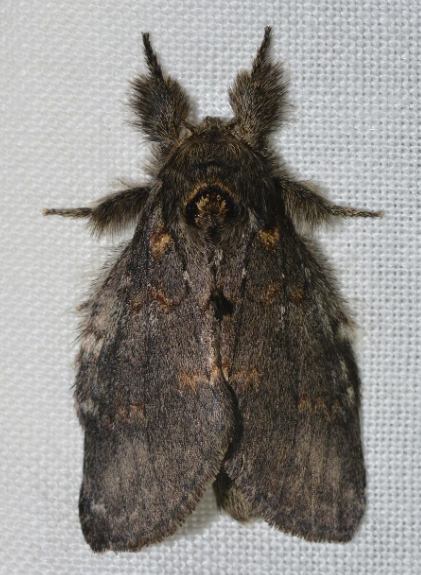
The Angulose Prominent Moth (Peridea angulosa) is a native North American moth associated with oak-dominated forests and wooded landscapes. Its caterpillars consume the leaves of several hardwood trees, but populations rarely become large enough to cause serious damage. In most situations, this moth should be viewed as part of the natural forest ecosystem rather than a significant pest.
Taxonomy and Classification
- Scientific name: Peridea angulosa
- Order: Lepidoptera
- Family: Notodontidae
- Subfamily: Phalerinae
- Common name: Angulose Prominent Moth
The Notodontidae are commonly called prominent moths because many species have tufts, projections, or unusual resting postures. The Angulose Prominent was first scientifically described by James Edward Smith in 1797.
Adult Identification
Adult Angulose Prominent Moths have a wingspan of approximately 35 to 45 millimeters. Their forewings are mottled with gray, brown, black, and cream markings that provide excellent camouflage against tree bark. Dark angular lines and patches give the moth its “angulose” name. The hindwings are generally lighter and less strongly patterned.
At rest, the moth holds its wings rooflike over its body. Its fuzzy thorax and patterned wings can make it resemble a piece of bark or lichen. Adults are nocturnal and may be attracted to exterior lights, illuminated windows, and moth-observation lights.
Caterpillar Identification
Mature caterpillars may reach approximately 45 millimeters long. Color varies from greenish or brown to reddish, particularly among some caterpillars active during fall. A distinctive pale spiracular stripe, often containing white and pink, runs along each side and continues toward the mandibles.
When disturbed, the caterpillar may coil its body and raise its head in a defensive, snakelike posture. This display can discourage small predators, although the caterpillar does not sting and is not considered dangerous to people.
Distribution and Habitat
The Angulose Prominent occurs across eastern North America. Its reported range extends from southern Canada through the eastern United States to Florida and westward to Texas. Typical habitats include deciduous forests, woodland borders, barrens, parks, and residential areas containing mature hardwood trees.
Host Trees and Feeding
Oaks in the genus Quercus are important larval hosts. Caterpillars have also been associated with American beech, American chestnut, hickories, and other trees in the beech and walnut families. They feed individually on foliage rather than forming large communal webs or tents.
Life Cycle and Behavior
Like other moths, the Angulose Prominent develops through egg, larval, pupal, and adult stages. Females place eggs on or near suitable host foliage. Caterpillars hatch and pass through several growth stages while eating leaves. Mature larvae eventually leave the tree and pupate in a protected location, commonly among soil or leaf litter.
Adults are generally observed from May through October, while mature caterpillars may be encountered from late spring into November. Two generations can occur during a year across much of the eastern range, although seasonal timing varies with latitude and weather.
Damage and Management
Individual caterpillars chew along leaf margins and may consume substantial portions of a leaf. However, scattered feeding normally has little effect on the health of an established tree. Control is rarely justified, and broad-spectrum insecticides could unnecessarily harm pollinators, predators, parasitoids, and other native moths.
If caterpillars are damaging a young ornamental tree, inspect the foliage and remove them by hand while wearing gloves. Maintain tree health through appropriate watering and mulching. Consider additional treatment only after confirming the species and documenting significant, continuing defoliation. Any pesticide used must be labeled for the host plant and target caterpillar.
Conclusion
The Angulose Prominent Moth is a well-camouflaged native woodland species whose caterpillars feed primarily on oaks and related hardwoods. Although minor leaf damage is possible, the moth seldom requires control and contributes to local food webs as prey for birds, predatory insects, and other wildlife.