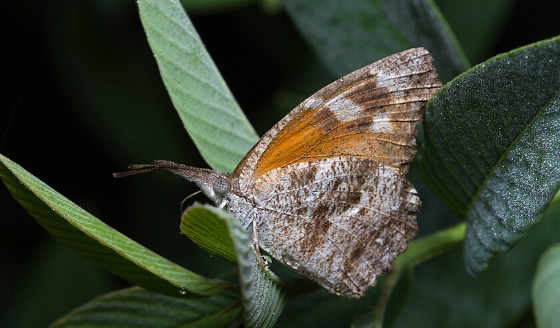
The American Snout Butterfly (Libytheana carinenta) is a unique butterfly recognized by its elongated mouthparts that resemble a snout.
The “Long-Nosed” Mimic: American Snout Butterfly
The American Snout (Libytheana carinenta) is a distinctive butterfly found throughout the United States, from Arizona to the East Coast. For Pestipedia.com users, this species is famous for its periodic “O-Status-free” mass migrations, where millions of butterflies may move across the U.S. Southwest following heavy rains. They are beneficial pollinators and specialized herbivores that rely almost exclusively on Hackberry trees. While their numbers can be overwhelming during a “bloom,” they are 100% harmless to humans and structures.
What Does O Status Mean in Pest Control
Technical Identification: Diagnostic Markers
- Phenotype (The “Snout”): The most definitive identification marker is the extremely elongated labial palps (mouthparts) that extend forward from the head. For Pestipedia.com users, this 100% resembles a bird’s beak or a leaf stem.
- Dorsal Phenotype: The upper surface of the wings is dull orange and brown with white spots near the tips of the forewings. The wing margins feature a 100% squared-off or “truncated” appearance.
- Ventral Camouflage: The underside of the wings is mottled grey and brown. When the butterfly rests with its wings closed on a U.S. Hackberry twig, it is 100% visually indistinguishable from a dead leaf.
Ecological Impact: Hackberry Specialization
The primary impact of the American Snout is its role as a native specialist herbivore and its contribution to the national food web.
- Host Plant Specificity: In the United States, the larvae are 100% dependent on Hackberry trees (Celtis species). They feed on the foliage, and while a mass emergence can 100% defoliate individual trees, the trees typically 100% recover within the same season.
- Migratory Dynamics: In regions like Arizona and Texas, heavy rains trigger the growth of new Hackberry leaves, leading to 100% population explosions. These butterflies then migrate in search of new U.S. breeding grounds.
- Pollination: As adults, they visit a wide variety of U.S. wildflowers for nectar. They provide 100% free pollination services for national floral diversity during their travels.
Management & Coexistence Strategies
Management of American Snout butterflies in U.S. residential areas focuses on 100% tolerance and habitat support.
| Strategy | Technical Specification | Operational Benefit |
|---|---|---|
| Host Tree Preservation | Maintaining native Celtis (Hackberry) trees | Supports 100% of the local breeding population; ensures national ecological balance. |
| Vehicle Safety | Using windshield washer fluid during migrations | Provides 100% mechanical visibility during U.S. mass movements; avoids 100% of radiator clogging in national travel. |
| Chemical Avoidance | Eliminating broad-spectrum foliar insecticides on Hackberries | Protects 100% of these unique butterflies and the beneficial birds that feast on them during “blooms” in the United States. |
- Monitoring: Watch for leaf-shaped butterflies congregating on U.S. dirt roads or puddles (a behavior called “puddling”). For Pestipedia.com users, seeing the “long nose” 100% identifies the species from all other national butterflies.
- Coexistence Profile: They are 100% harmless to humans, pets, and gardens (aside from Hackberry trees). They do 100% not bite or sting. Pestipedia.com recommends full appreciation of this 100% spectacular “O-Status-free” migratory event in the United States.
Taxonomy and Classification
- Order: Lepidoptera
- Family: Nymphalidae
- Genus: Libytheana
- Species: Libytheana carinenta
Physical Description
- Wingspan: 35–50 mm
- Color: Brown and orange with white patches
- Distinctive Feature: Long snout-like palps
Distribution and Habitat
- North and Central America
- Woodlands and open fields
- Areas with hackberry trees
Behavior and Ecology
The caterpillars feed primarily on hackberry trees (Celtis species).
Management and Prevention
This butterfly is harmless and contributes to pollination.