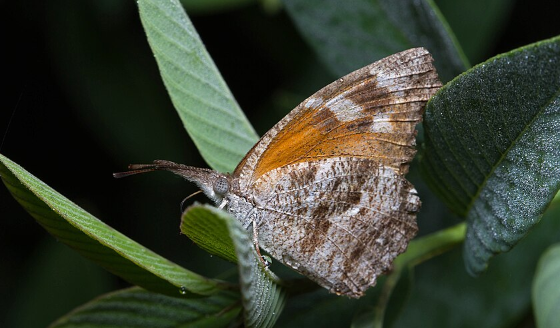
The American snout butterfly (Libytheana carinenta) is a distinctive North and South American butterfly named for the elongated mouthparts projecting from the front of its head. These structures resemble a long nose or beak, giving the butterfly an appearance unlike that of most other species found in the United States.
American snouts are closely associated with hackberry and sugarberry trees, which provide food for their caterpillars. Adults occur in woodlands, parks, gardens, and urban landscapes containing these host trees. In some years, enormous numbers migrate through Texas and neighboring regions, producing one of North America’s most dramatic butterfly events.
Taxonomy and Classification
- Scientific name: Libytheana carinenta
- Common names: American snout and common snout butterfly
- Order: Lepidoptera
- Family: Nymphalidae
- Subfamily: Libytheinae
- Genus: Libytheana
Snout butterflies were previously placed in a separate family called Libytheidae. Modern classifications generally treat them as the subfamily Libytheinae within Nymphalidae, the brush-footed butterfly family. Like other brush-footed butterflies, adults have a reduced front pair of legs that can be difficult to see.
Identification
Adult Butterfly
The most recognizable feature is the pair of unusually long labial palps extending forward from the head. These sensory mouthparts form the apparent “snout.” They should not be confused with the butterfly’s proboscis, which is the flexible feeding tube used to drink nectar and other liquids.
Adults have a wingspan of approximately 1.4 to 2 inches. The upper wings are dark brown to nearly black with orange patches near the bases and inner portions of the wings. Several white spots cross the outer half of each forewing. The forewing tips have a squared or slightly hooked shape.
The undersides of the hindwings are mottled gray, violet-gray, or brown. When an American snout closes its wings and rests against a twig, the mottled wings resemble a dead leaf. The extended palps and antennae imitate the leaf’s stem, helping conceal the butterfly from predators.
Eggs, Caterpillars, and Pupae
Eggs are small, pale yellow, and marked with vertical ridges. Females place them singly or in small groups near young hackberry leaves, shoots, or leaf axils.
Mature caterpillars grow to approximately 1 inch long. They are predominantly green with small yellow dots and narrow yellowish lines along the back and sides. The first two thoracic segments are enlarged, giving the larva a slightly humpbacked profile. Unlike hackberry emperor and tawny emperor caterpillars, American snout larvae lack conspicuous horns on the head.
The chrysalis is green and marked with small white dots and pale lines. It hangs vertically from a silk pad by a hooklike structure at the rear. Its color and angular outline help it blend with foliage.
Distribution and Habitat
The American snout has an extensive range stretching from Argentina through Central America and Mexico into the United States. Within the United States, it occurs from southern and central California eastward through much of the South, Midwest, and East. It may appear farther north as a seasonal migrant or temporary colonist.
Common habitats include woodland openings, stream corridors, roadsides, parks, suburban neighborhoods, and gardens where hackberry trees grow. Adults may be seen basking on branches, visiting flowers, resting on bare ground, or gathering around damp soil.
Resident populations are most dependable in warmer portions of the range. Adults can survive winter in southern regions and move north as conditions become favorable during spring and summer.
Life Cycle and Behavior
The American snout undergoes complete metamorphosis through egg, caterpillar, chrysalis, and adult stages. After hatching, a caterpillar feeds primarily on tender young hackberry foliage. Its green coloration makes it difficult to distinguish from partially opened leaves.
When fully grown, the caterpillar forms a hanging chrysalis. The adult emerges after completing its transformation, expands its wings, and begins searching for food and mates. Males frequently patrol around hackberry host trees while looking for females.
There are generally two generations per year through much of the species’ U.S. range. Florida and other warm areas may support three or more generations. Seasonal timing varies with temperature, rainfall, latitude, and the availability of new hackberry growth.
Adults feed on nectar from numerous flowers and may show a preference for yellow or white blossoms. They also visit damp soil to absorb water and dissolved minerals, a behavior known as puddling. Several butterflies may gather closely together at mud, stream edges, or wet pavement.
American Snout Migrations
American snouts are famous for occasional mass movements, particularly in Texas and northern Mexico. During exceptional population years, countless butterflies may travel together across roads, fields, towns, and open countryside. Smaller migrations can occur elsewhere in the southern and central United States.
These events are irregular rather than annual. They are associated with weather patterns that produce abundant new growth on hackberry host plants and allow unusually large numbers of caterpillars to survive. Drought followed by substantial rainfall may create favorable conditions by stimulating fresh foliage and altering pressure from parasites and other natural enemies.
A migrating swarm is not an infestation requiring treatment. The butterflies do not attack people, buildings, vehicles, crops, or stored food. They normally continue moving as weather and food availability change.
Host Plants
American snout caterpillars feed on trees in the genus Celtis. Important host plants include common hackberry, Celtis occidentalis, and sugarberry, Celtis laevigata. Spiny hackberry is especially important to populations in portions of Texas and Mexico.
Hackberries are valuable wildlife trees. Their fruit feeds birds and mammals, while their leaves support American snouts, hackberry emperors, tawny emperors, question mark butterflies, and other caterpillars. The presence of chewed leaves does not necessarily indicate a serious tree problem.
Damage and Pest Status
American snout butterflies are not considered household, agricultural, or structural pests. Adults do not bite, sting, or damage plants while feeding. Caterpillars consume hackberry leaves, but ordinary populations generally cause minor and temporary injury that healthy trees can tolerate.
Even during a population increase, caterpillar feeding is usually concentrated on naturally occurring host trees. Chemical control is rarely justified. Spraying hackberries can kill American snout larvae along with hackberry emperors, predatory insects, and other beneficial organisms.
Conservation and Garden Management
Gardeners can attract American snouts by preserving native hackberries or planting a regionally appropriate Celtis species. Before planting, consider the tree’s mature size, root space, soil requirements, and distance from structures. Hackberries are adaptable, but a large species needs adequate room to develop.
- Retain healthy hackberry and sugarberry trees where practical.
- Grow native nectar plants with overlapping bloom periods.
- Provide shallow, damp soil where butterflies can obtain minerals.
- Avoid routine broad-spectrum pesticide applications.
- Do not apply caterpillar treatments until the species has been identified.
- Leave some fallen leaves and natural shelter in low-use garden areas.
- Protect flowering plants from pesticide drift.
Products containing Bacillus thuringiensis subspecies kurstaki, commonly called Bt, are sometimes marketed as selective caterpillar controls. Although useful against certain pests, Bt can also kill American snout caterpillars that consume treated foliage. It should not be applied to host plants simply because butterfly larvae are present.
Conclusion
The American snout butterfly is easily recognized by its elongated palps, orange-and-white wing markings, and dead-leaf camouflage. Its caterpillars depend on hackberry trees, while adults use nectar, moisture, and minerals from a variety of sources. Although mass migrations may create an extraordinary spectacle, the species is harmless and normally requires no control. Protecting host trees and reducing unnecessary pesticide use are the best ways to support this unusual native butterfly.