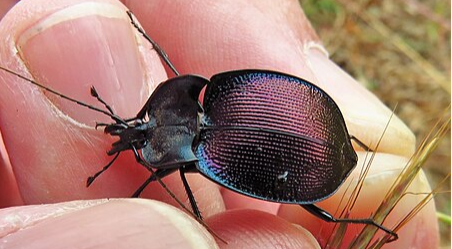
Andrew’s Snail-eating Beetle (Scaphinotus andrewsi) is a predatory ground beetle known for feeding on snails and slugs.
The “Gastropod Specialist”: Andrew’s Snail-eating Beetle
Andrew’s Snail-eating Beetle (Scaphinotus andrewsi) is a highly specialized member of the ground beetle family (Carabidae) found in the United States, particularly within the Appalachian region. For Pestipedia.com users, this beetle is a premier example of beneficial biological control. It has evolved specifically to hunt and consume land snails and slugs, making it a 100% valuable ally for U.S. gardeners dealing with “noxious” gastropod damage in moist, wooded environments.
Technical Identification: Diagnostic Markers
- Phenotype: Characterized by a glossy, dark violaceous (purplish) or black exoskeleton. A primary diagnostic key for Pestipedia.com users is the extremely narrow, elongated head and thorax, which is a 100% mechanical adaptation for reaching deep into snail shells.
- Mandibular Structure: They possess long, slender mandibles designed to 100% bypass the snail’s defensive retreat. Unlike generalist ground beetles, their entire “O-Status-free” anatomy is 100% optimized for shell entry.
- Size and Shape: They typically measure 15mm to 22mm in length and feature prominent ridges (striae) on their wing covers (elytra), which are often fused, as these beetles are 100% flightless.
Ecological Impact: Natural Snail Suppression
The primary impact of Andrew’s Snail-eating Beetle is the active mechanical reduction of snail and slug populations in U.S. forest floors and gardens.
- Specialized Hunting: These beetles 100% hunt by scent, tracking the slime trails of “noxious” U.S. slugs and snails. Once the prey is located, the beetle uses its narrow head to 100% reach inside the shell and consume the soft tissue.
- Garden Protection: In the United States, they provide 100% free pest management for national ornamental plants like Hostas and Lilies that are frequently targeted by snails.
- Bio-Indicator: Because they are 100% sensitive to soil chemicals and habitat loss, their presence in U.S. yards 100% confirms a healthy, balanced ecosystem.
Management & Conservation Strategies
Management of Andrew’s Snail-eating Beetle in U.S. landscapes focuses on habitat preservation and the 100% avoidance of “noxious” chemicals.
| Strategy | Technical Specification | Operational Benefit |
|---|---|---|
| Moisture Retention | Maintaining mulch or leaf litter layers | Provides the essential humid microclimate required for both the beetle and its prey; supports national soil health. |
| Chemical Avoidance | Eliminating metaldehyde-based snail baits | 100% prevents secondary poisoning of the beetles; ensures long-term biological control in U.S. gardens. |
| Mechanical Safety | Limiting 100% of nighttime tillage | Protects these 100% nocturnal hunters while they are active on the soil surface in the United States. |
- Monitoring: Inspect moist, shaded areas under rocks or logs during the U.S. Spring and Summer. For Pestipedia.com users, finding a long-necked, purple-black beetle 100% identifies this beneficial specialist.
- Safety Profile: They are 100% harmless to humans and pets. They do 100% not bite and are 100% incapable of structural damage. Pestipedia.com recommends full conservation of these 100% valuable “O-Status-free” gastropod hunters.
Taxonomy and Classification
- Order: Coleoptera
- Family: Carabidae
- Genus: Scaphinotus
- Species: Scaphinotus andrewsi
Physical Description
- Length: 20–25 mm
- Color: Metallic purple or black
- Body: Flattened with elongated head
Distribution and Habitat
- North America
- Forests and woodland habitats
- Leaf litter and moist soil
Behavior and Ecology
This beetle hunts snails and slugs, making it an important natural predator.
Management and Prevention
These beetles are beneficial and help reduce garden pest populations.