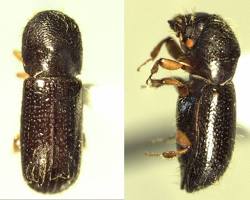
Xyleborus Beetles (Xyleborus spp.) are a group of highly destructive Ambrosia Beetles belonging to the weevil family. These tiny wood-boring beetles are serious invasive pests in forests, orchards, nurseries, and ornamental landscapes worldwide. Unlike many wood-boring insects that feed directly on wood, Xyleborus Beetles cultivate a specialized symbiotic fungus called ambrosia fungus, which serves as their primary food source. The beetles tunnel deep into sapwood and introduce fungal spores into the galleries they create. In many cases, the fungus—not the tunneling itself—is responsible for severe tree decline or death.
These beetles are especially problematic in stressed, drought-damaged, transplanted, or wounded trees. Orchard crops such as pecan, avocado, peach, and fruit trees are vulnerable, along with ornamental maples, oaks, and numerous hardwood species. Because infestations often develop rapidly and remain hidden beneath bark, Xyleborus Beetles can kill trees before visible symptoms become obvious.
Many species within the genus have become important invasive pests outside their native ranges. Their spread through international wood products, pallets, nursery stock, and firewood has created significant economic and ecological concerns in forests and agricultural systems worldwide.
Quick Facts
- Scientific Name: Xyleborus spp.
- Common Group: Ambrosia Beetles
- Order: Coleoptera
- Family: Curculionidae
- Main Conflict: Tree decline and death
- Habitat: Orchards, forests, nurseries, ornamental trees
- Diet: Symbiotic ambrosia fungus
- Status: Major invasive tree pests
Taxonomy and Classification
Xyleborus Beetles belong to the order Coleoptera and the family Curculionidae, commonly known as weevils. More specifically, they belong to the bark and ambrosia beetle subfamily Scolytinae.
The genus Xyleborus is one of the largest ambrosia beetle groups in the world, containing hundreds of species. Many species are highly invasive and capable of rapidly colonizing new geographic regions.
These beetles undergo complete metamorphosis consisting of:
- Egg
- Larva
- Pupa
- Adult
Unlike many beetles, Xyleborus species depend entirely on fungal cultivation for survival. Female beetles carry fungal spores inside specialized structures called mycangia, introducing the fungus into newly excavated tunnels.
Physical Description
Adult Xyleborus Beetles are extremely small, usually measuring only 1–3 mm long. Despite their tiny size, they can cause severe damage to large trees.
Adult Appearance
- Small cylindrical body shape
- Reddish-brown to black coloration
- Hard wing covers
- Compact, rounded body
- Females larger and more active than males
Females are responsible for locating host trees and initiating new galleries. In many species, males are flightless and remain within the original host tree.
Larvae
Larvae are:
- White or cream-colored
- Legless
- C-shaped
- Dependent on ambrosia fungus for food
Rather than feeding on wood directly, larvae consume the cultivated fungal growth lining the tunnel walls.
Damage Identification
The most recognizable signs of infestation include:
- Tiny entrance holes in bark
- Distinctive “toothpick” frass tubes
- Sawdust strings protruding from trunks
- Wet or stained sapwood
- Branch dieback
- Wilting foliage
- Rapid tree decline
The fragile toothpick-like frass structures are often the first visible sign of active infestation.
Distribution and Habitat
Xyleborus Beetles are distributed worldwide across tropical, subtropical, and temperate regions. Many invasive species have spread far beyond their native habitats through international trade and wood transportation.
Common habitats include:
- Forests
- Nurseries
- Fruit orchards
- Urban landscapes
- Woodlots
- Recently transplanted trees
They strongly prefer:
- Stressed trees
- Drought-damaged trees
- Flood-injured trees
- Freshly wounded trees
- Recently transplanted nursery stock
Nurseries are especially vulnerable because transplant stress makes trees highly attractive to invading females.
Behavior and Damage
The primary conflict associated with Xyleborus Beetles is their introduction of ambrosia fungi into healthy vascular tissues.
Tunnel Excavation
Females bore directly through bark into sapwood where they create intricate tunnel systems called galleries.
Inside the galleries, females inoculate the tunnel walls with fungal spores carried in their bodies. The fungus grows rapidly and becomes the food source for both adults and larvae.
Fungal Disease
The ambrosia fungi associated with Xyleborus Beetles may:
- Block xylem vessels
- Disrupt water movement
- Trigger wilt diseases
- Cause branch dieback
- Kill entire trees
Some species transmit highly destructive fungal pathogens such as Raffaelea lauricola, the cause of Laurel Wilt Disease.
Rapid Tree Decline
Once fungal colonization begins, symptoms can progress quickly:
- Leaf wilting
- Canopy thinning
- Branch death
- Sudden collapse
- Tree mortality
In some infestations, trees may die within weeks or months after attack.
Agricultural and Nursery Damage
High-value crops commonly affected include:
- Avocado
- Pecan
- Peach
- Maple
- Oak
- Fruit trees
- Nursery ornamentals
The beetles are especially damaging in commercial nursery systems where stressed transplanted trees are concentrated together.
Life Cycle
Egg Stage
Females lay eggs directly inside fungal-lined galleries.
Larval Stage
Larvae remain entirely inside the wood galleries while feeding on cultivated fungus.
Pupal Stage
Pupation occurs within protected chambers inside the tunnel system.
Adult Emergence
New adult females emerge and disperse to locate additional stressed host trees.
Many species produce overlapping generations throughout warm seasons.
Management and Prevention
Management focuses primarily on prevention, tree health, and sanitation.
Tree Health Management
Healthy trees are far less attractive to Xyleborus Beetles.
- Prevent drought stress
- Avoid overwatering
- Reduce root injury
- Protect trunks from damage
- Minimize transplant shock
Stress reduction is the most important preventive strategy.
Monitoring
Monitoring methods include:
- Ethanol-baited traps
- Visual bark inspection
- Checking for frass toothpicks
- Monitoring wilting symptoms
Ethanol released by stressed trees strongly attracts many ambrosia beetles.
Chemical Protection
Residual insecticide sprays may be applied to:
- Lower trunks
- Major branches
- Recently transplanted trees
Preventive applications are most effective during spring flight periods before beetles penetrate the bark.
Sanitation
Infested wood should be:
- Removed promptly
- Destroyed or chipped
- Kept away from healthy trees
Removing breeding material helps reduce future beetle populations.
Interesting Facts About Xyleborus Beetles
- They farm fungus inside wood tunnels.
- Females transport fungal spores in specialized body structures.
- Many species are invasive pests worldwide.
- Some species can kill mature trees rapidly.
- They are attracted to ethanol emitted by stressed trees.
Conservation and Research
Research on Xyleborus Beetles focuses heavily on invasive species management, fungal pathogens, and chemical ecology. Scientists continue studying:
- Beetle pheromones
- Attractant compounds
- Fungal symbiosis
- Early detection systems
- Biological controls
- Host resistance mechanisms
Researchers are also investigating how climate stress, drought, and global trade contribute to increasing ambrosia beetle outbreaks worldwide.