Overview
Urophora Fruit Flies (Urophora spp.) are small tephritid flies that play an important role in the biological control of invasive weeds. Unlike the fruit flies commonly associated with kitchens and ripening fruit, Urophora species are highly specialized insects that target specific plants, particularly invasive knapweeds in the genus Centaurea. Their larvae develop inside flower heads, where they feed on developing seeds and induce the formation of protective galls.
Native to Eurasia, several Urophora species have been intentionally introduced into North America and other regions to help suppress invasive weeds such as Spotted Knapweed (Centaurea stoebe) and Diffuse Knapweed (Centaurea diffusa). These invasive plants can dominate grasslands, rangelands, roadsides, and natural habitats, displacing native vegetation and reducing forage production.
Because Urophora Fruit Flies attack the reproductive structures of knapweed plants, they reduce seed production and limit the spread of infestations. Although they rarely eliminate invasive weeds entirely, they are considered valuable biological control agents that contribute to long-term weed management programs.
Their highly specialized feeding habits and minimal impact on non-target plants have made Urophora Fruit Flies one of the most studied and widely used weed biocontrol insects in North America.
Taxonomy and Classification
- Kingdom: Animalia
- Phylum: Arthropoda
- Class: Insecta
- Order: Diptera
- Family: Tephritidae
- Genus: Urophora
Urophora Fruit Flies belong to the family Tephritidae, commonly known as true fruit flies. Unlike household fruit flies, many tephritid species are associated with specific host plants and have complex ecological relationships with flowers, fruits, stems, or seed heads.
Several species have been used in biological control programs, including Urophora affinis and Urophora quadrifasciata, both of which attack invasive knapweed species.
Physical Description
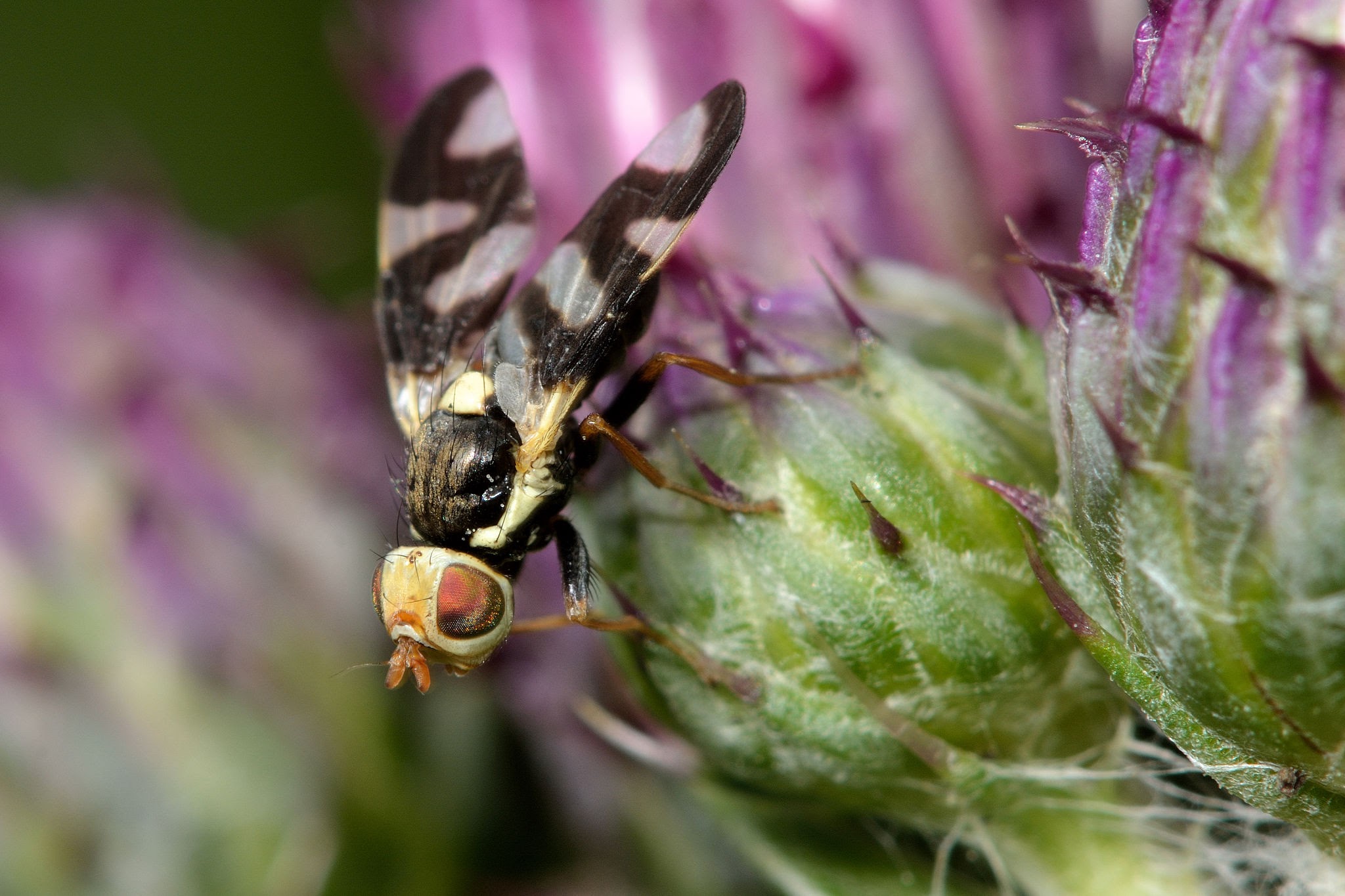
Adult Urophora Fruit Flies are small insects measuring approximately 3 to 5 millimeters in length. Although small, they are often attractive and distinctive due to their patterned wings.
- Adult Appearance: Small, dark-bodied fly with transparent wings.
- Wing Markings: Complex brown, black, or metallic banding patterns.
- Behavior: Adults frequently display ritualized wing-waving movements.
- Larva: Cream-colored maggot that develops within knapweed seed heads.
- Gall Formation: Larval feeding stimulates the formation of woody galls.
The patterned wings serve as one of the easiest ways to identify adult Urophora flies in the field.
Distribution and Habitat
Urophora Fruit Flies are native to Europe and Asia, where they evolved alongside their knapweed hosts. Due to their effectiveness as biological control agents, they have been introduced to parts of North America, including the United States and Canada.
They are most commonly found in habitats where invasive knapweed populations occur, including:
- Grasslands
- Rangelands
- Pastures
- Roadsides
- Disturbed habitats
- Open fields
- Conservation areas
- Prairies
Because their life cycle is tightly linked to knapweed plants, they are rarely found far from suitable host populations.
Life Cycle
Urophora Fruit Flies undergo complete metamorphosis with four distinct life stages:
- Egg
- Larva
- Pupa
- Adult
Adult females lay eggs directly into developing knapweed flower heads. After hatching, the larvae feed on developing seeds and surrounding plant tissues.
As the larva feeds, the plant responds by forming a hard, woody gall around it. This gall serves as both food source and protection, shielding the developing larva from predators, parasites, and environmental stress.
Larvae remain within the gall throughout development and eventually pupate inside the seed head. Adults emerge during the growing season and begin searching for suitable host plants where they can reproduce.
Behavior and Ecological Role
Unlike many agricultural pests, Urophora Fruit Flies are intentionally utilized as beneficial insects. Their primary ecological role in introduced regions is the suppression of invasive knapweed populations.
Their feeding behavior directly impacts plant reproduction by:
- Destroying developing seeds.
- Reducing viable seed production.
- Diverting plant resources into gall formation.
- Lowering the spread rate of invasive weeds.
Because knapweed species rely heavily on seed production for expansion, even moderate reductions in seed output can contribute significantly to long-term population suppression.
Impact on Invasive Weeds
Spotted Knapweed and Diffuse Knapweed are among the most problematic invasive weeds in many regions of North America. These plants can form dense stands that crowd out native vegetation and reduce biodiversity.
Negative impacts of knapweed infestations include:
- Loss of native plant diversity.
- Reduced wildlife habitat quality.
- Lower forage production for livestock.
- Increased soil erosion.
- Altered ecosystem processes.
Urophora Fruit Flies help address these issues by targeting seed production rather than directly killing plants. Over time, this reduces the ability of knapweed populations to expand into new areas.
Biological Control Programs
Biological control programs involving Urophora Fruit Flies have been implemented throughout numerous regions affected by invasive knapweed.
Before release, extensive testing was conducted to ensure that the flies would remain highly host-specific and would not attack native plants, crops, or ornamental species.
Their success is largely attributed to:
- Strong host specificity.
- Reliable establishment in suitable habitats.
- Effective reduction of seed production.
- Compatibility with other biological control agents.
Although they do not eradicate knapweed populations, they provide ongoing suppression with minimal environmental impact.
Management and Conservation
Because Urophora Fruit Flies are beneficial insects, management efforts focus on conserving and supporting their populations.
Protection
- Avoid broad-spectrum insecticide applications in biological control areas.
- Preserve established knapweed biocontrol sites.
- Monitor fly populations regularly.
- Support integrated weed management strategies.
Augmentation
In some programs, seed heads containing developing larvae are collected and redistributed to newly invaded areas. This process helps establish fly populations more rapidly and expand biological control efforts.
Research and Future Applications
Researchers continue studying Urophora Fruit Flies to better understand their long-term effectiveness and interactions with other biological control organisms. Current research focuses on:
- Gall formation biology.
- Host-plant interactions.
- Population dynamics.
- Climate adaptation.
- Combined biological control programs.
Scientists are particularly interested in how multiple biological control agents can work together to achieve more effective suppression of invasive knapweed populations.
Conclusion
Urophora Fruit Flies are highly specialized tephritid flies that serve as important biological control agents for invasive knapweed species. By developing inside seed heads and inducing gall formation, they reduce seed production and help limit the spread of troublesome weeds.
Although they do not eliminate knapweed infestations entirely, they contribute significantly to long-term weed management and ecological restoration efforts. Their host specificity, environmental safety, and effectiveness make them one of the most successful examples of biological weed control in modern integrated pest management programs.