Overview
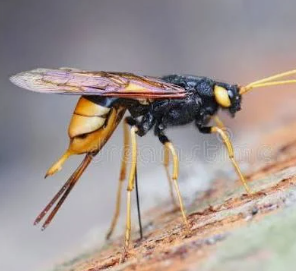
Urocerus Horntails are large wood-boring insects belonging to the family Siricidae, commonly known as wood wasps or horntails. Despite their intimidating appearance and resemblance to giant stinging wasps, these insects are harmless to humans and cannot sting. Their name comes from the horn-like projection found at the end of the abdomen, a distinctive feature shared by many members of the Siricidae family.
Urocerus species are primarily associated with coniferous forests and are commonly found infesting pine, spruce, fir, and other softwood trees. While they are considered important decomposers in natural ecosystems, they can become significant forestry pests when populations increase in commercial timber stands. Their larvae tunnel deep into wood, reducing lumber quality and creating pathways for fungal decay.
These insects are often regarded as secondary pests because they usually attack weakened, stressed, storm-damaged, or recently felled trees rather than healthy specimens. However, their association with wood-decaying fungi can accelerate tree decline and reduce the economic value of harvested timber.
Taxonomy and Classification
Urocerus Horntails belong to the order Hymenoptera, which also includes bees, ants, and wasps. Unlike many familiar wasps, horntails belong to the suborder Symphyta and lack the narrow “waist” found in most stinging wasps.
- Kingdom: Animalia
- Phylum: Arthropoda
- Class: Insecta
- Order: Hymenoptera
- Suborder: Symphyta
- Family: Siricidae
- Genus: Urocerus
Several species occur throughout North America and Eurasia, with the Blue Horntail (Urocerus cyaneus) being among the most recognizable.
Identification
Adult Urocerus Horntails are among the largest wood-associated insects found in North America.
- Length: Typically 20–40 mm.
- Body Shape: Cylindrical and robust.
- Color: Metallic blue-black, black, or dark brown, often with yellow or orange markings.
- Horn: Distinct horn-like projection at the end of the abdomen.
- Wings: Clear to smoky with strong venation.
- Antennae: Long and thread-like.
Females possess a long ovipositor that resembles a stinger but is actually used for drilling into wood to lay eggs. Males lack this structure but still possess the characteristic terminal horn.
Larvae are creamy-white, legless grubs that spend their entire developmental period hidden inside wood.
Distribution and Habitat
Urocerus Horntails occur throughout much of North America, Europe, and Asia. They are especially common in coniferous forests where suitable host trees are abundant.
Typical habitats include:
- Pine forests
- Spruce stands
- Fir forests
- Recently logged areas
- Lumber storage yards
- Storm-damaged woodlots
- Burned forest areas
Most infestations occur in weakened or recently killed trees, though stressed living trees may occasionally be attacked.
Life Cycle
The life cycle of Urocerus Horntails is unusually long and closely tied to both wood and symbiotic fungi.
Egg Stage
Females use their powerful ovipositors to drill into wood and deposit eggs beneath the bark. During this process, they also inject fungal spores and specialized mucus.
Larval Stage
After hatching, larvae tunnel deep into the wood. The injected fungus helps break down wood fibers, making nutrients more accessible for larval development.
Larvae may spend one to three years feeding within the tree depending on:
- Species
- Wood moisture content
- Temperature
- Host quality
Pupal Stage
Mature larvae construct pupal chambers within the wood where transformation occurs.
Adult Stage
Adults emerge through perfectly round exit holes and live only a few weeks. Their primary purpose is reproduction.
Behavior and Ecology
Urocerus Horntails play a valuable ecological role by helping recycle dead and dying wood in forest ecosystems.
Their tunneling activity:
- Accelerates decomposition
- Recycles nutrients
- Creates habitat for other organisms
- Supports forest succession processes
Their relationship with wood-decaying fungi is one of the most fascinating aspects of their biology. The fungi essentially prepare the wood for larval feeding while benefiting from transportation to new host trees.
Damage and Economic Importance
Although beneficial in natural ecosystems, Urocerus Horntails can create significant economic concerns in forestry operations.
Wood Tunneling
Larvae create deep galleries that weaken wood structure and reduce timber quality.
Fungal Introduction
The fungi introduced during egg laying can cause:
- Wood discoloration
- Accelerated decay
- Reduced lumber value
- Structural weakening
Finished Wood Infestations
One unusual problem occurs when larvae survive inside harvested lumber. Adults may emerge months or years later from:
- Furniture
- Cabinets
- Flooring
- Wood beams
- Decorative wood products
Although startling, these emerging adults do not reinfest seasoned lumber.
Signs of Infestation
Common indicators include:
- Perfectly round exit holes
- Fine sawdust-like frass
- Internal galleries
- Tree decline
- Adult wood wasps near weakened trees
- Fungal staining of wood
Because most of their activity occurs inside wood, infestations often remain unnoticed until adults emerge.
Management and Control (IPM)
Integrated Pest Management focuses primarily on prevention and forest health.
Maintain Tree Health
- Reduce drought stress.
- Prevent mechanical injuries.
- Improve growing conditions.
- Avoid overcrowding.
Sanitation
- Remove severely weakened trees.
- Dispose of infested logs promptly.
- Reduce breeding sites.
Kiln Drying
Commercial kiln drying effectively eliminates larvae hidden within lumber.
Biological Control
Natural enemies include:
- Parasitic wasps
- Woodpeckers
- Predatory beetles
- Entomopathogenic fungi
Giant Ichneumon Wasps (Megarhyssa spp.) are particularly important natural enemies and can locate larvae deep within wood.
Conclusion
Urocerus Horntails are impressive wood-boring insects that play an important role in forest ecosystems while also presenting challenges for forestry and timber industries. Their long life cycle, association with wood-decaying fungi, and ability to remain hidden inside wood make them unique among forest insects.
Although they may appear threatening, they are harmless to humans and should not be confused with stinging wasps. Proper forest management, sanitation, timber processing, and monitoring remain the most effective ways to minimize economic losses while maintaining healthy forest ecosystems.