Overview
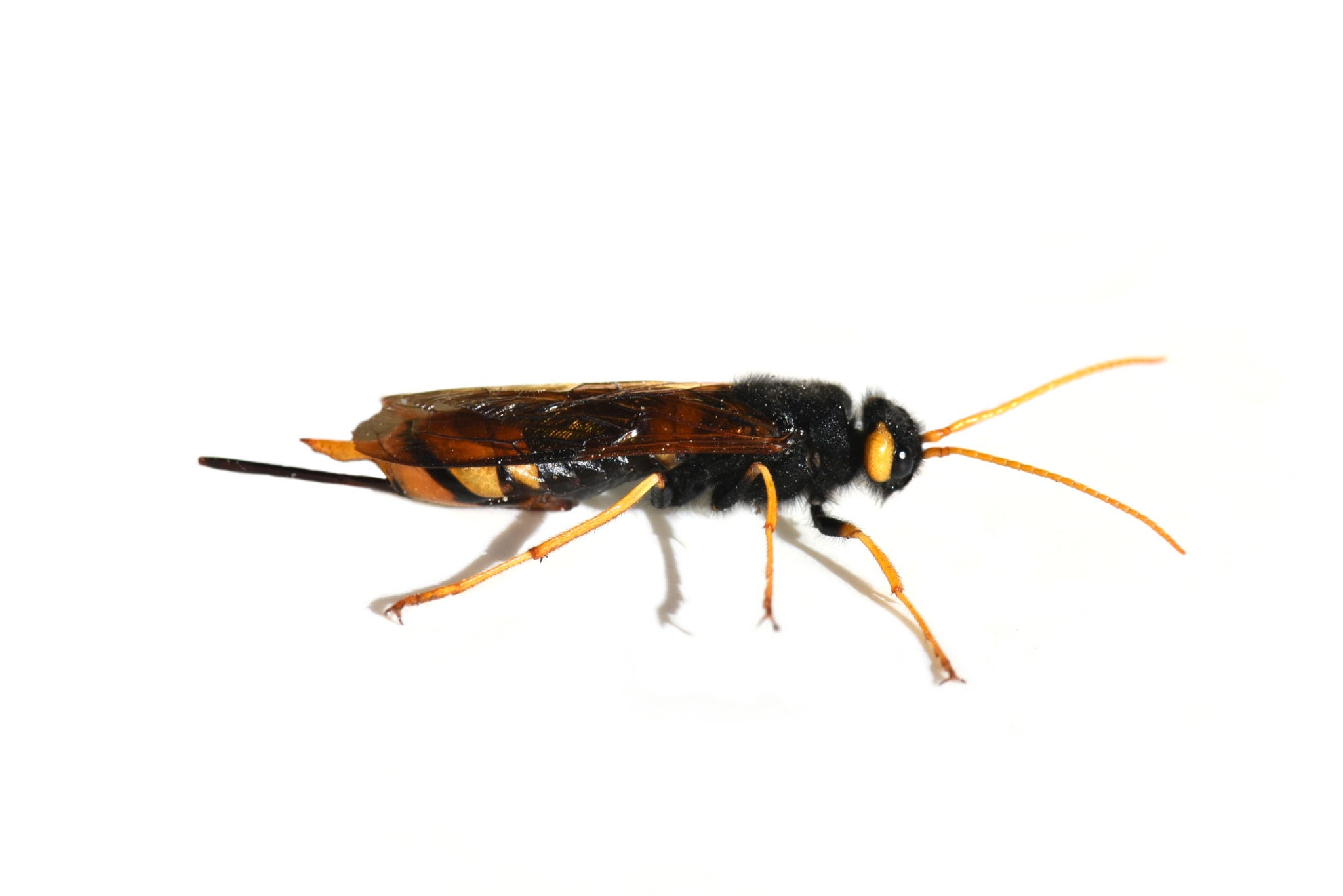
Urocerid Wood Wasps, commonly known as Horntails, are large wood-boring insects belonging to the family Siricidae. Despite their intimidating appearance and resemblance to stinging wasps, these insects are harmless to humans and cannot sting. Their common name comes from the horn-like projection found at the end of the abdomen.
Urocerid Wood Wasps are closely associated with coniferous forests and are commonly found infesting pine, spruce, fir, cedar, and other woody plants. Their larvae develop deep inside wood, where they tunnel for months or even years before emerging as adults. Because of their association with timber and forest products, these insects are important pests in forestry operations and lumber production.
In addition to physical tunneling damage, female wood wasps introduce symbiotic fungi into trees during egg laying. These fungi help break down wood tissue and provide food for developing larvae but can also accelerate wood deterioration and reduce timber quality.
Taxonomy and Classification
Urocerid Wood Wasps belong to the order Hymenoptera, the same order that includes bees, ants, and true wasps.
- Kingdom: Animalia
- Phylum: Arthropoda
- Class: Insecta
- Order: Hymenoptera
- Suborder: Symphyta
- Family: Siricidae
Unlike many familiar wasps, members of the suborder Symphyta lack the narrow “wasp waist” that separates the thorax and abdomen. This gives horntails their distinctive cylindrical appearance.
Identification
Adult Urocerid Wood Wasps are among the largest wood-boring insects found in North America.
- Length: Typically 20–40 mm, though some species exceed 50 mm.
- Body Shape: Long, cylindrical, and robust.
- Coloration: Black, brown, blue-black, yellow, orange, or metallic depending on species.
- Horn: Distinct spine-like projection at the end of the abdomen.
- Wings: Clear to smoky with strong venation.
- Antennae: Long and thread-like.
Females possess an impressive ovipositor that may extend beyond the body length. This structure is used to drill into wood for egg deposition and should not be mistaken for a stinger.
Larvae are creamy-white, legless grubs with a dark head capsule and a small spine at the end of the abdomen.
Distribution and Habitat
Urocerid Wood Wasps are distributed throughout North America, Europe, Asia, and other forested regions worldwide.
They are commonly found in:
- Coniferous forests
- Pine plantations
- Mixed woodlands
- Lumber yards
- Sawmills
- Stored logs
- Wood processing facilities
Most species prefer weakened, damaged, dying, or recently dead trees, although some invasive species can attack living trees under stress.
Life Cycle
The life cycle of Urocerid Wood Wasps is relatively long compared to many insects.
Egg Stage
Females use their powerful ovipositors to drill into wood and deposit eggs beneath the bark.
During this process, they also inject:
- Symbiotic fungal spores
- Toxic mucus secretions
The fungus begins colonizing the wood and helps prepare it for larval feeding.
Larval Stage
After hatching, larvae tunnel deep into the sapwood and heartwood.
Larval development may last from one to three years depending on:
- Species
- Wood condition
- Temperature
- Moisture levels
During this time, larvae create extensive galleries while feeding on fungus-conditioned wood.
Pupal Stage
Mature larvae construct pupal chambers within the wood where transformation occurs.
Adult Stage
Adults emerge through perfectly round exit holes and typically live only a few weeks. Their primary purpose is reproduction.
Behavior and Ecology
Urocerid Wood Wasps play an important ecological role in forest ecosystems.
By colonizing weakened trees, they help:
- Accelerate decomposition
- Recycle nutrients
- Create habitat for other organisms
- Support forest succession processes
Their fungal associations are among the most fascinating aspects of their biology. The fungus effectively digests wood tissue, making nutrients available to developing larvae.
This relationship is an example of a highly specialized insect-fungus symbiosis.
Damage and Economic Importance
Although beneficial in natural ecosystems, Urocerid Wood Wasps can cause significant economic losses in forestry and timber production.
Wood Tunneling
Larvae bore extensive galleries through wood, reducing structural integrity and lowering lumber grade.
Fungal Staining and Decay
The fungi introduced during egg laying may cause:
- Wood discoloration
- Structural degradation
- Reduced market value
- Processing difficulties
Finished Lumber Infestations
One of the most surprising impacts occurs when larvae remain inside harvested timber.
Adults may emerge years later from:
- Furniture
- Flooring
- Wall studs
- Cabinets
- Decorative wood products
Although alarming, these emerging adults do not establish new infestations in dry, finished wood.
Signs of Infestation
Common indicators of Urocerid Wood Wasp activity include:
- Perfectly round emergence holes
- Sawdust-like frass
- Internal wood galleries
- Tree decline or dieback
- Adult wasps around weakened trees
- Fungal staining in wood
Infestations often remain hidden until adults emerge.
Management and Control (IPM)
Integrated Pest Management focuses primarily on prevention and forest health.
Maintain Tree Health
- Prevent drought stress.
- Avoid mechanical injury.
- Reduce overcrowding.
- Provide proper site conditions.
Sanitation
- Remove severely weakened trees.
- Dispose of infested logs promptly.
- Avoid storing infested wood near valuable timber.
Kiln Drying
Kiln drying remains the most effective method for preventing emergence from lumber products.
High temperatures kill larvae and pupae hidden within wood.
Biological Control
Several natural enemies help suppress populations, including:
- Parasitic wasps
- Woodpeckers
- Predatory beetles
- Entomopathogenic fungi
One notable natural enemy is the Giant Ichneumon Wasp (Megarhyssa spp.), which uses its extremely long ovipositor to parasitize wood wasp larvae deep inside trees.
Research and Forestry Significance
Research on Urocerid Wood Wasps focuses on:
- Forest pest management
- Invasive species prevention
- Wood-fungus interactions
- Biological control agents
- Timber protection strategies
Particular attention has been given to the invasive Sirex Wood Wasp (Sirex noctilio), which has become a major forestry pest in several countries.
Conclusion
Urocerid Wood Wasps, or horntails, are fascinating wood-boring insects that play important ecological roles while also posing challenges to forestry and timber industries. Their unique relationship with wood-decaying fungi allows larvae to develop deep within trees, often remaining hidden for years.
Although they appear intimidating, these insects are harmless to people and do not sting. Effective management relies on maintaining healthy forests, proper timber processing, sanitation practices, and monitoring vulnerable tree populations. Understanding their biology helps foresters, landowners, and homeowners minimize damage while appreciating the important role these insects play in natural ecosystems.