Overview
Urothrips Thrips are small insects belonging to the order Thysanoptera, a diverse group commonly known as thrips. Unlike many economically important thrips species that attack crops and ornamental plants, Urothrips species are primarily associated with decaying organic matter, fungi, leaf litter, and forest-floor habitats. These unusual thrips are often considered beneficial decomposers rather than serious agricultural pests.
Although they share many characteristics with plant-feeding thrips, Urothrips species occupy a different ecological niche. Most feed on fungal spores, decaying vegetation, and microorganisms found in moist environments. Their presence is often an indicator of abundant organic matter and healthy decomposition processes.
Homeowners occasionally encounter Urothrips when moving mulch, compost, rotting logs, or damp leaf litter. Because they resemble tiny dark insects or miniature worms, they are frequently mistaken for harmful pests. However, unlike many crop-damaging thrips, Urothrips rarely cause direct injury to living plants.
Taxonomy and Classification
Urothrips belong to the order Thysanoptera, which contains thousands of species worldwide.
- Kingdom: Animalia
- Phylum: Arthropoda
- Class: Insecta
- Order: Thysanoptera
- Suborder: Tubulifera
- Family: Phlaeothripidae
- Genus: Urothrips
Unlike many pest thrips found in the family Thripidae, Urothrips belong to a group that is primarily associated with fungal feeding and decomposition.
Identification
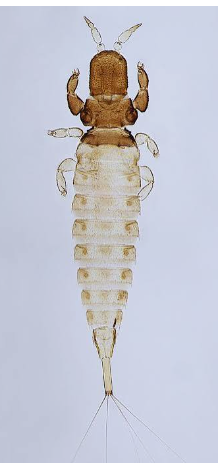
Urothrips are larger and more heavily built than many common thrips species.
- Length: Approximately 2–5 mm.
- Body Shape: Elongated and cylindrical.
- Color: Dark brown to black.
- Wings: Often absent or greatly reduced.
- Tail Segment: Distinctive tube-shaped terminal abdominal segment.
- Bristles: Long hairs extending from the abdomen.
The most recognizable feature is the elongated tube-like structure at the end of the abdomen, a characteristic trait of many Tubulifera thrips.
Many species appear heavily armored due to their thickened exoskeletons, an adaptation that helps protect them while moving through abrasive soil and leaf litter environments.
Distribution and Habitat
Urothrips species occur in tropical, subtropical, and temperate regions worldwide.
Common habitats include:
- Leaf litter
- Forest floors
- Compost piles
- Rotting logs
- Mulch beds
- Decaying plant material
- Moist organic debris
Unlike flower thrips that live on living plants, Urothrips spend most of their lives hidden within decomposing organic matter where fungal growth is abundant.
Life Cycle
Like other thrips, Urothrips undergo a unique developmental process that combines features of incomplete and complete metamorphosis.
Egg Stage
Females deposit eggs within protected organic material, often near fungal growth.
Larval Stages
Young larvae feed actively on fungal spores, hyphae, and decomposing plant matter.
During this period they molt several times while increasing in size.
Pupal-Like Stages
Unlike many insects with simple metamorphosis, thrips pass through inactive developmental stages that resemble pupae.
Adult Stage
Adults emerge fully developed and continue feeding within the same habitat.
Under favorable conditions, populations can reproduce rapidly and complete multiple generations each year.
Behavior and Ecology
Urothrips play an important ecological role as decomposers and recyclers of organic matter.
Their feeding activities help:
- Break down dead vegetation
- Distribute fungal spores
- Accelerate decomposition
- Recycle nutrients into the soil
- Support soil food webs
Because they feed primarily on fungi and decaying material, they rarely compete directly with agricultural crops.
Their armored bodies and reduced wings reflect their adaptation to life in confined spaces beneath leaf litter and mulch.
Damage and Economic Importance
Unlike many thrips species, Urothrips are generally not considered serious agricultural pests.
Direct Plant Damage
Most Urothrips species do not feed extensively on healthy living plants. As a result, they rarely cause:
- Silvering of leaves
- Flower distortion
- Fruit scarring
- Growth abnormalities
Nuisance Occurrences
Large populations may occasionally be encountered in:
- Mulch piles
- Greenhouses
- Compost systems
- Damp landscaping materials
These situations often create concern among homeowners, but the insects are usually harmless and temporary.
Indicator Species
The presence of large numbers of Urothrips may indicate:
- Excessive moisture
- Heavy fungal growth
- Accumulated organic debris
- Poor mulch aeration
In many cases, they are a symptom of environmental conditions rather than a problem themselves.
Signs of Urothrips Activity
Common signs include:
- Tiny dark insects in mulch
- Thrips crawling beneath logs
- Populations in compost piles
- Clusters within damp leaf litter
- Presence around fungal growth
Unlike pest thrips, visible feeding injury to plants is usually absent.
Management and Control (IPM)
Because Urothrips are generally beneficial or neutral organisms, control is rarely necessary.
Reduce Excess Moisture
- Improve drainage.
- Avoid overwatering landscape beds.
- Allow mulch to dry periodically.
Manage Organic Debris
- Remove excessive accumulations of wet leaves.
- Turn compost regularly.
- Avoid overly thick mulch layers.
Encourage Natural Predators
Many predators naturally feed on Urothrips populations:
- Ground beetles
- Spiders
- Predatory mites
- Centipedes
Avoid Unnecessary Insecticides
Broad-spectrum insecticides are generally unnecessary and may harm beneficial organisms that contribute to soil health.
Research and Ecological Importance
Scientists continue studying Urothrips and related fungi-feeding thrips because of their role in decomposition and nutrient cycling.
Research areas include:
- Soil ecosystem health
- Decomposition dynamics
- Fungal-insect interactions
- Biodiversity monitoring
- Forest ecology
Their presence often reflects healthy biological activity within forest and landscape soils.
Conclusion
Urothrips Thrips are unusual members of the thrips order that differ significantly from the plant-damaging species commonly encountered in agriculture and horticulture. Rather than attacking living plants, they serve as important decomposers that help recycle nutrients and support healthy soil ecosystems.
Although their appearance and abundance can occasionally concern homeowners, these insects are generally harmless and beneficial. Maintaining balanced moisture levels, proper sanitation, and healthy soil conditions is usually all that is required to keep populations at natural levels while preserving their ecological value.