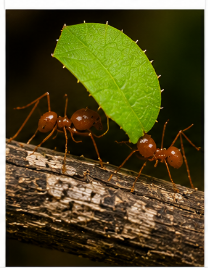
Leafcutter Ants are highly organized fungus-farming ants found in the Americas. They are best known for cutting pieces of fresh leaves and carrying them in long columns back to their underground nests. Despite their name and appearance, Leafcutter Ants do not eat the leaves directly. Instead, they use the plant material to cultivate a specialized fungus that serves as the colony’s primary food source.
Leafcutter Ants are among the most complex social insects in the world. A mature colony may contain millions of workers divided into specialized castes responsible for cutting vegetation, transporting leaves, defending trails, maintaining the fungus gardens, caring for brood, and supporting the queen.
Ecologically, Leafcutter Ants are important decomposers and soil engineers. However, they can also become serious agricultural and landscape pests because large colonies are capable of removing substantial quantities of foliage from crops, fruit trees, ornamental plants, and young vegetation.
Taxonomy and Classification
Leafcutter Ants belong to the order Hymenoptera, family Formicidae, subfamily Myrmicinae, and tribe Attini. The best-known leafcutting genera are Atta and Acromyrmex.
- Kingdom: Animalia
- Phylum: Arthropoda
- Class: Insecta
- Order: Hymenoptera
- Family: Formicidae
- Subfamily: Myrmicinae
- Tribe: Attini
- Major Genera: Atta and Acromyrmex
Not every fungus-growing ant is a Leafcutter Ant. The Attini includes many species that cultivate fungi using dead vegetation, insect remains, or other organic material. True Leafcutter Ants are distinguished by their ability to harvest fresh plant tissue on a large scale.
Physical Description
Leafcutter Ant colonies contain workers of dramatically different sizes. This variation allows individual ants to perform specialized tasks.
- Small Workers: Maintain fungus gardens and care for brood.
- Medium Workers: Cut and transport leaves.
- Large Workers: Defend the colony and trails.
- Queen: Much larger than workers and responsible for egg production.
Workers are generally reddish brown, dark brown, or black, depending on the species. They have powerful mandibles capable of slicing through leaves and other plant tissue.
Many species have small spines on the thorax. Large soldier workers may have disproportionately large heads containing powerful jaw muscles.
Distribution and Habitat
Leafcutter Ants are native to the New World and occur from parts of the southern United States through Mexico, Central America, South America, and into Argentina.
They are especially abundant in tropical and subtropical habitats, including:
- Rainforests
- Seasonal forests
- Grasslands
- Savannas
- Agricultural areas
- Orchards
- Pastures
- Urban landscapes
Some species tolerate relatively dry environments and may establish extensive colonies in open farmland or landscaped properties.
Colony Structure
Leafcutter Ant colonies are among the largest and most sophisticated ant societies. Mature colonies of some Atta species can contain millions of workers and occupy enormous underground nest systems.
The colony is organized into different castes, including:
- Queen: Produces the eggs that maintain the colony.
- Garden Workers: Tend the fungus and remove contamination.
- Brood Workers: Care for eggs, larvae, and pupae.
- Foragers: Locate suitable vegetation.
- Leaf Cutters: Cut sections from leaves.
- Transport Workers: Carry plant fragments back to the nest.
- Soldiers: Defend trails and nest entrances.
This division of labor allows colonies to harvest vegetation and maintain their fungus gardens with remarkable efficiency.
Fungus Farming
The defining feature of Leafcutter Ant biology is their cultivation of fungus. The ants do not simply store leaves underground for later consumption.
Workers first cut vegetation into manageable pieces and transport it to the nest. Inside specialized underground chambers, smaller workers chew the leaf fragments into a pulp and incorporate them into the fungus garden.
The cultivated fungus grows through this plant substrate and produces nutrient-rich structures consumed by the ants and developing larvae.
The ants and fungus depend heavily on one another. The fungus receives a continuous supply of prepared plant material and protection from competing microorganisms, while the ants receive a stable food source.
Leaf-Cutting Behavior
Leafcutter Ants use powerful mandibles to slice sections from leaves, flowers, and other plant tissues. A worker may cut a piece several times larger than its own body and carry it back to the nest.
Foraging trails may extend considerable distances from the colony. When activity is high, thousands of ants can travel along these pathways, creating easily visible columns of workers carrying bright green leaf fragments.
Foraging often occurs during cooler periods of the day or at night, particularly in hot climates.
Life Cycle
Leafcutter Ants undergo complete metamorphosis, developing through egg, larval, pupal, and adult stages.
The colony begins when a newly mated queen leaves her original nest and establishes a new nesting site. She carries a small portion of the fungus from her parent colony, which she uses to start the first fungus garden.
The queen produces the first workers, which eventually take over foraging, brood care, nest excavation, and fungus maintenance.
Once mature, a colony may produce winged reproductive males and females. These individuals participate in mating flights, after which newly fertilized queens attempt to establish additional colonies.
Agricultural and Landscape Damage
Leafcutter Ants can become important agricultural pests because they remove large amounts of foliage from crops and valuable plants.
Commonly attacked plants may include:
- Fruit trees
- Coffee
- Citrus
- Cacao
- Vegetable crops
- Young forest trees
- Ornamental shrubs
- Flowers
- Pasture plants
Healthy mature plants may tolerate moderate leaf removal, but seedlings and young plants can be completely defoliated. Repeated harvesting can reduce photosynthesis, stunt growth, delay fruit production, and occasionally kill small plants.
Signs of an Infestation
Leafcutter Ant colonies are usually easier to detect than many underground ant species because of their visible foraging activity.
Common signs include:
- Long trails of ants carrying leaf fragments
- Fresh semicircular cuts along leaf edges
- Sudden loss of foliage overnight
- Large soil mounds around nest openings
- Multiple entrances connected by heavily traveled trails
- Accumulations of discarded plant or fungus material
Following an active trail can often reveal the approximate location of the main nest.
Ecological Importance
Although they can be serious pests, Leafcutter Ants are extremely important components of tropical ecosystems.
Their activities contribute to:
- Decomposition of plant material
- Nutrient cycling
- Soil aeration
- Movement of nutrients into deeper soil layers
- Creation of habitat for other organisms
- Modification of plant communities
Their extensive underground tunnels can improve soil structure and redistribute organic matter through the ecosystem.
Inspection and Monitoring
Monitoring is especially important around young orchards, nurseries, gardens, and restoration plantings.
Inspect for:
- Fresh leaf-cutting damage
- Active trails
- Workers transporting vegetation
- Soil mounds
- New nest entrances
Foraging activity is often easiest to observe during evening, nighttime, or early morning when temperatures are cooler.
Management and Prevention
Leafcutter Ant management is challenging because the visible workers represent only a small portion of the colony. Killing ants on the trail does little to affect the queen, brood, or underground fungus gardens.
An effective Integrated Pest Management (IPM) program focuses on protecting valuable plants and targeting the colony when economic or landscape damage becomes unacceptable.
Protect Young Plants
Seedlings and newly planted trees are particularly vulnerable. Physical barriers, trunk guards, and close monitoring may reduce damage during establishment.
Reduce Attractive Vegetation
Managing weeds and unnecessary vegetation near high-value plantings may reduce some nearby food sources, although Leafcutter Ants can forage over significant distances.
Baiting
Ant baits are often more effective than contact sprays because workers carry bait back toward the colony. Products designed specifically for Leafcutter Ants may target the ants directly or disrupt the fungus garden they depend on.
Baits must be placed and used according to label directions. Rain, moisture, temperature, and competing vegetation can affect acceptance.
Direct Nest Treatment
Large colonies may require professional treatment because nest systems can contain many chambers and entrances extending deep underground.
Surface spraying alone is generally ineffective against established colonies because most ants remain protected below ground.
Biological Control
Leafcutter Ants have natural enemies that include parasitic flies, predators, and microorganisms. Their fungus gardens are also threatened by competing fungi and pathogens.
The ants have evolved sophisticated sanitation behavior to protect the garden, including grooming, removal of contaminated material, and production of antimicrobial compounds.
Research into these natural relationships may eventually produce more selective and environmentally compatible management tools.
Research and Scientific Importance
Leafcutter Ants are widely studied because of their advanced agriculture, division of labor, communication, genetics, disease control, and colony organization.
Their fungus-farming system is one of the most sophisticated examples of symbiosis known among insects. Scientists also study the chemical signals used to organize trails, assign tasks, identify nestmates, and defend the colony.
Research into their fungus gardens has also provided insights into antibiotics, microbial competition, evolution, and sustainable agriculture.
Conservation
Most Leafcutter Ant species are not considered pests everywhere they occur. In natural habitats they are important ecosystem engineers and should generally be left undisturbed unless they are causing unacceptable agricultural, structural, or landscape damage.
Habitat loss and land-use change can affect local species, particularly those with limited geographic ranges. Management should therefore focus on problem colonies rather than indiscriminate elimination of Leafcutter Ants from natural environments.
Conclusion
Leafcutter Ants are extraordinary social insects that harvest vegetation not for direct consumption but to cultivate underground fungus gardens. Their complex colonies can contain millions of ants organized into specialized castes responsible for farming, defense, transport, brood care, and nest maintenance.
In natural ecosystems, Leafcutter Ants contribute to decomposition, nutrient cycling, and soil improvement. In farms, orchards, gardens, and young plantings, however, large colonies can rapidly defoliate valuable vegetation and become significant pests.
Effective management requires monitoring active trails, protecting vulnerable plants, and using colony-level control methods such as appropriately labeled baits or professional nest treatment rather than relying solely on contact sprays. Their ecological importance should also be considered before control is undertaken.