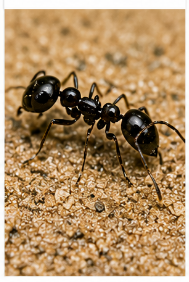
Little Black Ants (Monomorium minimum) are tiny native ants commonly found throughout much of North America. They are primarily considered nuisance pests because workers frequently enter homes, apartments, restaurants, offices, and other buildings while searching for sweets, grease, proteins, and moisture. Their extremely small size allows them to pass through narrow cracks around windows, foundations, utility lines, doors, and plumbing penetrations that larger ants cannot easily use.
Most colonies originate outdoors in soil, beneath stones, inside decaying wood, under bark, or beneath landscape debris. However, Little Black Ants may also establish nests inside wall voids, insulation, rotting structural wood, and other protected indoor spaces. They do not normally cause structural damage and lack a medically important sting, but persistent trails across counters, cabinets, sinks, and pantry shelves can contaminate food and create an ongoing sanitation concern.
Taxonomy and Classification
Little Black Ants belong to the family Formicidae, which contains the world’s ants. They undergo complete metamorphosis through egg, larval, pupal, and adult stages.
- Order: Hymenoptera
- Family: Formicidae
- Subfamily: Myrmicinae
- Genus: Monomorium
- Species: Monomorium minimum
- Common Name: Little Black Ant
The species should not be confused with every tiny dark-colored ant found indoors. Pharaoh ants, pavement ants, odorous house ants, rover ants, and several other species may appear similar without close inspection. Correct identification is important because different ants may respond differently to baits and other management methods.
Physical Description
Little Black Ant workers are extremely small and relatively uniform in appearance.
- Worker Length: Approximately 1/16 inch, or about 1.5–2 mm.
- Color: Shiny black, dark brown, or nearly black.
- Body: Slender, with all workers generally similar in size.
- Waist: Two visible nodes between the thorax and abdomen.
- Antennae: Elbowed, with a distinct terminal club.
- Queens: Larger than workers and responsible for egg production.
The uniformly dark body and two-segmented waist are useful identification clues, but magnification may be necessary to distinguish Little Black Ants from other small household species.
Colony Structure and Lifespan
Little Black Ant colonies contain queens, workers, developing brood, and seasonally produced winged males and females. Workers perform nearly all visible colony duties, including gathering food, caring for larvae, defending the nest, and maintaining tunnels and chambers.
The lifespan of an individual ant depends on its caste, access to food, temperature, predation, and environmental conditions. Workers generally live for several weeks to a few months, while reproductive queens can survive considerably longer under protected conditions. Exact lifespan estimates vary because colonies outdoors experience weather, predators, food shortages, and pest-control treatments that are not present in laboratory studies.
Even when individual workers are short-lived, colonies can persist because queens continue producing eggs and new workers replace older individuals. This is why killing only the ants visible on a countertop rarely eliminates the underlying infestation.
Distribution and Habitat
Little Black Ants are widely distributed across the United States and portions of southern Canada. They occupy natural, agricultural, urban, and suburban environments.
Outdoor nesting locations commonly include:
- Soil beneath stones
- Mulch and landscape beds
- Decaying logs and stumps
- Tree bark and hollow wood
- Sidewalk and pavement edges
- Leaf litter
- Piles of lumber or yard debris
Indoors, they may occupy:
- Wall voids
- Cabinet gaps
- Insulation
- Window and door frames
- Areas around plumbing
- Moist or deteriorating wood
Their tiny bodies allow workers to exploit gaps that may be almost invisible to homeowners.
Behavior and Foraging
Little Black Ants are omnivorous scavengers that feed on many different materials. Workers typically form narrow but distinct trails between a nest and a dependable food source.
Common food preferences include:
- Sugar and syrup
- Fruit and sweet drinks
- Grease and cooking residue
- Meat and protein-rich foods
- Pet food
- Dead insects
- Honeydew produced by aphids and scale insects
Food preferences may change according to the nutritional needs of the colony. A bait that attracts workers during one period may receive less attention later if the colony shifts from a need for carbohydrates to proteins or fats.
Relationship with Aphids and Honeydew
Outdoors, Little Black Ants are frequently associated with aphids, mealybugs, soft scales, and other honeydew-producing insects. Workers consume the sugary liquid excreted by these plant pests and may protect them from lady beetles, lacewings, parasitic wasps, and other natural enemies.
This relationship can indirectly worsen plant problems because protected aphid or scale populations may increase. Ant trails climbing shrubs, trees, or garden plants can therefore indicate the presence of sap-feeding insects higher on the plant.
Damage and Conflict
Little Black Ants do not normally damage sound structural wood, fabrics, or household belongings. Their primary impact is nuisance activity and food contamination.
- Kitchen Invasions: Workers trail across counters, sinks, cabinets, and appliances.
- Food Contamination: Ants may enter opened packages or contact food-preparation surfaces.
- Persistent Trails: Established pheromone trails can lead large numbers of workers indoors.
- Indoor Nesting: Colonies in wall voids can be difficult to locate and eliminate.
- Plant-Pest Protection: Ants may protect aphids and scales in exchange for honeydew.
They are not considered dangerous ants and generally do not inflict medically significant bites or stings.
Inspection and Monitoring
Successful control begins by following workers rather than immediately spraying them. Ant trails can reveal where they are entering the building and may point toward the nesting area.
Inspect:
- Foundation cracks
- Utility and cable penetrations
- Window and door frames
- Plumbing gaps beneath sinks
- Countertop edges and cabinet seams
- Moist wood and water-damaged areas
- Landscape stones, mulch, and debris near the structure
Monitoring bait placements can also reveal whether the ants prefer sweet, protein-based, or grease-based foods at a particular time.
Management and Prevention
Little Black Ant management is most successful when sanitation, exclusion, moisture correction, and baiting are combined through an Integrated Pest Management approach.
Sanitation
- Clean grease, crumbs, syrup, and spilled drinks promptly.
- Store cereals, sweets, pet food, and pantry products in sealed containers.
- Rinse beverage containers before recycling.
- Empty garbage regularly and clean residue from bins.
- Do not leave pet food exposed overnight.
Moisture Reduction
- Repair leaking faucets and pipes.
- Dry sinks and countertops when possible.
- Correct water-damaged or rotting wood.
- Improve ventilation in damp kitchens, bathrooms, and crawl spaces.
Exclusion
- Seal cracks around windows, doors, foundations, and siding.
- Close gaps around plumbing, wires, and utility lines.
- Repair damaged screens and weather stripping.
- Trim branches and shrubs that touch the building.
Baiting
Slow-acting ant baits are generally more effective than spraying visible trails. Workers consume the bait and share it with nestmates through food exchange, allowing the active ingredient to reach larvae and queens.
- Place gel or liquid bait near active trails and entry points.
- Use bait stations where children and pets cannot access them.
- Allow workers to feed without disturbing the trail.
- Replace dried, contaminated, or ignored bait.
- Try a different bait formulation if feeding stops.
Do not spray repellent insecticide directly over bait placements or active trails. Fast-acting sprays may kill only exposed workers, repel surviving ants from the bait, and cause trails to shift to another part of the building.
Outdoor Management
Reducing favorable nesting conditions around the exterior can limit recurring invasions.
- Move firewood away from the building.
- Remove unnecessary boards, stones, and yard debris.
- Keep mulch from contacting siding.
- Correct drainage problems near the foundation.
- Manage aphids and scale insects when ant activity is associated with honeydew.
Eliminating every outdoor colony is neither practical nor necessary. The goal is to reduce nests and food sources immediately around the structure while preventing workers from entering.
When Professional Control May Be Needed
Professional pest management may be appropriate when trails continue despite sanitation and baiting, when several indoor nesting sites are suspected, or when ants are emerging from inaccessible wall voids. A qualified technician can identify the species, locate likely nests, select appropriate bait formulations, and treat exterior entry zones without relying solely on broad indoor spraying.
Conservation and Research
Little Black Ants are native scavengers that contribute to decomposition and soil food webs outdoors, but they require management when they invade structures. Research focuses on ant communication, food preferences, colony organization, and bait formulations capable of reaching hidden queens and brood. Improved species identification and targeted baiting reduce unnecessary pesticide use while providing more reliable colony control.
Conclusion
Little Black Ants (Monomorium minimum) are tiny native ants that become persistent household nuisances when workers enter buildings in search of food, moisture, or shelter. Their small size, broad diet, and ability to form strong foraging trails can make infestations difficult to manage with surface sprays alone. Sanitation, moisture correction, exclusion, careful inspection, and slow-acting baits provide the most effective long-term solution. By targeting the colony rather than only the visible workers, homeowners can reduce indoor activity while avoiding unnecessary pesticide applications.