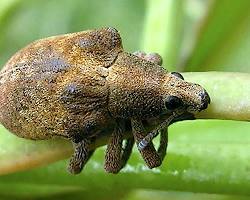
The Eucalyptus Snout Beetle (Gonipterus platensis and related Gonipterus species), commonly called the Eucalyptus Weevil, is one of the most destructive invasive pests affecting eucalyptus trees worldwide. Native to Australia, this beetle has spread across multiple continents wherever eucalyptus trees are cultivated for timber, landscaping, windbreaks, or ornamental purposes. Both adults and larvae feed aggressively on eucalyptus foliage, causing severe defoliation, canopy thinning, branch dieback, and long-term reductions in tree health and timber production.
In the United States, especially in California, the Eucalyptus Snout Beetle is considered a major invasive pest threatening eucalyptus groves and urban landscapes. Heavy infestations can significantly weaken trees, reduce growth rates, and increase vulnerability to secondary pests such as wood-boring beetles and fungal diseases.
Taxonomy and Classification
- Order: Coleoptera
- Family: Curculionidae
- Genus: Gonipterus
- Common Name: Eucalyptus Snout Beetle
The Eucalyptus Snout Beetle belongs to the weevil family Curculionidae, one of the largest beetle families in the world. Weevils are recognized by their elongated snouts, known as rostrums, which contain specialized mouthparts used for feeding and egg-laying.
Several closely related Gonipterus species are collectively referred to as eucalyptus snout beetles because of their similar appearance, biology, and feeding behavior.
Identification
Adult Eucalyptus Snout Beetles are small to medium-sized weevils measuring approximately 7 to 9 millimeters long. They possess a robust oval body with grayish-brown or reddish-brown coloration and characteristic pale scales that often form mottled or V-shaped markings across the wing covers.
Key identifying characteristics include:
- Short, broad snout (rostrum)
- Elbowed antennae
- Mottled gray or brown coloration
- Oval-shaped body
- Scalloped leaf feeding damage
The larvae differ significantly from adults and are often more damaging. They are sluggish, soft-bodied, yellowish-green grubs with dark markings and black head capsules. Larvae frequently appear coated with slime and fecal material, which helps protect them from desiccation and predators.
Females also produce distinctive dark brown or black egg capsules, called oothecae, attached to eucalyptus leaves. These capsules are important diagnostic signs of active infestations.
Distribution and Habitat
Originally native to Australia, the Eucalyptus Snout Beetle is now established in many regions around the world where eucalyptus trees are grown.
Infested regions include:
- California
- South America
- South Africa
- Southern Europe
- New Zealand
- Mediterranean climates worldwide
The beetles thrive in:
- Eucalyptus plantations
- Urban tree plantings
- Windbreaks
- Roadside landscapes
- Parks and gardens
- Commercial timber groves
Young eucalyptus trees and fresh terminal growth are especially vulnerable to attack.
Life Cycle
The Eucalyptus Snout Beetle undergoes complete metamorphosis consisting of four stages:
- Egg
- Larva
- Pupa
- Adult
Females lay eggs inside protective capsules attached to leaves. After hatching, larvae feed openly on foliage, especially on tender new growth. Once mature, larvae drop to the ground and pupate within the soil or leaf litter beneath the tree canopy. Adults later emerge and resume feeding and reproduction.
Multiple generations may occur annually in warm climates, allowing populations to build rapidly during favorable conditions.
Feeding Behavior and Damage
Both adult and larval stages feed on eucalyptus foliage, but larvae are usually responsible for the most severe defoliation.
Adult Feeding
Adults chew irregular notches and scalloped patterns along leaf margins. This reduces the photosynthetic surface area of the tree and weakens canopy development.
Larval Feeding
Larvae consume soft leaf tissue and young shoots, often skeletonizing leaves and leaving only veins behind. Heavy feeding causes:
- Canopy thinning
- Tip dieback
- Stunted growth
- Premature leaf drop
- Reduced timber production
- Excessive branching
Repeated defoliation exhausts the tree’s energy reserves and may eventually lead to decline or death in heavily stressed trees. Infested trees also become more vulnerable to borer insects and disease organisms.
Economic Importance
The Eucalyptus Snout Beetle is a major economic pest in regions where eucalyptus is cultivated commercially.
Economic impacts include:
- Reduced timber yield
- Decreased tree growth rates
- Loss of ornamental value
- Increased maintenance costs
- Tree mortality in severe infestations
Young plantations are especially vulnerable because repeated defoliation can permanently stunt tree development.
Management and Control (IPM)
Biological Control
The most successful long-term control strategy involves the use of parasitoid wasps such as Anaphes nitens. These tiny wasps parasitize beetle eggs and have been highly effective in suppressing populations in several countries.
Monitoring
Regular inspection of foliage is essential for detecting:
- Scalloped leaf margins
- Dark egg capsules
- Larval feeding clusters
- Canopy thinning
Mechanical Control
- Prune heavily infested tips
- Destroy egg capsules
- Remove larvae manually on small trees
- Use sticky trunk barriers to intercept migrating larvae
Chemical Control
Targeted insecticide applications may be used in severe infestations, especially on high-value ornamental trees.
Cultural Practices
Maintaining healthy trees through proper irrigation, soil care, and stress reduction helps improve resistance and recovery from feeding damage.
Conclusion
The Eucalyptus Snout Beetle is one of the most important invasive pests affecting eucalyptus trees worldwide. Its aggressive foliage feeding by both adults and larvae can severely weaken trees, reduce timber production, and damage ornamental landscapes. Successful management depends on early detection, biological control programs, integrated pest management strategies, and maintaining healthy tree vigor to reduce long-term damage.