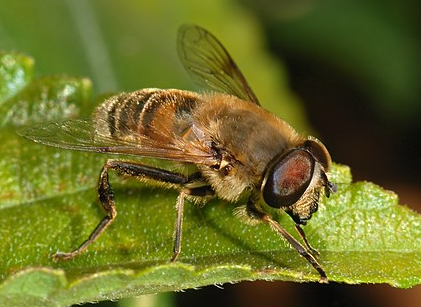
The Eristalis Hover Fly, commonly known as the Drone Fly (Eristalis tenax), is a highly beneficial insect widely recognized for its remarkable resemblance to a honey bee. This species belongs to the hover fly family and is commonly found throughout North America, Europe, Asia, and many other temperate and subtropical regions. Despite its bee-like appearance, the Drone Fly is completely harmless to humans and plays an essential ecological role as both a pollinator and decomposer.
The Drone Fly is especially notable for its unusual larval stage, known as the Rat-Tailed Maggot, which develops in stagnant or organically rich water. These larvae possess an elongated breathing siphon that allows them to survive in oxygen-poor aquatic environments. Although the larval habitat may occasionally create sanitation concerns, adult Drone Flies are considered extremely valuable pollinators in gardens, farms, orchards, and natural ecosystems.
Taxonomy and Classification
- Order: Diptera
- Family: Syrphidae
- Genus: Eristalis
- Species: Eristalis tenax
- Common Names: Drone Fly, Eristalis Hover Fly
The Drone Fly belongs to the hover fly family Syrphidae, a large and ecologically important group commonly referred to as flower flies or hover flies. Hover flies are famous for their ability to remain suspended in midair while feeding or searching for flowers.
Eristalis tenax is one of the best-known examples of Batesian mimicry, a defensive adaptation in which a harmless species imitates a harmful or stinging species to deter predators. In this case, the Drone Fly mimics honey bees in both appearance and flight behavior.
Identification
Adult Drone Flies closely resemble honey bees, often causing confusion among gardeners and homeowners. Adults typically measure about 12 to 15 millimeters long and possess a robust, hairy body with brown, orange, and yellow banding.
Key identifying characteristics include:
- Single pair of wings (flies have one pair, bees have two)
- Large compound eyes
- Short antennae
- Bee-like coloration and body shape
- Distinct hovering flight behavior
Unlike bees or wasps, Drone Flies do not possess stingers and cannot bite or sting humans.
The larval stage, known as the Rat-Tailed Maggot, is highly distinctive. These larvae are cylindrical, pale-colored maggots equipped with a long telescoping breathing tube that extends from the rear of the body. This “tail” functions as a siphon, allowing the larva to breathe while submerged in stagnant water or organic sludge.
Distribution and Habitat
Eristalis Hover Flies are cosmopolitan insects found across much of the world. They are especially common in:
- Gardens
- Agricultural fields
- Orchards
- Wetlands
- Urban landscapes
- Parks and meadows
Adult Drone Flies are frequently seen visiting flowers where they feed on nectar and pollen. Larvae develop in moist or stagnant organic environments such as:
- Manure pits
- Drainage ditches
- Septic systems
- Livestock lagoons
- Stagnant ponds
- Organic sludge
The species thrives in areas where flowering plants and moist organic breeding sites occur together.
Life Cycle
The Drone Fly undergoes complete metamorphosis consisting of four stages:
- Egg
- Larva (Rat-Tailed Maggot)
- Pupa
- Adult
Females lay eggs in stagnant water or wet organic material rich in microorganisms. After hatching, larvae feed on decaying organic matter, bacteria, and microorganisms while breathing through their extended siphon tube.
Larvae eventually leave the water and pupate in drier environments nearby. Adult flies emerge shortly afterward and begin feeding on floral resources.
In warm climates, multiple generations may occur annually.
Behavior and Ecology
Adult Drone Flies are active pollinators and contribute significantly to plant reproduction in both natural and agricultural ecosystems. They frequently visit:
- Wildflowers
- Fruit blossoms
- Vegetable flowers
- Garden ornamentals
- Native flowering plants
Their hovering flight allows them to efficiently forage while transferring pollen between flowers.
The larvae serve an important ecological role by breaking down organic waste materials in aquatic habitats. This recycling process helps improve nutrient cycling and decomposition within ecosystems.
Sanitation and Health Concerns
Although Drone Flies themselves are beneficial insects, the presence of Rat-Tailed Maggots often indicates excessive organic buildup or poor sanitation in water systems.
Occasionally, accidental ingestion of contaminated water containing larvae has been associated with rare cases of intestinal myiasis in humans or livestock, though such cases are uncommon.
Finding Rat-Tailed Maggots in standing water may indicate problems such as:
- Blocked drainage systems
- Faulty septic systems
- Poor manure management
- Stagnant livestock water
- Organic waste accumulation
Management and Prevention
Encouraging Adult Hover Flies
Since adult Drone Flies are important pollinators, they should generally be protected rather than eliminated.
- Plant flowering species to support pollinators
- Reduce unnecessary pesticide use
- Maintain pollinator-friendly habitats
Managing Larval Habitats
If larval populations become problematic, focus on improving sanitation and reducing stagnant organic water sources.
- Drain standing water
- Clean clogged gutters and drains
- Maintain septic systems
- Improve manure management
- Cover rain barrels and water containers
These measures help reduce breeding opportunities while preserving beneficial adult pollinators.
Ecological Importance
The Eristalis Hover Fly is one of the most beneficial flies found in gardens and agricultural ecosystems. Adults contribute to pollination, while larvae aid in decomposition and nutrient recycling. Their bee mimicry provides protection from predators without posing any threat to humans.
Because of these benefits, Drone Flies are considered valuable members of healthy ecosystems and should be conserved whenever possible.