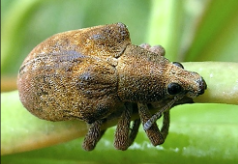
Eucalyptus Weevils most commonly refers to the Eucalyptus Snout Beetle (Gonipterus scutellatus) and several closely related species that attack eucalyptus trees throughout the world. These invasive beetles are among the most destructive pests affecting ornamental eucalyptus plantings, timber plantations, and commercial pulpwood production outside of Australia. Both the larvae and adults feed on eucalyptus foliage, but the larvae are especially destructive because they consume large amounts of young leaf tissue, causing extensive defoliation, stunted growth, and tree decline.
Taxonomy and Classification
Eucalyptus Weevils belong to the order Coleoptera and the family Curculionidae, commonly known as the true weevils or snout beetles. They undergo complete metamorphosis consisting of egg, larva, pupa, and adult stages.
The genus Gonipterus contains several closely related eucalyptus-feeding species that are difficult to distinguish without detailed scientific examination. These beetles evolved alongside eucalyptus trees in Australia but became severe invasive pests after eucalyptus species were planted extensively in other parts of the world.
Unlike many generalist weevils, eucalyptus snout beetles are highly specialized feeders that primarily attack Eucalyptus species.
Identification
Adult eucalyptus weevils are medium-sized beetles measuring approximately 8–14 mm long. Their coloration is generally grayish-brown to reddish-brown with mottled patterns that provide camouflage against bark and foliage.
Like other weevils, they possess a distinct elongated snout (rostrum) extending from the head. This structure contains chewing mouthparts used for feeding on eucalyptus leaves.
The larvae are hump-backed, legless grubs with pale green to yellow-green coloration. One of the most recognizable features of the larvae is the presence of dark sticky strands of frass (excrement) attached to leaves and surrounding foliage.
Eggs are laid inside distinctive brown or reddish egg capsules called oothecae, which are attached to eucalyptus leaves.
Distribution and Habitat
Native to Australia, eucalyptus weevils have spread to many eucalyptus-growing regions worldwide, including:
- North and South America
- Southern Europe
- Africa
- New Zealand
- Asia
Their habitat is closely tied to eucalyptus trees, especially young plantations, ornamental landscapes, windbreaks, and commercial forestry operations.
These beetles are especially problematic in regions where eucalyptus trees lack the natural predators and parasitoids that regulate populations in Australia.
Life Cycle
Eucalyptus weevils undergo complete metamorphosis with four distinct life stages:
- Egg
- Larva
- Pupa
- Adult
Females deposit clusters of eggs inside protective capsules attached to eucalyptus leaves. After hatching, larvae begin feeding immediately on tender foliage and expanding leaf tissue.
The larval stage is the most destructive period of the life cycle. Larvae feed aggressively for several weeks before dropping to the soil to pupate.
Pupation occurs underground beneath the host tree. Adult beetles later emerge from the soil and return to the canopy to feed, mate, and lay eggs.
In warm climates, multiple overlapping generations may occur annually, allowing populations to build rapidly.
Behavior and Feeding
Both adult and larval eucalyptus weevils feed on foliage, but larvae cause the most severe defoliation.
Typical feeding damage includes:
- Scalloped leaf edges
- Skeletonized foliage
- Chewed leaf margins
- Loss of juvenile foliage
- Defoliated branches
- Reduced canopy density
Larvae often consume soft leaf tissue while leaving veins intact, producing a ragged appearance throughout the canopy.
Adults feed more slowly but still contribute to cumulative foliage loss, particularly during heavy infestations.
Damage and Economic Importance
Eucalyptus Weevils are considered major forestry pests due to their ability to significantly reduce eucalyptus growth and productivity.
Major impacts include:
- Defoliation: Severe leaf loss weakens trees.
- Growth Reduction: Trees produce less timber and biomass.
- Seedling Mortality: Young trees may die after repeated attacks.
- Economic Losses: Plantation productivity declines significantly.
- Aesthetic Damage: Ornamental eucalyptus trees become sparse and unattractive.
Repeated infestations stress trees and may increase vulnerability to drought, disease, and secondary pests.
Natural Enemies
The most successful biological control agent against eucalyptus weevils is the tiny parasitic wasp Anaphes nitens.
This beneficial wasp parasitizes weevil eggs, preventing larval development and significantly reducing weevil populations in many regions.
Other natural enemies may include:
- Predatory insects
- Birds
- Spiders
- Parasitic flies and wasps
Management and Control (IPM)
Integrated Pest Management (IPM) is the preferred strategy for controlling eucalyptus weevils.
- Biological Control: Preserve and release beneficial parasitoids such as Anaphes nitens.
- Monitoring: Inspect foliage for egg capsules, larvae, and feeding damage.
- Species Selection: Plant eucalyptus varieties less susceptible to attack.
- Tree Health: Maintain proper irrigation and nutrition to reduce stress.
- Systemic Insecticides: High-value ornamental trees may require professional treatment.
- Sanitation: Remove heavily infested debris when practical.
Broad insecticide spraying in large plantations is generally impractical and may disrupt beneficial biological control organisms.
Ecological Importance
Although destructive outside their native range, eucalyptus weevils are part of the natural Australian ecosystem where they coexist with eucalyptus forests and native predators.
Their invasive success elsewhere highlights the ecological risks associated with transporting plants and insects across continents without their natural biological controls.
Conclusion
Eucalyptus Weevils are highly destructive invasive beetles capable of causing severe defoliation and economic losses in eucalyptus plantations and landscapes worldwide. Their rapid reproduction, specialized feeding habits, and ability to overwhelm young trees make them among the most important eucalyptus pests globally. Long-term management depends heavily on biological control, resistant tree selection, and integrated pest management strategies that preserve natural enemies while protecting valuable eucalyptus resources.