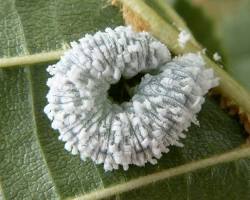
The Slug Sawfly (Eriocampa spp.), commonly known as the Woolly Alder Sawfly in some species, is a group of leaf-feeding insects known for their unusual slug-like larvae. Although often mistaken for caterpillars, sawflies are not butterflies or moths. Instead, they belong to the order Hymenoptera, making them more closely related to wasps, bees, and ants.
Slug sawfly larvae are important ornamental and landscape pests because they feed on leaf tissue, causing extensive skeletonization and aesthetic damage to trees and shrubs. Some species, particularly those attacking alder, birch, pear, and ornamental plants, can cause severe defoliation during outbreak years.
Taxonomy and Classification
- Order: Hymenoptera
- Suborder: Symphyta
- Family: Tenthredinidae
- Genus: Eriocampa
- Common Names: Slug Sawfly, Woolly Alder Sawfly
Sawflies are primitive relatives of wasps and bees. Unlike true wasps, they lack the narrow “waist” that separates the thorax and abdomen. The name “sawfly” comes from the female’s saw-like ovipositor, which is used to cut into plant tissue and deposit eggs.
Species within the genus Eriocampa are best known for their slug-like larvae that feed externally on foliage while protected by waxy or slimy coatings.
Identification
Larvae
The larval stage is the most damaging and easiest to identify. Larvae are:
- Slug-like in appearance
- Pale green beneath the coating
- Covered with white waxy filaments or slime
- Approximately 20 mm long when mature
- Equipped with a dark head capsule hidden beneath the coating
The thick waxy covering serves as a defensive adaptation that helps deter predators and may interfere with predatory insects attempting to feed on the larvae.
Adults
Adult Slug Sawflies resemble small non-stinging wasps. They possess:
- Glossy dark wings
- Black or dark-colored bodies
- Orange or reddish thoraxes in some species
- Thick waists lacking the narrow constriction of true wasps
Adults are usually far less noticeable than larvae and are rarely seen by homeowners.
Distribution and Habitat
Slug Sawflies occur throughout much of North America and Europe wherever suitable host plants grow. They are especially common in:
- Ornamental landscapes
- Urban parks
- Forest edges
- Gardens
- Wooded residential areas
Host plants vary by species but commonly include:
- Alder trees
- Birch trees
- Pear trees
- Cherry trees
- Other ornamental deciduous trees
Larvae are most commonly found feeding on the undersides of leaves during late spring and summer.
Life Cycle
Slug Sawflies undergo complete metamorphosis consisting of four life stages:
- Egg
- Larva
- Pupa
- Adult
Adult females use their saw-like ovipositors to insert eggs directly into leaf tissue.
After hatching, larvae begin feeding on leaf surfaces, usually from the underside of the foliage. They consume soft tissue while leaving veins intact, resulting in a lace-like or skeletonized appearance.
Once mature, larvae drop to the soil where they pupate beneath leaf litter or within the upper soil layer. Adults later emerge to continue the cycle.
Depending on climate and species, one or more generations may occur annually.
Feeding Damage
Slug Sawfly larvae are foliage feeders that damage plants through extensive leaf consumption.
Typical damage includes:
- Leaf skeletonization
- Brown or scorched foliage appearance
- Premature leaf drop
- Reduced plant vigor
- Aesthetic damage to ornamental trees
During heavy infestations, large portions of the canopy may appear thin or browned. While mature trees usually survive infestations, repeated defoliation can weaken plants and make them more vulnerable to environmental stress or secondary pests.
Behavior and Ecology
Slug Sawfly larvae are primarily defensive feeders. Their waxy or slimy coatings help:
- Deter predators
- Reduce desiccation
- Provide camouflage
- Protect against small parasitic insects
The larvae often feed in groups and remain concentrated on the undersides of leaves where they are less visible to predators and homeowners.
Natural enemies such as parasitic wasps, birds, predatory insects, and spiders help regulate populations in healthy ecosystems.
Management and Control (IPM)
Monitoring
Regularly inspect the undersides of leaves during spring and summer for:
- Waxy slug-like larvae
- Leaf skeletonization
- Scorched foliage
- White wax residue
Mechanical Removal
Small infestations can often be controlled manually.
- Handpick larvae
- Drop larvae into soapy water
- Prune heavily infested leaves
- Use strong water sprays to dislodge larvae
Strong water streams are especially effective on smaller ornamental trees and shrubs.
Horticultural Soaps
Insecticidal soaps may help dissolve the protective wax coating and suffocate larvae.
Biological Control
Encouraging beneficial predators and parasitoids can help suppress populations naturally.
Important: Bacillus thuringiensis (Bt), commonly used against caterpillars, is generally ineffective against sawfly larvae because sawflies are not true caterpillars.
Economic and Landscape Importance
Slug Sawflies are primarily considered ornamental landscape pests rather than major agricultural pests. However, severe infestations can reduce the visual quality of:
- Shade trees
- Ornamental plantings
- Urban landscapes
- Nursery stock
In commercial nursery settings, repeated defoliation may reduce plant marketability and vigor.
Conclusion
The Slug Sawfly is a distinctive foliage-feeding insect known for its unusual wax-covered larvae and leaf skeletonization damage. Although infestations are rarely fatal to mature trees, heavy feeding can significantly reduce ornamental value and weaken plants over time.
Early detection, mechanical removal, proper monitoring, and preservation of natural enemies remain the most effective and environmentally responsible methods for managing Slug Sawfly populations.